_e20dbbbb-8b52-47ad-85d5-bc3eb067102e.png)
KNOWLEDGE
Knowledge
Technology and Services
Preventing Short Circuits in Electronic Components Caused by Solder Ball Spatter | Protective Design for Automated Soldering Equipment Based on Past Defect Cases
2026-09-10
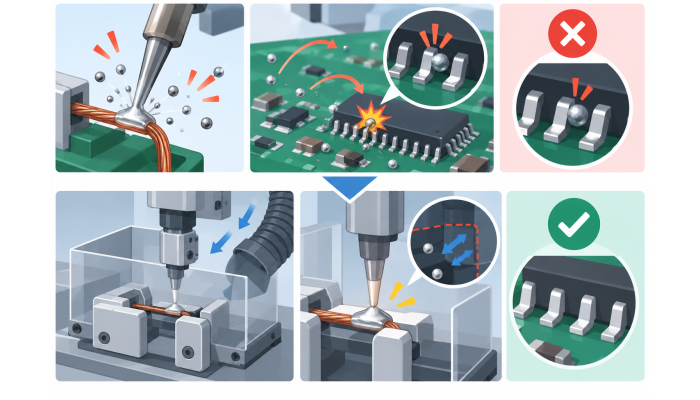
In electronic component manufacturing processes, solder balls that scatter and adhere to circuits or workpieces may lead to short circuits or quality defects after delivery.
In automated soldering processes, consistently controlling the scattering of solder debris requires measures that go beyond soldering conditions alone. The structure of the equipment and the design of jigs are also important factors.
This article explains the causes of solder ball spatter, as well as dedicated protective jigs and protective design approaches for automated soldering equipment to help prevent short circuits and adhesion defects in electronic components.
Contents
- Causes of Solder Ball Spatter
- Risks Leading to Short Circuits and Adhesion Defects
- Preventing Spatter and Reducing Discharge Problems with Dedicated Protective Jigs
- Addressing Quality Issues in Litz Wire Soldering
- PRONEC's Approach to Supporting Stable Production
- Frequently Asked Questions
- Glossary
Causes of Solder Ball Spatter
In automated soldering processes, the scattering of solder balls and solder debris can become a problem.
The main cause is the rapid vaporization of flux components when they come into contact with the high temperature of a molten solder bath. The resulting internal gas pressure makes fine particles of molten metal more likely to scatter into the surrounding area.
The range of spatter and the locations where solder particles adhere can also vary depending on solder wire feeding conditions, airflow around the soldering tip, and the internal structure of the equipment. For this reason, maintaining stable quality requires measures that consider not only soldering conditions but also equipment structure and jig design.
Risks Leading to Short Circuits and Adhesion Defects
Fine solder particles and solder balls dispersed in the air may fall onto printed circuit boards with narrow pin pitches or small gaps between terminals. If these foreign particles adhere between terminals, they can become a cause of short circuits when electrical current is applied.
In coil manufacturing processes, solder balls may also adhere not only to the circuit board but to the workpiece itself, potentially resulting in appearance defects or adhesion defects.
These defects may sometimes be difficult to detect during normal incoming inspection. If a defect becomes apparent after delivery under actual operating conditions, it may lead to quality problems or warranty-related responses. Preventing such defects within the manufacturing process is therefore important.
Preventing Spatter and Reducing Discharge Problems with Dedicated Protective Jigs
To prevent solder balls from adhering to the workpiece, introducing a dedicated protective jig that appropriately covers areas other than the soldering points is effective.
A dedicated jig can reduce direct adhesion of molten metal particles to the workpiece. It also makes it easier to control the areas where scattered particles may accumulate, which can improve cleaning efficiency and reduce the frequency of equipment stoppages.
At the same time, the effects of heat must also be considered when designing the jig. If a bonding layer or coating on the workpiece melts during the process and adheres to or accumulates on the jig, it may cause the workpiece to catch or lead to discharge problems.
For this reason, jig design should take into account shape, material, clearance, and ease of cleaning. Establishing an appropriate maintenance cycle is also important for stable operation of an automated production line.
Addressing Quality Issues in Litz Wire Soldering
In the soldering process for Tetron-covered litz wire, incomplete melting of the covering material can become an issue. A two-stage dipping method, in which heating and dipping are carried out in stages, is effective for addressing this problem. Stabilizing both covering removal and soldering can help improve connection quality.
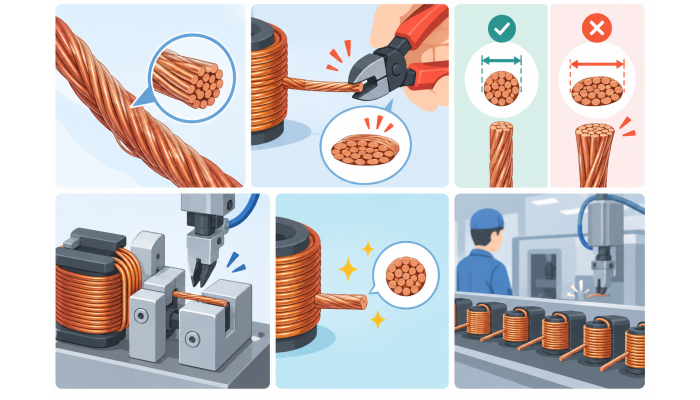
In addition, when the lead-out section of litz wire is cut using ordinary nippers or similar tools, the cross-section of the copper wire may be crushed and deformed into an oval shape. As a result, the dimensions may exceed those specified in the drawing, potentially leading to assembly defects in subsequent processes.
To prevent dimensional overrun, it is effective to use a dedicated jig that can accurately fix the cutting position together with an automatic cutting machine that provides stable cutting control. By suppressing deformation of the cross-section, it becomes easier to maintain dimensional accuracy according to specifications and achieve stable electrical connections.
PRONEC's Approach to Supporting Stable Production
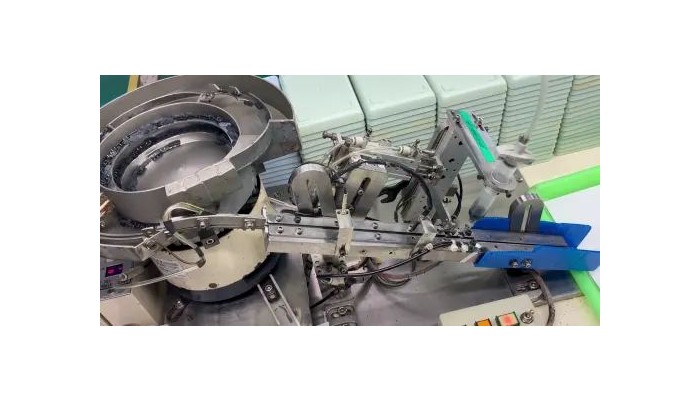
PRONEC CO., LTD. develops and manufactures automated soldering equipment, including rotary-type and robotic-arm-type systems.
The company uses technology that controls the surface level of molten solder with high precision, helping reduce variation in soldering position, dipping amount, and processing conditions. Based on past defect histories and production data, PRONEC has also introduced dedicated protective jigs and improved wire cutting machines as part of its efforts to stabilize quality.
For mass-production processes involving coils and electronic components, if you are experiencing issues such as solder ball spatter, solder adhesion to workpieces, or dimensional defects in lead-out wires, PRONEC can propose an automation method suited to the product shape and process conditions.
Frequently Asked Questions
Q. Why do solder balls scatter during automated soldering?
A. The main cause is the rapid vaporization of flux components when they come into contact with the heat of the solder bath. The resulting gas pressure makes fine particles of molten metal more likely to scatter into the surrounding area.
Q. What causes workpieces to catch on a jig or fail to discharge properly?
A. The main cause is the bonding layer or coating on the workpiece melting due to heat and then adhering to or accumulating on the jig. Jig design that reduces such accumulation, together with the establishment of a regular cleaning cycle, is important.
Q. How can dimensional overrun and crushing of the wire cross-section be prevented?
A. Using a dedicated jig with a positioning function together with an automatic cutting machine can reduce wire movement and deformation during cutting. This helps reduce the risk of the cross-section being crushed into an oval shape and exceeding dimensional limits.
Glossary
- Automated soldering equipment: Machinery used to consistently join metal components or terminals using molten solder. It helps reduce variation caused by operators and supports stable quality in mass-production processes.
- Solder ball: A fine metal particle generated during the soldering process. If it adheres to a circuit board or workpiece, it may cause a short circuit, appearance defect, or adhesion defect.
- Dimensional overrun: A condition in which a dimension exceeds the range specified in a drawing or specification. This may occur when the cross-section of a wire is crushed during cutting, increasing the outer diameter of the lead-out wire.
※For inquiries regarding coil prototype development, mass production, automated soldering processes, or various types of winding, please feel free to contact PRONEC.
Company Information

Medical equipment / Electrical component for transportation equipment / Electronic parts
Air core coil, Bobbin coil, Coil Assembly, Solenoid coil, Wireless power transfer coil, WPC, RFID, Winding machine, OEM / Plastic molded products, overmolded products
PRONEC is a specialized manufacturer in Thailand with over 30 years of experience in air-core coils, precision coils, and electronic component assemblies. With integrated in-house capabilities from pr ...
PICKUP
Technology & Services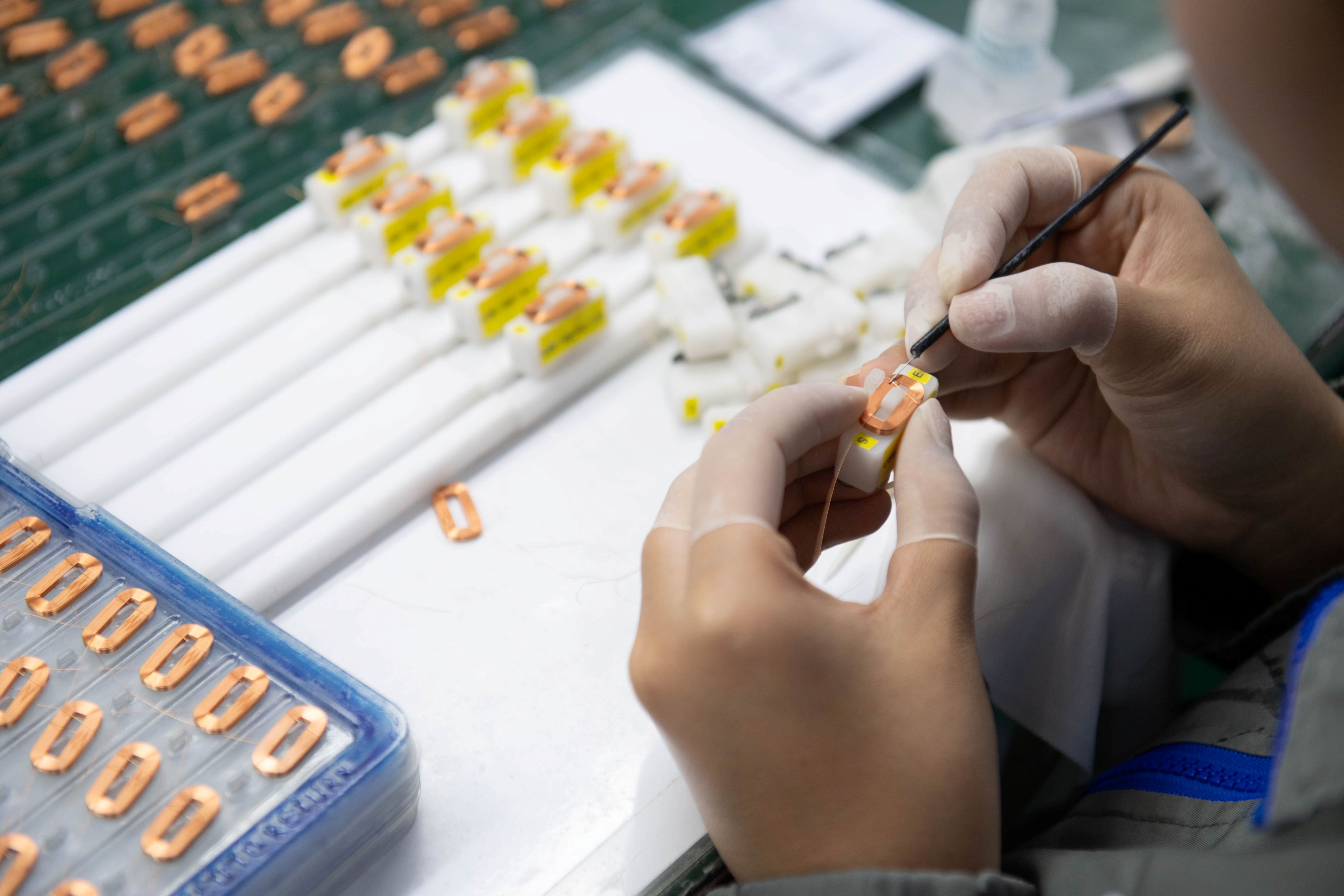
CONTACT
Contact