
KNOWLEDGE
Knowledge
Technology and Services
【Miyake Seminar】What are the differences between single-stage press and progressive die press? 6 criteria for their selection on the production floor.
2026-08-27
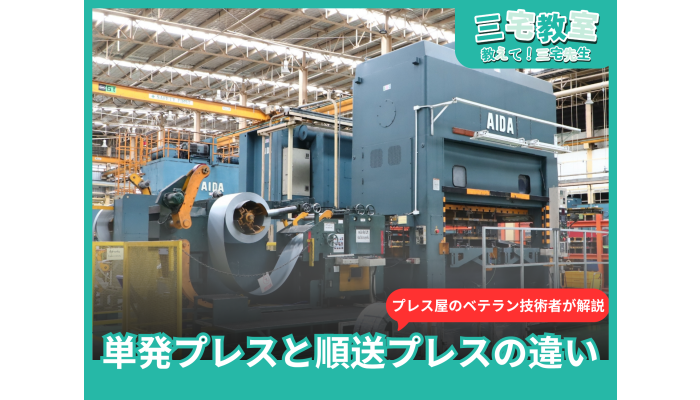
「Single-shot press and progressive press: Which one should our parts be manufactured with?」
This is one of the most frequently asked questions we receive during meetings with customers. It's not a matter of one being superior to the other; the optimal solution changes depending on the balance of product shape, quantity, required quality, and delivery time—this is both the difficulty and the fascination of press processing.
This series, 「Miyake's Classroom」, is a technical column where Miyake, our factory manager who oversees the technical department, shares the content he usually teaches young employees on-site, directly with external audiences. Based on materials actually used in our in-house training, we will explain technical terms in an easy-to-understand manner.
The theme of the first installment is the most crucial branching point at the entry to press processing: 「Distinguishing between Single-Shot Press and Progressive Press」.
What are Single-Shot Press and Progressive Press? — Starting with the Basics
Single-shot press is a method where processing proceeds one step at a time using a single press machine. It uses strip-shaped sheet material, and dies are changed for each process such as blanking, bending, and drawing, or multiple press machines are arranged in sequence.
Progressive press is a method where multiple processes are performed continuously within a single press machine while automatically feeding strip-shaped coil material. As the material advances within the die, blanking, bending, and forming are applied in stages, and the product is separated in the final process.
Factory Manager Miyake: 「I always tell new recruits this: Single-shot is like 'a craftsman playing shogi one move at a time,' while progressive is like 'a conveyor belt that doesn't stop once assembled.' It's not about which is stronger. The situations are different.」
Young Employee A: 「So, if the quantity is large, it's progressive, and if it's small, it's single-shot?」
Factory Manager Miyake: 「That's half correct. But if you decide based solely on quantity, you'll definitely fail. There are six decision axes. Let's look at them in order.」
【Comparison Table】Single-Shot Press vs. Progressive Press from 6 Perspectives
| Comparison Item | Single-Shot Press | Progressive Press |
|---|---|---|
| Personnel | High (for non-robot lines). Manual labor required from material feeding to press operation and packaging. | Low. Only 1-2 people for material feeding and packaging (depending on product size). |
| Setup Time | Long setup time. Becomes longer by the number of die stages. | Short setup time. |
| Material Aspect | Sheet material | Coil material |
| Productivity | High. Can produce faster than robots depending on conditions. However, output is influenced by product shape, machine layout, and operator skill. | High. Easy to maintain stable output. |
| Quality Aspect | Quality risk due to human error. | No quality risk due to human error. |
| Safety Aspect | Press operators need to put their hands into the die. | No need to put hands into the die except during setup and repair. |
Below, we will delve deeper into each item from an on-site perspective.
Decision Criterion ①: Personnel System — How "where people stand" changes costs
In single-shot press, people are involved in each process, from material feeding to press operation and packaging. For non-robot lines, the required number of personnel is clearly higher than for progressive press.
On the other hand, with progressive press, once the coil material is set, only material feeding and finished product packaging are required. Depending on the product size, it can be operated by about 1-3 people.
Factory Manager Miyake: 「It's not just about labor costs. More personnel means more people to train and more effort in scheduling shifts. Conversely, while progressive press can be run with a small number of people, the quality depends on whether those 1-3 individuals can detect abnormalities. The design philosophy for human resource utilization is different.」
Furthermore, at our company, we are promoting labor-saving through robot introduction even for single-shot press lines, working to reduce the personnel difference between the methods.
Decision Criterion ②: Setup Time — The "number of die stages" directly translates to time
Single-shot press has a long setup time. The reason is clear: setup occurs for each die stage. It's a simple matter that if there are 5 processes, 5 setups are required.
With progressive press, all processes are completed by setting one die, so the setup time is short.
Factory Manager Miyake: 「Many people overlook this. For small lot sizes, setup time can sometimes be longer than processing time. To avoid situations like 'we decided on single-shot because of low production volume, but ended up doing nothing but setups,' always compare the total time including setup time.」
Decision Criterion ③: Material Form — Difference in handling between sheet material and coil material
Progressive press assumes coil material. In contrast, single-shot press uses sheet material.
The advantage of sheet material is that it is smaller in size and lighter in weight compared to coil material. This is advantageous in terms of storage space, in-house transportation, and ease of changeover.
Decision Criterion ④: Productivity — The answer to "which is faster" depends on conditions
It might be surprising, but the productivity of single-shot press is by no means low. In fact, there are cases where manual operation is faster than a robot line if conditions are met.
However, the output of single-shot press is influenced by three variables: product shape, machine layout, and operator skill. This means the figures can vary by day and by operator.
Progressive press can maintain stable productivity once it's up and running.
Factory Manager Miyake: 「Single-shot productivity 'can fluctuate up and down.' Progressive 'draws a clean straight line.' In terms of predictability for delivery times, progressive press has the advantage.」
Decision Criterion ⑤: Quality Aspect — Room for human error
In single-shot press, people carry products between processes and set them into the die. Structurally, there is a risk of human error.
Progressive press is clearly superior in this regard. Since the material automatically advances within the die,
- Skipping processes (omitting necessary processes)
- Pressing two sheets at once
- Incorrect product orientation
such mistakes simply do not occur.
Furthermore, regarding the guaranteed shot count for dies, progressive dies tend to have a higher setting compared to single-shot dies. For long-term, mass production projects, this difference impacts the calculation of die depreciation.
Decision Criterion ⑥: Safety Aspect — Whether to put hands into the die or not
In single-shot press, press operators constantly stand in front of the press machine and perform tasks that involve putting their hands into the die. In progressive press, there is no need to put hands into the die or approach the press machine, except during setup and repair.
As a safety measure, our company is thoroughly implementing safety sensors on all of our more than 100 press machines, working to ensure safety in press operations.
Factory Manager Miyake: 「I always tell young people this: Quality can be redone. Delivery times can be apologized for. But safety is irreversible. That's why safety isn't a 'countermeasure item,' but a 'prerequisite.'」
The Pitfall of Progressive Press — Limitations in dimensional adjustment
This is where Miyake's Classroom gets to the main topic. I will talk about things not written in textbooks, known only on-site.
Progressive press has a significant constraint: limitations in product dimensional adjustment.
If you try to fine-tune dimensions with a progressive die during mass production by adjusting the die height, the dimensions of all processes will change simultaneously and subtly. In other words, you cannot adjust dimensions for just one specific process.
Specific example: Lowering the die height to adjust bending height → Simultaneously, the depth of engraving performed in another process also deepens.
Factory Manager Miyake: 「If a request like 'just 0.1mm here' comes up after mass production has started, progressive press becomes really difficult. That's why, if you choose progressive press, the key is how much can be built into the die design stage. Conversely, single-shot press allows independent adjustment for each process. This flexibility is a great asset in prototyping stages or projects where specification changes are unpredictable.」
Young Employee A: 「...I finally understand why single-shot press still exists.」
What Only Single-Shot Press Can Do
Let's re-organize the strengths of single-shot press.
1. Can handle complex shapes It can handle products with complex shapes, such as those with significant bending height.
2. Can control burr direction Since the product's orientation and front/back can be changed for each process, it can meet demands such as reversing the burr direction.
3. Flexible in production management Products designed for single-shot press can also be run on progressive press machines, allowing for flexible adjustments to production plans. The ability to create an alternative when equipment is fully occupied is a great source of relief for the production floor.
Summary: Which one should you choose?
Factory Manager Miyake: 「Ultimately, deciding on the method isn't just about drawings and quantity. It's about choosing by imagining 'what this product will be like in a few years, its productivity, safety, and the cost benefits for the customer.' That's the job of a press shop.」
Our company supports both single-shot press and progressive press methods, and we propose the optimal manufacturing method according to our customers' product specifications and production plans. If you consult us from the drawing stage, we will consider all constraints that will become relevant after mass production.
Frequently Asked Questions
Q. What is the biggest difference between single-shot press and progressive press? A. It's the material form and the processing method. Single-shot press uses sheet material and processes one step at a time. Progressive press continuously processes multiple steps within a single die while automatically feeding coil material.
Q. Are there any disadvantages to progressive press? A. The low degree of freedom in dimensional adjustment while mounted on the press machine during mass production. Adjusting the die height simultaneously changes the dimensions of all processes, making it impossible to fine-tune only specific processes.
Q. Which is more suitable for small lots? A. Generally, single-shot press is suitable, but a comparison of total time including setup time is necessary. If there are many die stages, the setup time can sometimes exceed the processing time.
Q. Is single-shot press low in productivity? A. No. If conditions are met, there are cases where it can be faster than a robot line. However, output varies depending on product shape, machine layout, and operator skill.
Company Information

Office automation equipment / Home electrical appliances / Audio-video equipment
FRAMF FISING LEFT / PLATE MAGNET CATCH / PLATE SHIELD
Our company is the second factory in Thailand of SOHBI KOHGEI CO., LTD. , which is headquartered in Yao City, Osaka Prefecture, Japan. On an expansive site in Nakhon Ratchasima Province, also known as ...
PICKUP
Technology & Services
CONTACT
Contact