_7dd30602-2faf-441d-831a-dc212ee5ad6f.png)
KNOWLEDGE
Knowledge
Technology and Services
【Miyake Classroom】What is the difference between powder coating and solvent-based coating? 6 key points from the field
2026-08-28
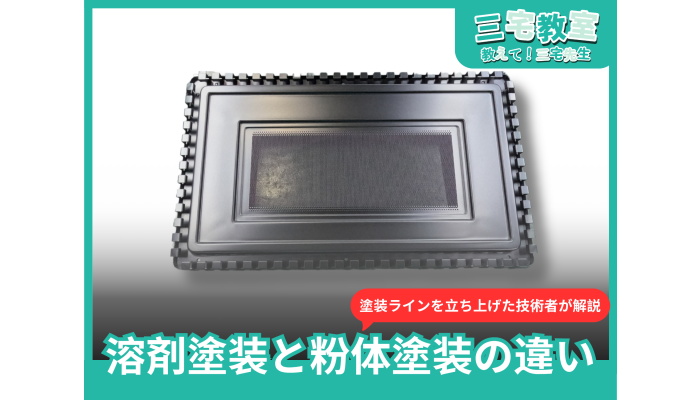
「Powder Coating vs. Solvent Coating: Which Should You Choose?」
Similar to our previous discussion on single-shot pressing and progressive die pressing, there is no single answer to the question "which is superior." The appropriate coating method depends on where the product will be used.
This series, "Miyake's Classroom," is a technical column where Miyake, our factory manager who oversees the technical division and led the establishment of our in-house coating line, shares the knowledge he usually imparts to junior employees on the factory floor with our external audience. The explanations are based on materials actually used in our internal training.
The theme of the second installment is "The Differences Between Powder Coating and Solvent Coating." Additionally, we will touch upon electrostatic coating and heat-resistant coating, which are distinct applications within solvent coating.
What are Powder Coating and Solvent Coating? — The Difference Lies in the Form of the Paint
Solvent coating is a method where paint is sprayed in a liquid state, dissolved in a solvent (such as thinner). We handle electrostatic coating, which uses static electricity to enhance coating efficiency, and heat-resistant coating, for parts used in high-temperature environments.
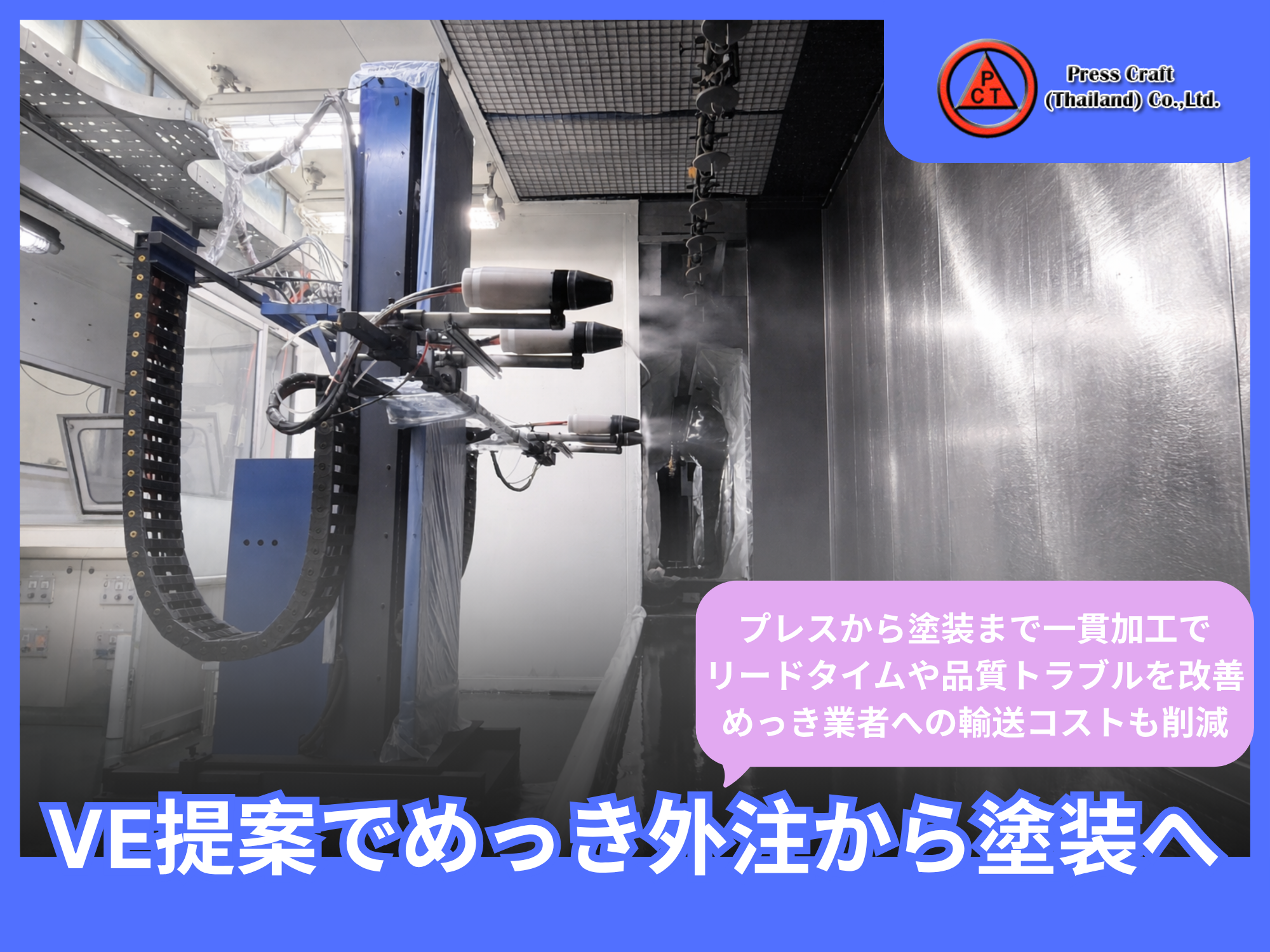
Powder coating, as its name suggests, is a method where paint in powder form is sprayed. It does not use solvents; the powder adheres to the product as is, and a coating film is formed by baking it to melt and solidify. Since 2026, we have introduced the latest powder coating equipment from Gema, a Swiss company.
Factory Manager Miyake: "I always tell young people to first look at the 'form' of the paint. Is it liquid or powder? This one point alone determines everything: film thickness, number of colors, and whether the paint can be reused. All other differences are derived from this."
Junior Employee A: "So, does that mean they are fundamentally different substances?"
Factory Manager Miyake: "That's the interesting part; they have more similarities than differences. Let's look at those first."
【Comparison Table】Solvent Coating (Electrostatic/Heat-Resistant) vs. Powder Coating
| Comparison Item | Solvent Coating (Electrostatic) | Solvent Coating (Heat-Resistant) | Powder Coating |
|---|---|---|---|
| Use of Electricity | Required | Required | Required |
| Jigs | Required | Required | Required |
| Masking | Required | Required | Required |
| Pre-treatment (Cleaning) | Required | Required | Required |
| Color | Supports various colors | Mainly black | Mainly black |
| Film Thickness | Thin | Thin | Thick |
| Film Thickness (Reference Value) | 15〜20μm ※Risk of sagging above 25μm | 15〜20μm ※Risk of sagging above 25μm | 30〜100μm / 1 coat |
| Film Thickness Control Factors | Paint spray time/volume/distance/number of coats (e.g., nozzle diameter, jig) | Same as left | Same as left |
| Film Thickness Variation | Prone to occur | Prone to occur | Prone to occur |
| Baking Temperature | 180℃ | 250〜380℃ | 180℃ |
| Paint Reuse | Not possible | Not possible | Possible (recycled by suction) |
| Paint Shelf Life | Exists | Exists | Exists |
| Main Applications | Decorative items and appliance parts | Parts requiring heat resistance | Parts exposed to outdoor air and humidity |
| Product Examples | Refrigerator / OA equipment parts | Internal parts of microwave ovens | Exterior parts of outdoor air conditioning units |
First, Understand the "Similarities" — All Four Processes Are the Same
The first four rows of the comparison table are the most important part of this discussion.
Use of electricity, jigs, masking, and pre-treatment (cleaning) — these four are necessary for all methods: powder, solvent, electrostatic, and heat-resistant.
Factory Manager Miyake: "Sometimes people say, 'Powder coating is environmentally friendly, so the process must be simpler,' but that's completely wrong. If you neglect pre-treatment cleaning, whether it's powder or solvent, the coating will peel off equally. Jigs are needed, and masking for areas not to be coated is also needed. It's not about the number of steps."
Junior Employee A: "So, where do the differences come in then?"
Factory Manager Miyake: "From this point onward."
Pre-treatment is the foundation of coating quality. No matter how good the paint, if oil or dirt remains, adhesion failure is inevitable. Before selecting a coating method, we recommend checking whether the pre-treatment design is appropriate.
Difference ①: Film Thickness — "How many μm can be applied in one coat" Determines Everything
This is the most fundamental difference between powder coating and solvent coating.
- Solvent coating: 15〜20μm (risk of sagging above 25μm)
- Powder coating: 30〜100μm / 1 coat
Powder coating can form a thick film of 30-100μm in a single application. In contrast, solvent coating, being liquid, will sag under its own weight if applied too thickly. This is why 25μm is the practical upper limit.
Factory Manager Miyake: "If someone asked to achieve 100μm with solvent coating, what do you think would happen? You'd have to apply multiple coats. Coat, bake, then coat and bake again. This increases the number of steps and the operating time of the baking oven. With powder coating, it's a one-shot job."
This difference directly translates to differences in application. Parts exposed to rain, humidity, and UV rays, like the exterior of outdoor air conditioning units, require a thick coating film. That's why powder coating is chosen. On the other hand, parts used indoors, like refrigerators and OA equipment, where aesthetic appeal is important, are better suited for solvent coating, which provides a thin, uniform finish.
Difference ②: Baking Temperature — The 180℃ vs. 250-380℃ Barrier
The baking temperature for both powder coating and solvent coating (electrostatic) is 180℃, which is actually the same.
The difference arises with heat-resistant coating, which requires baking at high temperatures of 250〜380℃.
Factory Manager Miyake: "Here, it's crucial to confirm whether the product can withstand that temperature. The base material, plate thickness, and even the jigs. Baking at 380℃ is a significant thermal history for the component. If you decide based only on the coating specifications, you'll regret it later."
Heat-resistant coating is used for parts exposed to high temperatures during use, such as the internal components of microwave ovens. The main color is black.
Difference ③: Paint Reuse — The "Recovery" Mechanism Unique to Powder Coating
A major strength of powder coating is the reuse of paint.
Powder paint that does not adhere to the product within the coating booth can be collected by suction and reused. This is not possible with solvent coating.
Factory Manager Miyake: "The concept of yield rate is fundamentally different. With solvent, any overspray simply has to be discarded. With powder, you can collect and reuse it. This is a significant factor in terms of both running costs and waste management."
However, there is a caveat. Powder paints also have a shelf life. Like solvent paints, they cannot be stored indefinitely. The premise is that all paint, including recovered paint, must be used within its managed shelf life.
Factory Manager Miyake: "Some people mistakenly believe that 'powder doesn't spoil,' but it does have an expiration date. The ability to recover it is different from being able to use it forever."
Difference ④: Color — Solvent (Electrostatic) if Multi-Color Support is Needed
In terms of color freedom, solvent coating (electrostatic) has an advantage. It can accommodate a wide variety of colors.
On the other hand, powder coating and heat-resistant coating are mainly black. For parts with high decorative requirements or projects with diverse color specifications, this point can be a decisive factor in selecting the coating method.
The reason why solvent (electrostatic) coating is used for refrigerator and OA equipment parts is not only its thin film thickness but also its ability to support aesthetic colors.
Difference ⑤: Changeover Loss — The Cost Behind Multi-Color Support
A large number of colors directly leads to a high frequency of changeovers.
Solvent coating (electrostatic), while supporting multiple colors, faces the challenge of high changeover loss. Each time a color is switched, cleaning and paint replacement occur, resulting in a loss of paint and time.
Factory Manager Miyake: "From the perspective of the factory floor, requests for 'more colors' are synonymous with 'more changeovers.' Of course, we will accommodate them. However, if production plans can be arranged to run the same colors together, costs can be reduced. This is an area where the order receiver and the order placer should discuss."
This loss can be minimized by optimizing lot sizes and delivery timings. If you consult with us at the design or ordering stage, we can propose solutions that include color composition.
Difference ⑥: Applications and Product Examples — Where Are They Actually Used?
| Method | Application | Product Examples |
|---|---|---|
| Solvent Coating (Electrostatic) | Decorative items and appliance parts | Refrigerators, OA equipment parts |
| Solvent Coating (Heat-Resistant) | Parts requiring heat resistance | Internal parts of microwave ovens |
| Powder Coating | Parts exposed to outdoor air and humidity | Exterior parts of outdoor air conditioning units |
Even for the same type of appliance, the exterior of a refrigerator uses solvent coating, while the exterior of an outdoor air conditioning unit uses powder coating. This difference stems from the usage environment: indoors versus outdoors.
An Often Overlooked Common Weakness — Uneven Film Thickness
Finally, let's address a common challenge across all three methods: uneven film thickness is prone to occur with any method.
The control factors influencing film thickness (examples only) are also common across all three methods:
- Paint spray time
- Paint volume
- Distance between nozzle and product
- Number of coating passes
- Nozzle diameter, jigs
And the causes of film thickness variation (examples only) are also the same:
- Product shape
- Operator skill
- Robot orientation and distance
Factory Manager Miyake: "It's a misconception that 'film thickness will stabilize if we switch to powder coating.' It just applies thickly; it doesn't eliminate unevenness. It's equally difficult for paint to reach recessed or intricate shapes, whether it's liquid or powder. So, we have to refine it through jig design and robot teaching. This is where our expertise comes in."
Junior Employee A: "So, even if the method changes, it ultimately comes down to the craftsmanship on the factory floor."
Factory Manager Miyake: "Exactly. Method selection is the starting line, not the finish line."
Since film thickness variation is closely related to product shape, if you consult with us at the drawing stage, we can propose shapes that are easier to coat and consider jig designs.
Summary: Which Should You Choose?
| For parts that are… | Suitable Method |
|---|---|
| Exposed to outdoors/humidity / require thick film | Powder Coating |
| Want to reduce paint cost/waste | Powder Coating |
| Require aesthetic colors/multi-color support | Solvent Coating (Electrostatic) |
| Require thin, uniform finish (15-20μm) | Solvent Coating (Electrostatic) |
| Exposed to high temperatures during use | Solvent Coating (Heat-Resistant) |
Factory Manager Miyake: "As I said last time, you must imagine what environment the part will be in and how it will be used several years from now to make your decision. Coating isn't just about appearance. It also plays a vital role in protecting the product."
We offer powder coating and solvent coating (electrostatic and heat-resistant) and propose methods tailored to the product's usage environment and required specifications. You can consult with us on everything from pre-treatment to jig design.
Frequently Asked Questions
Q. What is the biggest difference between powder coating and solvent coating? A. The film thickness that can be formed in one application. Powder coating can achieve 30-100μm in one coat, while solvent coating is around 15-20μm, with a risk of sagging above 25μm.
Q. I heard powder coating is environmentally friendly; does it simplify the process? A. The number of steps remains the same. The use of electricity, jigs, masking, and pre-treatment (cleaning) are all required, just like with solvent coating. However, the ability to collect and reuse paint that did not adhere to the product is an advantage unique to powder coating.
Q. Can I specify any color for powder coating? A. Powder coating is mainly black. If multi-color support is required, solvent coating (electrostatic) is more suitable.
Q. Does the baking temperature differ by method? A. Both powder coating and solvent coating (electrostatic) are baked at 180℃. Only heat-resistant coating requires high temperatures of 250-380℃, necessitating confirmation of the base material's and jig's heat resistance.
Q. Does powder paint have a shelf life? A. Yes, it does. Like solvent paints, powder paints have a specified shelf life, and all paint, including recovered and reused paint, must be used within this period.
Q. Will powder coating eliminate uneven film thickness? A. No, it will not. Uneven film thickness is prone to occur with all three methods and is influenced by product shape, operator skill, and robot orientation and distance. It requires careful refinement through jig design and teaching.
Company Information

Office automation equipment / Home electrical appliances / Audio-video equipment
Precision stamped parts for office automation (OA) equipment (including secondary processing such as assembly, welding, riveting, and painting) / Stamped parts for home appliances / Stamped parts for the aviation industry (PMA articles for Airbus/Boeing)
Our company is the second factory in Thailand of SOHBI KOHGEI CO., LTD. , which is headquartered in Yao City, Osaka Prefecture, Japan. On an expansive site in Nakhon Ratchasima Province, also known as ...
PICKUP
Technology & Services
CONTACT
Contact