


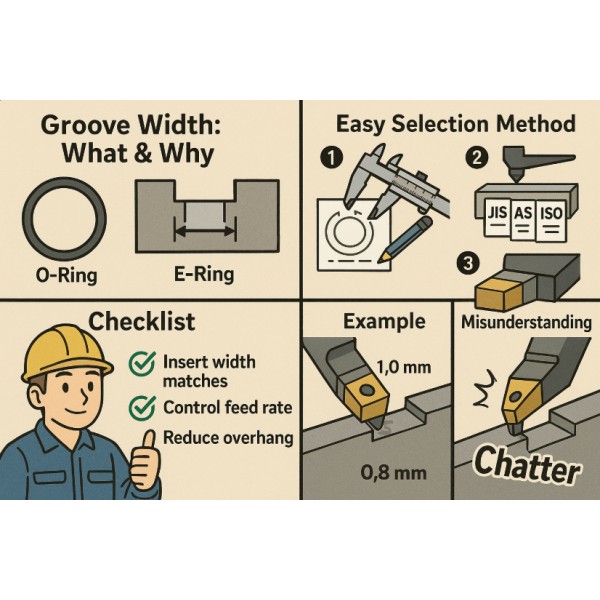
How to Select Groove Width for O-Rings / E-Rings|Reduce Chipping and Vibration
🌟 Key Takeaways• Correct groove width helps reduce edge chipping and machining vibration.
• O-Rings and E-Rings must follow internationally standardized groove-width values.
• Groove-width tolerance directly affects surface finish and cutting-tool life.
• Tool selection must correspond to material hardness such as stainless steel or aluminum.
• Proper chip-flow control and stable tool holding help prevent shallow-groove issues on small parts.
ーーーーーーーーーーーーーーーーーーーーーーーーーーーーーーー
Grooves for O-Rings and E-Rings require high precision in turning operations, especially for small parts or shallow grooves. Incorrect groove width can cause chipping, vibration, poor surface finish, or assembly failure. Understanding how to choose the correct groove width is fundamental for CNC operators and manufacturing engineers.
________________________________________
Basic Concept of Groove Width (What & Why)
Groove width is a critical dimension that directly affects seal or retaining-ring assembly.
• If the groove is too wide: the seal becomes loose, leading to leakage or detachment.
• If the groove is too narrow: assembly becomes difficult, and the seal may deform.
Standard groove-width values for O-Rings and E-Rings are defined in JIS / AS / ISO specifications.
Simple Method for Selecting Groove Width
1.Identify the required O-Ring or E-Ring size from the drawing or customer specification.
2.Refer to the corresponding groove-width values in JIS / AS / ISO standards.
3.Select an insert with equal or slightly greater width to compensate for burrs, runout, and material spring-back.
________________________________________
Checklist for CNC Machinists & Programmers
• Use an insert whose width matches or closely follows the specified groove width.
• Keep feed rate moderate to reduce chipping risk.
• Minimize tool overhang to reduce vibration.
• Use the proper grade for the material—for example, tougher grades for stainless steel cutting.
• For Swiss-type machines, choose a high-rigidity tool holder to maintain chip-flow stability.
________________________________________
Examples & Common Misconceptions
Example:
If a small O-Ring requires a 1.0 mm groove width, choose a cutting tool with a 1.0 or 1.05 mm width. Avoid using a 0.8 mm insert and widening the groove through multiple passes, as this increases vibration and results in poor surface finish.
Misconception
“Using a narrower insert is safer for narrow grooves.”
In reality: A narrower insert increases runout and raises the chance of chatter, accelerating tool wear.
________________________________________
📘 Summary
Correct selection of groove width reduces chipping, minimizes vibration, and ensures proper seal or retaining-ring assembly. Referring to standards and selecting tools suitable for the material are essential skills for beginners in groove machining.
📥
To deepen your understanding of groove machining, you may explore the related Advance article below. MMC Hardmetal (Thailand) serves as the key reference source for this content.
________________________________________
❓ FAQ
Q1: Must the insert always match the groove width?
It should match or be very close in width to maintain surface finish quality and minimize vibration.
Q2: Why must shallow grooves on Swiss-type machines be handled carefully?
Swiss-type machines have short overhang and continuous feeding, making them prone to chatter if the tool width is inappropriate.
________________________________________
📚 Glossary (Key Terms)
• Groove Width: Width determining seal/retaining-ring fit.
• O-Ring: Circular seal used to prevent leakage.
• E-Ring: Standard retaining ring used for securing shafts or components.
• Chatter: Vibration caused by tool or workpiece instability.
• Runout: Radial deviation in the holding system.
• Overhang: Length of tool extension from the holder.
• Rigidity: Stiffness of the tool holder or clamping structure.
• Feed Rate: Tool-advancing speed during turning.
________________________________________
📖 Reference
O-Ring Groove Spec – Internal Technical Sheet (N/A) – Internal Validation
Retaining Ring Dimension Standard – External Catalogue (N/A) – External Verification
________________________________________
🔗 Cluster Internal Link
• Core Content: https://prime.nc-net.com/92663/en/product_others/detail_goods/27157
• Advance Knowledge: “https://prime.nc-net.com/92663/en/product_others/detail_goods/27648
________________________________________
🔒 Trust
This content is based on information from MMC Hardmetal (Thailand) to ensure engineering accuracy aligned with relevant standards.
________________________________________
#Machining #CNC #Grooving #ORing #ERing
#CuttingTools #SurfaceFinish #Manufacturing #PrecisionEngineering #MachiningTips
📆 Updated: 2025-12-04
CONTACT
Contact FormCompany Information
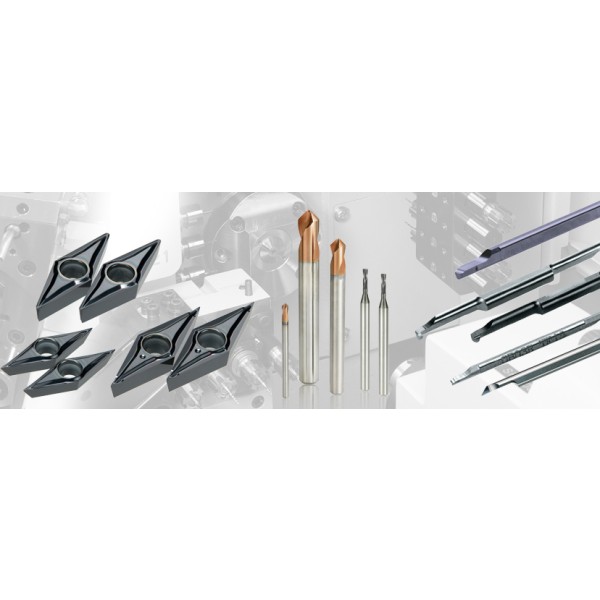
Jigs and tools
Turning Tools / Rotary Tools / Drilling Tools
Mitsubishi Materials carbide tools provide innovative cutting tools and solutions to customers worldwide.