


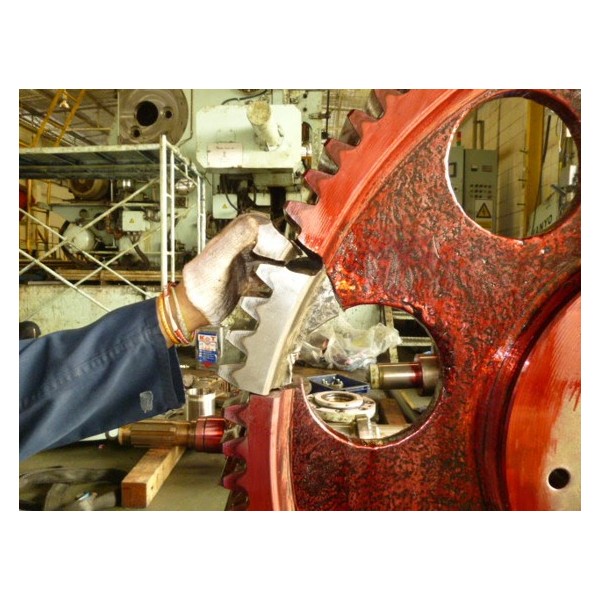
METAL FASTENING Process, Thailand: Crack Repair without Welding
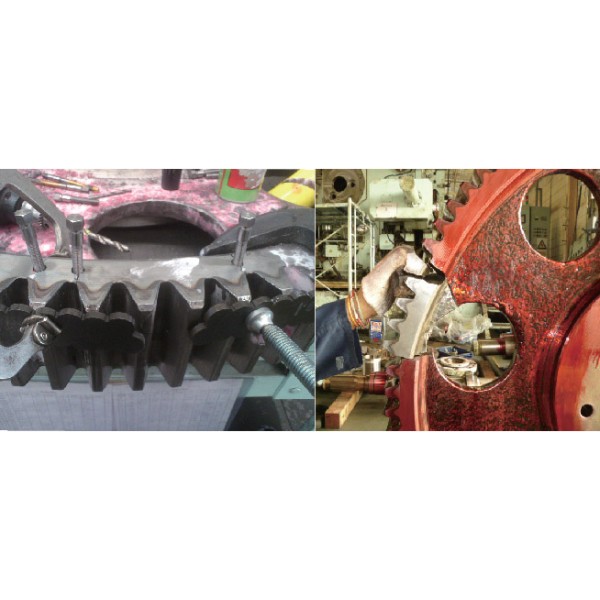
The Metal Fastening method used by our company is classified as Cold Metal Stitching Technique. Cold Metal Stitching Technique is a cast iron repair method developed over 100 years ago, and it is a method that has evolved through ship repair.
Introduced as Metalock in publications such as the Class 2 Marine Engine Mechanic Instructor's Manual and the Journal of the Marine Engineering Society in Japan, Vol.18. No.9 (Journal of the M.E.S.J., Vol.18. No.9).
Cast iron excels in mass productivity and is still used in various industrial equipment, but it is known as a material difficult to weld. Not limited to cast iron, when cracks occur in metal equipment, welding is often the first solution that comes to mind. However, welding, by applying heat, can lead to further problems such as deformation, embrittlement, and residual stress after repair. Cast iron, in particular, requires even more specialized heat management. This is a factor that makes cast iron welding difficult. To perform welding accurately, disassembly, adjustment, and reassembly of the equipment are always required. This can incur enormous costs and time. However, neglecting disassembly in an attempt to reduce these efforts will degrade the accuracy of the welding.
The Metal Fastening method solves these problems.
The Metal Fastening method is used in many industries such as power generation, cement, chemical, press processing, resin molding, and transportation.
1. Since no heat is used, no material changes occur in the equipment (base material).
2. No deformation occurs.
3. Problems such as secondary cracks immediately after repair, caused by material changes, do not occur.
4. If there is sufficient working space, disassembly of equipment is not required.
5. Completion in as little as one day.
6. Stable quality achieved by a systematic method using structural mechanics, without relying on skilled labor.
7. Considering the production schedule, emergency repairs, permanent repairs, and additional reinforcement can be performed in stages to match the construction period.
8. Even if cracks occur, if there are no issues with product manufacturing precision, re-adjustment of equipment after repair is not required.
9. Since no open flames are used, there is no impact on surrounding equipment.
CONTACT
Contact FormCompany Information
บริษัท เอส.เอ็ม.แอล.เทคโนโลยี (ประเทศไทย) จำกัด