


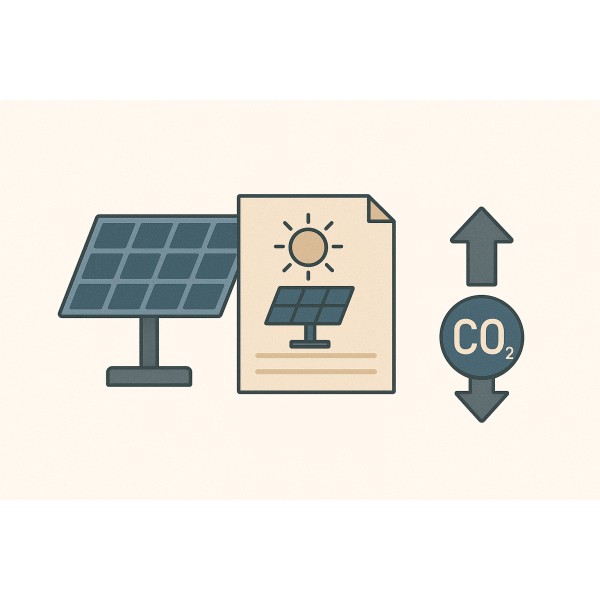
Solar Strategy for Achieving CO₂ Reduction Through Renewable Energy Utilization|Technical Guide
Achieving a decarbonized society requires the widespread adoption of renewable energy. This article explains the CO₂ reduction mechanism through solar power systems and strategic implementation from a technical perspective.
Relationship between Renewable Energy and CO₂ Reduction
With the global push towards carbon neutrality, reducing greenhouse gas emissions especially carbon dioxide (CO₂) has become an urgent priority for companies and municipalities alike. One of the key approaches is the introduction of renewable energy.
Renewable energy refers to energy derived from naturally replenishing resources, such as solar, wind, hydro, geothermal, and biomass. Among these, solar power is regarded as the most accessible and scalable option.
Basic Components and Principle of Solar Power Systems
A solar photovoltaic (PV) system consists of the following main components:
Solar modules (panels): Convert sunlight directly into electricity
Power conditioner (inverter): Converts DC electricity to AC for grid connection
Junction boxes, wiring, circuit breakers: Ensure safe and efficient power management
Battery storage (optional): Stores part of the generated electricity for peak shaving or emergency use
The key feature of solar power is that it generates electricity without emitting any CO₂.
Calculating CO₂ Reduction through Solar Power
CO₂ reduction from solar power can be roughly estimated using this formula:
Annual CO₂ reduction (kg-CO₂) = Annual power generation (kWh) × Emission factor (kg-CO₂/kWh)
In Japan, the average emission factor (assuming thermal power as the alternative source) is approximately 0.5–0.6 kg-CO₂/kWh.
For example, a self-consumption solar system generating 100,000 kWh annually can reduce about 50,000–60,000 kg (or 50–60 tons) of CO₂.
This is equivalent to the annual CO₂ absorption of around 3,500 - 4,000 Japanese cedar trees (assuming 14 kg CO₂ absorption per tree per year).
Strategies and Operational Design for Maximizing Impact
To fully maximize CO₂ reduction with solar power, the following strategic approaches are important:
Adopt a self-consumption model: Using generated electricity on-site reduces both electricity costs and CO₂ emissions.
Peak shifting with battery storage: Store daytime electricity for use at night or during peak hours to maintain reduction effects over a wider time range.
Integration with Energy Management Systems (EMS): Monitor and control overall electricity usage in real time to increase solar power utilization rates.
Choose long-life, high-efficiency panels: Since systems are expected to operate for over 20 years, selecting panels with high conversion efficiency, strong thermal characteristics, and high durability is crucial for sustained CO₂ reduction.
CONTACT
Contact FormCompany Information

Solar power generation / Energy-saving related business / Renewable energy business
ITC ENEX (THAILAND) CO., LTD. is a Thailand-based company providing sustainable solutions in the energy sector. Leveraging the extensive technology and experience of its parent company, Japan's ENEX G ...