


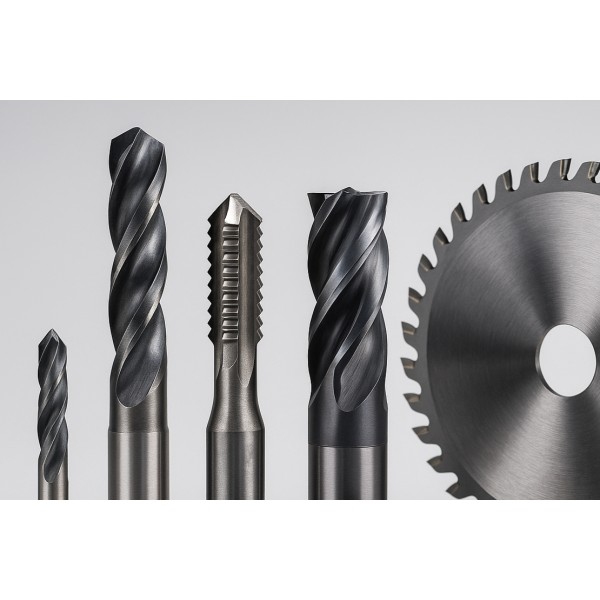
What is High Speed Steel (HSS)? | Why It Remains a Core Material for Cutting Tools
Key Takeaways
- High Speed Steel (HSS) maintains hardness at 600–650°C with values around 62–67 HRC.
- Alloying elements (W, Mo, Cr, V) form hard carbides that improve wear and heat resistance.
- Common HSS types M2, M35, M42, T1 fit different cutting conditions and materials.
- Correct tool selection, cooling, and regrinding significantly extend tool life.
- HSS remains cost-effective despite carbide tools dominating extreme-hardness applications.
High Speed Steel (HSS) is a core material in metal cutting tools due to its ability to retain hardness under high heat generated during machining. Its toughness and versatility make it suitable for drills, end mills, and turning tools across many industries.
HSS was developed to withstand high-speed machining conditions without losing hardness even when the cutting zone reaches 600–650°C. Its alloy composition tungsten, molybdenum, chromium, and vanadium promotes the formation of hard carbides. These carbides enhance wear resistance and help maintain 62–67 HRC during operation.
The material offers several benefits: cutting speeds 2–4 times faster than ordinary carbon steels, long-lasting sharpness, and strong economic value due to regrind ability and wide applicability.
Common Types of HSS
- M2 (SKH51): A standard grade balancing cost, toughness, and hardness; suitable for general use.
- M35: Contains 5% cobalt for higher hot hardness; ideal for stainless steel and harder alloys.
- M42: Contains 8% cobalt, providing maximum heat resistance for heavy-duty operations.
- T1: A high-tungsten grade with excellent hardness; more specialized and higher in cost.
Common Misconceptions
HSS cannot cut all extremely hard materials that require carbide. Coolant is important to prevent overheating. Higher cost does not always mean better; M2 is sufficient for many general tasks.
HSS remains a strong, economical choice for machining due to its heat resistance, toughness, and versatility. Understanding grades, correct operating parameters, and maintenance practices help extend tool life and provide a foundation for progressing into advanced cutting-tool knowledge.
ーーーーーーーーーーーーーーーーーーーーーーーーーーーーーーーーーーーーーーーーーーーーーーーーーーーーーーーーー
❓ FAQ
Q: How is HSS different from carbide tools?
A: HSS offers greater toughness and lower cost; carbide is harder and cuts 5–10 times faster.
Q: How do M2 and M35 differ?
A: M35 contains 5% cobalt, offering 2–3 HRC higher hardness and better performance on tough materials, with 30–50% higher cost.
Q: Which coolant should I use?
A: Cutting oil for heavy duty; emulsion for general machining.
📚 Glossary
- Carbide: Extremely hard cutting-tool material for high-speed machining
- HRC: Rockwell C hardness scale
- Cobalt: Alloying element that boosts hot hardness in HSS
- Emulsion Coolant: Water-oil mixture used as general machining coolant
📖 Reference
- AISI M-Series and T-Series Standards
- JIS G 4403
- Global Cutting-Tool Manufacturer Manuals
- ASM Handbook Volume 16: Machining
#HighSpeedSteel #HSS #CuttingTools #Machining #Drilling #Milling #EngineeringMaterials #Metalworking #ToolSteel #Manufacturing
CONTACT
Contact FormCompany Information
Special steel / Machinery steel / Laser machine
Founded in 2016, Storemate Co., Ltd. specializes in the import and distribution of premium-quality steel, machinery, and industrial tools. With our headquarters located in Bangkok and two production f ...