


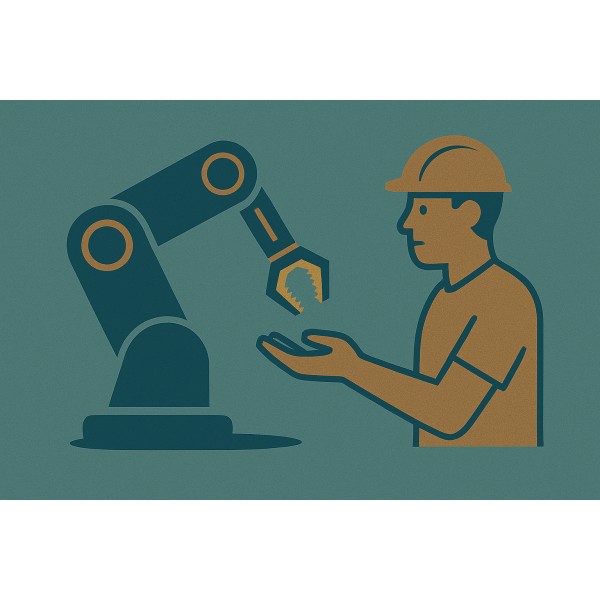
Collaborative Robot|Structure and Results from Use in Factories
Collaborative Robots (Cobots) enhance safety, efficiency, and flexibility in industrial factories, while effectively reducing costs and addressing labor shortages.
■ What are Collaborative Robots?
A Collaborative Robot (or Cobot) is a robot that can safely work in the same space as humans, without the need for fences or safety zones typically required for conventional industrial robots.
- Easy to install, convenient to move, suitable for flexible manufacturing.
- Addresses the aging society and labor shortage issues.
- Designed according to ISO 10218 and ISO/TS 15066 standards.
- Equipped with safety sensors such as Torque Sensor and Force Limiter.
■ Basic Structure of Collaborative Robots
A collaborative robot system consists of:
- Multi-axis robotic arm (6 or 7 axes)
Moves like a human arm, supporting diverse tasks.
- Force sensing system
e.g., Torque Sensor, Force Sensor; automatically stops when abnormal force is detected.
- Controller
Manages movement, monitors safety, and supports AI-driven learning.
- End Effector
Supports the installation of grippers, nut runners, picking tools, etc.
- Teaching Interface
Easy to use via Tablet or Teaching Pendant; even beginners can learn in a few hours.
■ Benefits of Using Collaborative Robots
- Reduces repetitive tasks – workforce can focus on higher-value work
Reallocates personnel to analysis or quality control processes.
- Flexibility in production line changes
Supports small-batch, diverse product manufacturing, with convenient robot repositioning.
- Enhanced safety and reduced safety zone costs
No need for protective fences, lowering safety system design costs.
- Consistent work quality
Reduces variability from human labor, lowers defect rates, and increases precision.
■ Precautions for Implementation
1. Risk Assessment
A standard-compliant risk analysis must be conducted for maximum safety.
2. Selection of Appropriate Processes
Not all tasks are suitable for robots; ROI and task characteristics should be carefully considered.
3. Design of Human-Robot Collaboration
A clear collaborative workflow must be designed to ensure smooth, safe, and efficient operation.
#CollaborativeRobot #Cobot #CollaborativeRobot #ReduceRepetitiveLabor #FactoryAutomation #RoboticArmSystem #SmartWorkforce #FlexibleProductionSystem #Industry4.0 #ISO10218
CONTACT
Contact FormCompany Information
Machine tools / Industrial machinery
Robotic / Drives and Motion Control / System Engineering
Yaskawa Electric (Thailand) Co., Ltd. (YAPT) was established in 2004. As part of the global network of Yaskawa Electric Corporation, headquartered in Japan, YAPT provides industrial automation product ...