
KNOWLEDGE
Knowledge
Technology and Services
What are the pros and cons of collaborative robots?
2026-04-14

What Are the Advantages and Disadvantages of Collaborative Robots? Also Explaining the Difference from Industrial Robots
In recent years, the introduction of collaborative robots has been rapidly progressing as a measure for factory automation and labor shortages. Collaborative robots, unlike conventional industrial robots, are attracting attention as robots that can safely work in the same workspace as humans.
However, when considering their introduction, it is important to understand not only the advantages but also the disadvantages.
This article clearly explains the advantages of collaborative robots, their disadvantages, and the differences from industrial robots.
What Are Collaborative Robots?
Collaborative robots are robots designed to work safely in the same workspace as humans. They have a mechanism to stop when they come into contact with a person, thanks to technologies such as safety sensors and torque control.
Therefore, a characteristic feature is that they can often be introduced without installing safety fences, unlike conventional industrial robots.
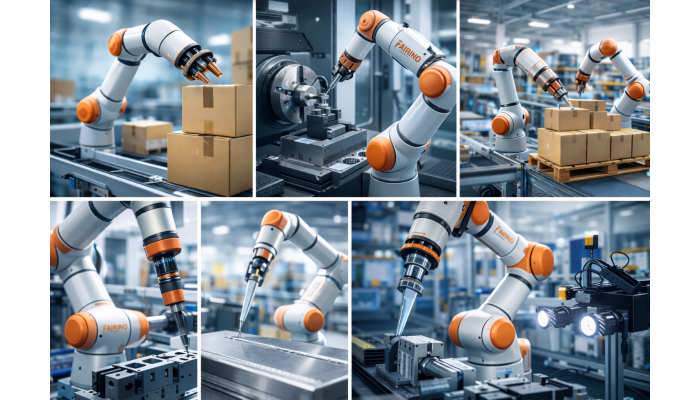
Currently, they are used for the following applications.
- Pick & Place: transfer work
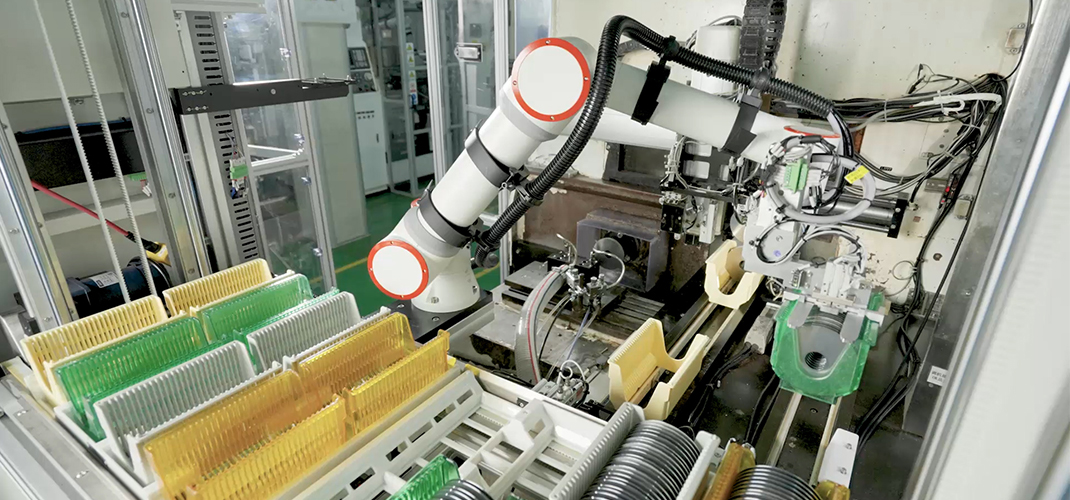
- Machine tending
- Palletizing
- Screwdriving
- Visual inspection
Advantages of Collaborative Robots
1. High Safety
The biggest advantage of collaborative robots is their high safety.
They are designed to be used in the same workspace as humans, so they are equipped with safety functions that control force and speed. Therefore, in many cases, they can be introduced without installing safety fences, and factory layout changes are relatively easy.
2. Relatively Low Introduction Cost
Conventional industrial robots often require safety fences, dedicated equipment, and large-scale installation work, which tends to result in high introduction costs.
On the other hand, collaborative robots are relatively compact and easy to install, offering the advantage of being able to start automation at a low cost.
3. Easy Programming
Collaborative robots are designed with an emphasis on operability, making them relatively easy to operate even without specialized knowledge of robotics.
Many collaborative robots allow for the following operations.
- Intuitive touch operation
- Teaching by manually moving the robot
Therefore, even on-site workers can learn to operate them in a short time.
4. Flexible Automation
Collaborative robots are relatively compact and easy to relocate, allowing for flexible adaptation to changes in production lines.
For example, they are easy to introduce in sites such as the following.
- Small-lot production
- High-mix production
- Sites with frequent changes in work processes
5. Addresses Labor Shortages
The manufacturing industry faces a chronic labor shortage.
Introducing collaborative robots can automate simple tasks, enable night work, and reduce the burden on workers, leading to increased productivity.
Disadvantages of Collaborative Robots
1. Small Payload Capacity
Collaborative robots are designed with an emphasis on safety, so they tend to have a smaller payload capacity compared to industrial robots.
Therefore, they may not be suitable for applications such as the following.
- Heavy object transport
- Large component transport
2. Slow Operating Speed
Working in the same space as humans requires ensuring safety. Therefore, collaborative robots may operate slower compared to industrial robots.
In high-speed production lines, industrial robots may be more suitable.
3. Advanced Systems Require Additional Equipment
Some tasks cannot be handled by collaborative robots alone.
For example, additional equipment may be required to achieve functions such as the following.
- Image recognition
- High-precision positioning
- Complex automation systems
In such cases, system design combining cameras, sensors, PLCs, and other equipment becomes important.
Differences Between Collaborative Robots and Industrial Robots
| Item | Collaborative Robot | Industrial Robot |
|---|---|---|
| Safety | High | Often requires safety fences |
| Introduction Cost | Relatively low | Tends to be high |
| Operating Speed | Slightly slow | High speed |
| Payload Capacity | Tends to be small | Large |
| Flexibility | High | Tends to be for dedicated applications |
What Kind of Factories Are Suitable for Collaborative Robots?
Collaborative robots are suitable for factories that meet the following conditions.
- Are struggling with labor shortages
- Want to automate simple tasks
- Have many small-lot production runs
- Want to start automation at a low cost
In particular, collaborative robots are widely adopted for applications such as Pick & Place, machine tending, and palletizing.
Summary
Collaborative robots, combining safety and ease of introduction, are being increasingly adopted in many factories.
Their main advantages are as follows.
- High safety
- Relatively low introduction cost
- Easy operation
- Flexible automation
On the other hand, they also have the following disadvantages.
- Small payload capacity
- Slow operating speed
When considering introduction, it is important to select a robot that is suitable for the specific tasks and production line.
Company Information

Industrial machinery / Measuring machinery
Collaborative robot
We, FAIRINO THAILAND Official Distributor by Shodensha Thailand, have been selling optical equipment, including microscopes, since our establishment in October 2012, as the Thai local subsidiary of Sh ...


PICKUP
Technology & Services
CONTACT
Contact