
SERVICES
Technology & Services
Air-cooled Dry Vacuum Pump [FT3-L Type]/ 3-Lobe & Water-free Cooling / Resolving Pipe Clogging & Rust from Thailand's Hard Water to Reduce Maintenance Workload
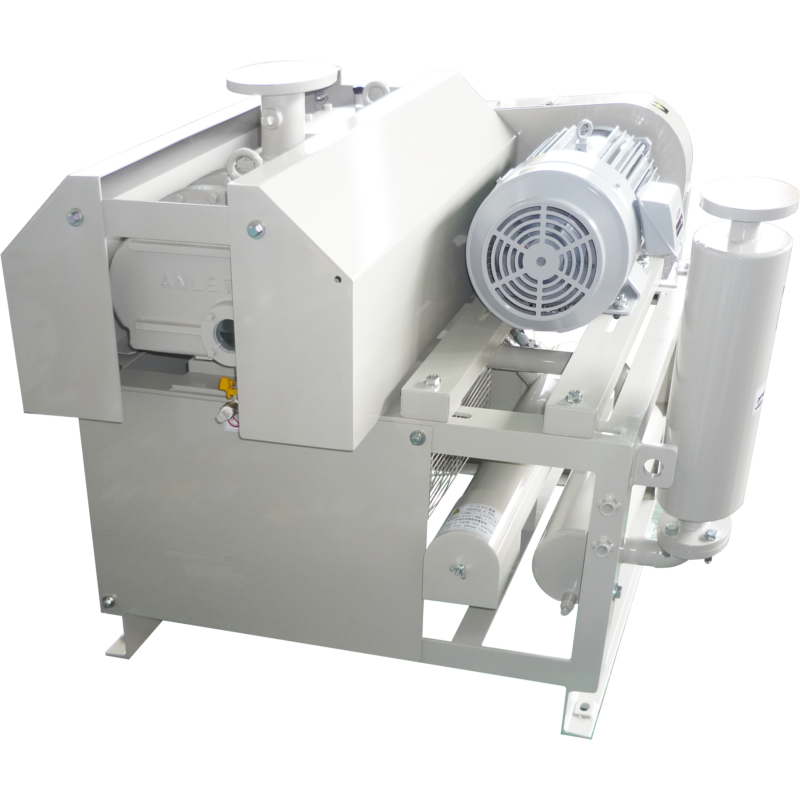
At manufacturing sites in Thailand, the hardness of cooling water is high depending on the region and water source, making it easy for scale (water scale) to adhere to the cooling pipes of vacuum pumps. Scale causes flow reduction and pipe clogging, leading to equipment trouble. A solution to these challenges is to select a method that does not use cooling water. By adopting an air-cooled system, the man-hours required for water quality management and pipe cleaning can be reduced, making it easier to secure the equipment's original operating time. This article organizes the concept and practical points.
Table of Contents
- Reasons why hard water in Thailand leads to pipe clogging and its effects
- Reduction of management burden and improvement of operational efficiency by air-cooling
- Avoidance of water troubles and stable operation realized by air-cooled structure
- Exhaust conditions and check points to suppress when selecting a vacuum pump
- What Anlet can do
- FAQ
- Keywords for understanding this article
■ Reasons why hard water in Thailand leads to pipe clogging and its effects
In Thailand, industrial water and groundwater may contain many minerals such as calcium and magnesium. These crystallize within the cooling pipes of vacuum pumps and accumulate as scale. Precipitation proceeds easily, especially in areas where water temperature rises, such as the cooling jacket or inside the heat exchanger, and strong scale layers can form in a short period. When scale sticks to the inside of the pipes, the water channel narrows, and cooling efficiency decreases. As a result, the pump body overheats, leading to seal deterioration and contact trouble due to thermal expansion of internal parts. These effects also extend to equipment life. Once clogging occurs, high-pressure washing or chemical cleaning with chemicals is required, and during that time, the production line must be stopped. As long as water-cooled pumps are used, the risk of sudden stops caused by water quality and cleaning man-hours will continue to affect field operations.
■ Reduction of management burden and improvement of operational efficiency by air-cooling
Introducing an air-cooled dry vacuum pump that does not use cooling water can suppress the burden related to water use and maintenance of incidental equipment that occurred in the water-cooled system. In particular, the point that equipment for supplying or circulating cooling water becomes unnecessary is a major difference in terms of operation. In the water-cooled system, in addition to the cost of cooling water itself, multiple elements such as the operation of cooling towers and circulation pumps, chemical management, and regular cleaning overlap. On the other hand, the air-cooled system can significantly reduce the management burden around such water. Also, because it is a structure not affected by water quality, troubles caused by scale or corrosion can be easily avoided. As a result, it leads to reduced risk of sudden stops caused by water and easier maintenance planning. Additionally, since the operation of cooling towers and auxiliary machinery becomes unnecessary, it also contributes to the suppression of power consumption including incidental equipment. Not only from the perspective of energy management but also in terms of reducing water consumption, it contributes to the reduction of environmental impact. Air-cooling is not just an equipment update, but can be said to be one of the options to simultaneously proceed with the review of the management burden at manufacturing sites in Thailand and the securing of stable operation.
■ Avoidance of water troubles and stable operation realized by air-cooled structure
The air-cooled dry vacuum pump "FT3-L series" adopts an air-cooled system using a cooling fan and does not use cooling water. This makes it possible to structurally avoid troubles caused by water quality, such as scale clogging of cooling pipes and internal corrosion, which tend to be issues at sites in Thailand. Since water management is unnecessary, it is easy to install in places far from cooling towers or in areas where it is difficult to lay water supply and drainage pipes. The degree of freedom in equipment layout increases, and it is possible to respond flexibly to additions or relocations. Furthermore, because of the oil-free structure that does not use seal oil, the risk of oil backflow to the intake side or oil mist contamination to the discharge side can be suppressed. This characteristic contributes to stable quality in processes such as the vacuum drying process after washing precision parts, resin molding where contamination of foreign matter is to be avoided, and filling processes for drugs and food.
■ Exhaust conditions and check points to suppress when selecting a vacuum pump
When selecting a vacuum pump, it is necessary to organize the exhaust speed and required vacuum degree (ultimate pressure) according to the application in advance. The FT3-L type has a lineup of designed exhaust speeds from 60 m³/h to 1000 m³/h, and corresponds to the pressure range from atmospheric pressure to ultimate pressure. In selection, first, grasp the volume of the container and piping to be exhausted and the target ultimate pressure. Then, confirm the allowable exhaust time to reach the prescribed pressure. Furthermore, whether moisture or solvent mist is included in the sucked gas is also an important judgment material. As applications, it is possible to respond to a wide range of processes such as vacuum drying, suction conveyance, resin molding, and vacuum packaging. On the other hand, when contamination of water vapor or mist is expected, by using a trap for drain collection together, the stable operation of the pump and long-term reliability can be further improved.
■ What Anlet can do
Anlet provides air-cooled dry vacuum pumps that lead to reduced trouble caused by cooling water based on technology cultivated as a specialist manufacturer of 3-lobe roots type. Against the backdrop of achievements in the roots blower market in Japan, we have established a repair training and technical support system in cooperation with local partners in Thailand. This has built a system that can respond at bases close to manufacturing sites even in the event of failure or regular overhaul. For sites that have issues with pipe clogging or frequent maintenance seen in water-cooled pumps, we propose reduction of the maintenance burden by air-cooling and review of operational efficiency by replacement from existing equipment. With unique 3-lobe rotor processing technology, we realize low noise, low vibration, and high efficiency exhaust, contributing to the reduction of the risk of sudden stops caused by water. Through these efforts, we support stable operation and reduction of management burden at manufacturing sites in Thailand.
■ FAQ
Q1: Will air-cooled vacuum pumps have more noise or vibration compared to water-cooled ones?
A1: Anlet's air-cooled vacuum pumps suppress noise and vibration with a 3-lobe roots type structure and a unique casing design. By adopting the 3-lobe type with more suction and exhaust cycles per revolution, pulsation becomes smaller, and it has the characteristic of being superior in quietness compared to general 2-lobe types.
Q2: Can air-cooled systems sufficiently cool even in a high-temperature environment like Thailand?
A2: We adopt a cooling fan design intended for use in high-temperature environments and support continuous operation. It is less likely to be affected by performance fluctuations due to rising cooling water temperature seen in water-sealed types, and if appropriate surrounding ventilation is secured, stable performance becomes easy to maintain.
Q3: What kind of work is reduced by switching to an air-cooled system?
A3: Many tasks related to water, such as water quality management of cooling water, regular cleaning of cooling towers, scale removal in pipes, and water leak inspections, can be reduced. As a result, maintenance personnel can easily allocate time to other equipment inspections and improvement work.
■ Keywords for understanding this article
- Scale: Components such as calcium and magnesium contained in water that precipitate due to heating and adhere or stick to the inside of pipes and equipment.
- Air-cooled system: A cooling method that does not use cooling water and dissipates heat by blowing air from a fan or through heat exchange with air.
- Dry vacuum pump: A vacuum pump with a structure that does not use liquid such as water or oil within the gas contact part.
- 3-lobe roots type: A structure that conveys gas by rotating a 3-lobe rotor. Pulsation is small, contributing to low noise and low vibration.
- Oil-free: A characteristic of a structure that does not use seal oil inside the pump, suppressing the risk of oil contamination in the exhaust.
Company Information

ANLET is a manufacturer and distributor of Roots blowers, vacuum pumps, and dust collectors, with a strong focus on energy saving and environmental sustainability. Its key differentiator is its patent ...
CATALOG
Related Catalogs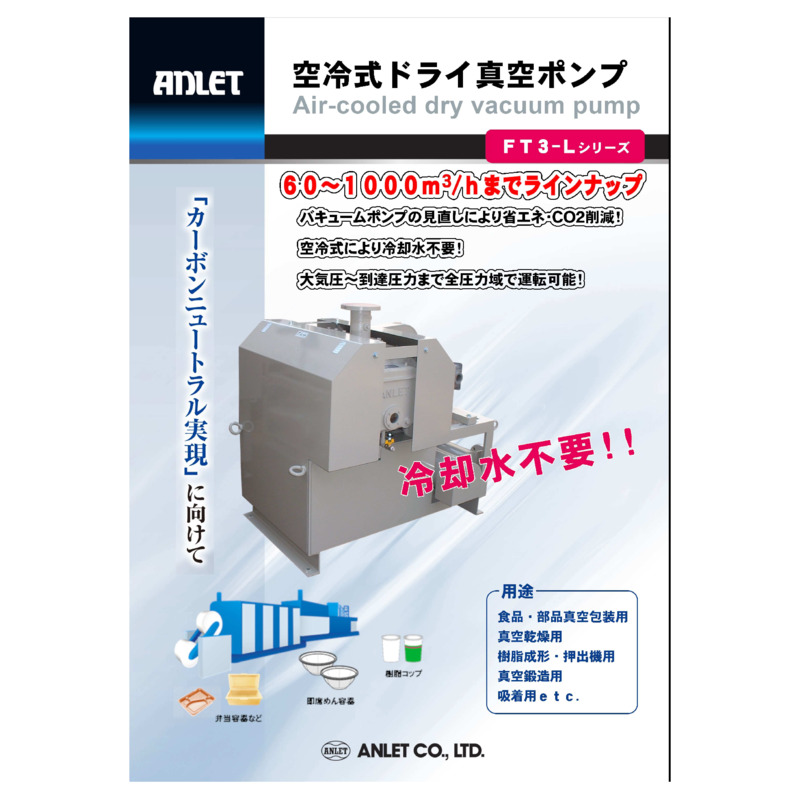
PICKUP
Technology & Services

CONTACT
Contact