
SERVICES
Technology & Services
【Process Conversion Using Sheet Forging Press Technology】Convert Machined Parts to Press-Formed Parts and Reduce Mass-Production Costs While Maintaining Machining-Equivalent Dimensional Accuracy
LINEX PRECISION (THAILAND) CO., LTD. provides development proposals, sourcing, and supply services for sheet-forged press parts made from metal sheet materials.
Based on drawings and required specifications for existing machined parts, we evaluate the feasibility of converting them to a sheet-metal press process that utilizes cold-forging technology. We develop the die structure and forming process according to the material, sheet thickness, shape, required accuracy, and production volume, and provide support from prototype verification and mass-production launch through continuous supply.
Table of Contents
- Benefits of Converting from Machining to Sheet Forging Press
- Supported Materials, Sizes, and Processing Examples
- Precision Forming That Enables the Reduction of Machining Processes
- Support System from Design VE Proposals to Mass-Production Supply
- Frequently Asked Questions (FAQ)
Benefits of Converting from Machining to Sheet Forging Press
When mass-produced parts are manufactured by machining, a larger machining allowance results in higher material costs and longer processing times, making it difficult to reduce the unit cost of each part.
Sheet forging press is a manufacturing process in which pressure is applied to metal sheet material, causing the material to flow plastically within a die and form a three-dimensional shape. Compared with machining, this process generates less cutting waste and can therefore improve material yield.
In addition, continuous processing using dies can reduce the processing time and manufacturing cost per part when conditions such as the product shape and production volume are suitable.
Sheet forging press requires an initial investment in tooling. LINEX compares the current machining cost, material cost, production volume, planned production period, and tooling cost before proposing process conversion after confirming that a cost advantage can be achieved.
Strength-Oriented Design Utilizing Material Flow
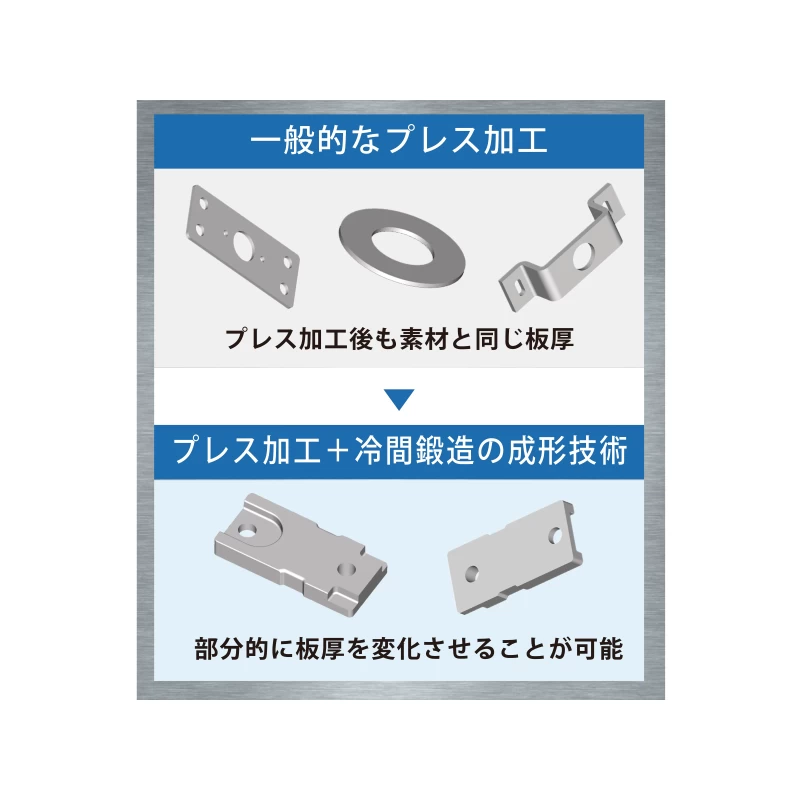
LINEX PRECISION also supports forming processes that combine drawing operations to adjust the sheet thickness in different areas of a part.
For example, material can be moved to areas that require greater strength to secure sufficient thickness, while areas subject to relatively low loads can be made thinner. This makes it possible to reduce the overall weight of the part while maintaining the required strength.
However, mechanical strength and fatigue strength vary depending on the material, shape, forming conditions, heat treatment, surface treatment, and operating conditions. When necessary, prototypes are produced for dimensional verification.
Supported Materials, Sizes, and Processing Examples
Supported Specifications
Item | Supported Details |
Supported materials | SPHC, SPCC, SAPH440, SCM415, S45C, S22CB, SK85, SUS304, SUS430, C1020, C2600, C2680, and others |
Maximum sheet thickness | Up to 8 mm |
Forming size | Up to approximately □80 or φ80 |
Supported shapes | Convex and concave shapes, stepped shapes, gear shapes, micro-grooves, drawn shapes, localized thickening, localized thinning, and others |
Supported processes | Sheet forging press, press forming incorporating cold-forging elements, and combined processes using both pressing and machining |
Feasibility depends on the material, sheet thickness, processing area, shape, required accuracy and production volume. After reviewing the drawings or 3D data, we evaluate the die structure, number of processes, and equipment to be used.
Gear Forming
Complex gear shapes, such as involute gears and rack gears, can be formed directly from sheet material.
Processing example:
- Material: SAPH440
- Sheet thickness: 5.0 mm
- Gear height: 2.5 mm
- Gear module: 1.0
Depending on the shape and required accuracy, additional machining processes can be reduced, shortening the processing time during mass production.
Grid-Groove Forming
Oil grooves on sliding surfaces and fine patterns for lubricant retention can be formed directly using a die.
Processing example:
- Material: SK85
- Grid pitch: 0.3 mm
- Grid-groove width: 0.04 mm
- Grid-groove depth: 0.015 mm (15 μm)
Forming micro-grooves during the pressing process may reduce additional processes such as machining and etching.
Precision Forming That Enables the Reduction of Machining Processes
In conventional sheet-metal pressing, rollover, fractured surfaces, and burrs can occur in punched areas. As a result, it may be difficult to achieve edge shapes and dimensional accuracy equivalent to those of machined parts.
Sheet forging press incorporates the compression-forming elements of cold forging into the die and manufacturing process, forming the material while constraining it inside the die. This makes it possible to produce localized thick sections, precise convex and concave shapes, and smooth sheared surfaces.
Depending on the shape and tolerance requirements, areas that were previously finished by machining or grinding can be formed directly within the pressing process, allowing additional machining operations to be reduced or eliminated.
When evaluating process conversion, the following conditions are mainly reviewed:
- Required dimensions and tolerances
- Geometric tolerances such as flatness, coaxiality, and roundness
- Requirements for sheared surfaces and external appearance
- Material, hardness, and sheet thickness
- Whether heat treatment or surface treatment is required
- Production volume and target cost
Not all machined parts can be completed by pressing alone. Depending on the required accuracy and shape, we may also propose a combined process in which only the necessary areas are machined after press forming.
Support System from Design VE Proposals to Mass-Production Supply
Converting machined parts to sheet forging press requires more than simply changing the manufacturing method. The design must also be reviewed in terms of the shape, dimensional references, material, and process suitable for press forming.
At LINEX PRECISION (THAILAND) CO., LTD., Japanese engineers review the existing drawings and required specifications and provide support for the following activities:
- Feasibility evaluation for conversion to sheet forging press
- VE proposals for shape modifications suitable for press forming
- Evaluation of materials, sheet thickness, heat treatment, and surface treatment
- Evaluation of die structures and forming processes
- Cost comparison, including tooling costs
- Prototype production, measurement
- Establishment of mass-production processes and inspection methods
- Mass-production launch and continuous supply
It is also possible to confirm the design intent, inspection methods, and quality requirements directly in Japanese between the design department in Japan and the purchasing and manufacturing departments in Thailand.
※ This processing technology is provided in cooperation with Shinmei Industry Co., Ltd., a partner company with advanced press-die technology.
Frequently Asked Questions (FAQ)
Q1: How do you determine whether a machined part can be converted to sheet forging press?
A1: We review the existing drawings or 3D data, material, required accuracy, production volume, and current manufacturing processes.
Based on this information, we evaluate whether the shape can be formed from sheet material, whether the required material flow can be achieved, whether additional machining can be reduced, and whether a cost advantage can be expected after including the tooling cost.
If shape modifications are required, we provide VE proposals to make the part easier to press-form while maintaining its intended function.
Q2: Can dimensional accuracy equivalent to that of machined parts be achieved?
A2: By incorporating cold-forging elements and forming the material while constraining it inside the die, it is possible to target higher dimensional accuracy and smoother sheared surfaces than those achieved by conventional sheet-metal pressing.
However, the achievable accuracy varies depending on the material, sheet thickness, shape, die structure, and measurement location. After reviewing the drawing, we identify the areas that can be completed by pressing alone and those that require additional machining.
Q3: At what production volume does the process become cost-effective?
A3: The break-even production volume varies depending on the current machining cost, material cost, tooling cost, number of pressing processes, and whether secondary processing is required.
We review the annual usage volume and planned production period and compare the total cost of continuing with machining against the total cost of converting to sheet forging press.
Q4: Can we consult with you from the prototype stage?
A4: Yes. We can evaluate the feasibility of process conversion based on existing drawings or conceptual-stage 3D data.
We organize and review the shape, material, required tolerances, die structure, prototype method, and evaluation items, and provide support from prototype production through mass-production launch.
※ For further details, please contact us using the form at the bottom of the page.
Company Information

Industrial screws and fasteners / Industrial screws and fasteners / Specialized injection-molded and cast parts
LINEX PRECISION is a specialized trading company for machine element parts, offering a wide range of products from JIS-standard items such as bolts and nuts to custom drawing-based parts, including ma ...
CATALOG
Related Catalogs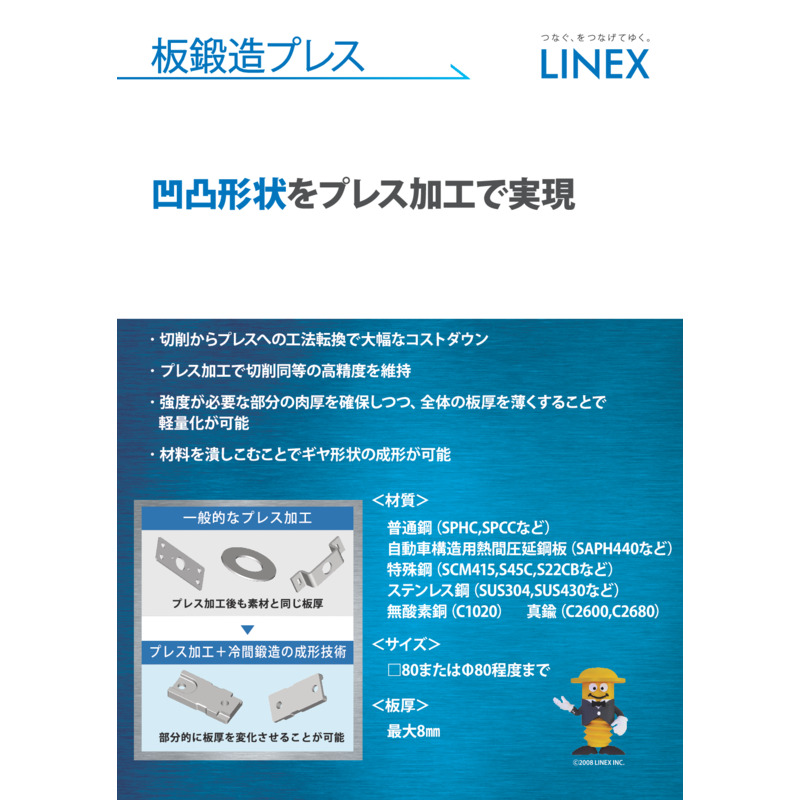
CONTACT
Contact