
KNOWLEDGE
Knowledge
Technology and Services
Is Your Ion Exchange Resin Regeneration Contractor Actually Compliant? What to Check on DIW Licensing and Waste Management in Thailand
2026-09-23
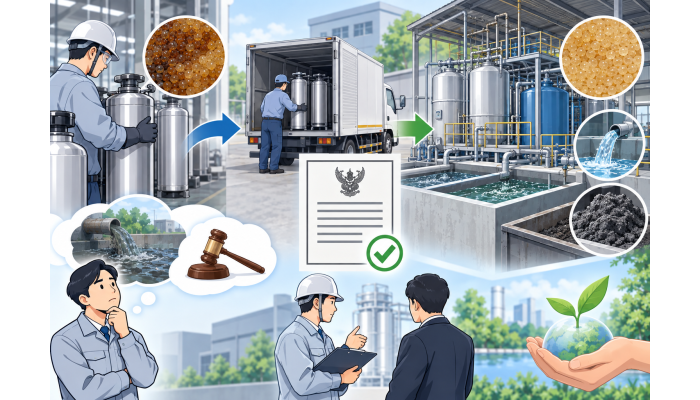
Ion exchange resin is widely used in Thailand's surface treatment and cleaning operations to maintain water quality and remove impurities. Resin whose adsorption capacity has declined can be regenerated for reuse — but since regeneration generates wastewater containing acids and alkalis, choosing the right contractor requires care.
What matters most is whether the contractor holds the necessary factory license and operates within its permitted scope. Thailand's Department of Industrial Works (DIW) has established factory categories for treating and recycling industrial waste, along with a system for managing waste removed from a factory. Industrial waste regulations in effect since 2023 also make clear that a waste-generating factory's responsibility doesn't end once waste is handed over — it continues until proper treatment is complete.
This article explains what to check regarding DIW licensing and waste management when outsourcing ion exchange resin regeneration in Thailand, along with how to choose an appropriate contractor.
Table of Contents
- Why Outsourcing Resin Regeneration Carries Environmental Risk
- Why Waste Generators Remain Responsible Even After Outsourcing
- Factory Type No.106 and the License Scope You Should Check Before Choosing a Contractor
- What to Check in Acid/Alkali Wastewater and Sludge Treatment Systems
- What FUTABA IS CO., LTD. Can Support
- Frequently Asked Questions (FAQ)
Why Outsourcing Resin Regeneration Carries Environmental Risk
Ion exchange resin used in surface treatment and cleaning processes adsorbs metal ions and other impurities to maintain water quality. Once saturated, it must be regenerated with chemicals that strip out the adsorbed ions, restoring it for reuse.
This process generates wastewater containing acid or alkali, depending on the resin type and what it has adsorbed — and sometimes metals released from the resin as well.
If regeneration is outsourced to an operator without the proper license or treatment equipment, the resulting wastewater and sludge may not be managed correctly. DIW actively supervises recycling and treatment operators classified under Factory Types No.105 and No.106, and takes administrative action against factories that treat waste improperly.
So when outsourcing resin regeneration, weigh not just performance or price, but whether the contractor has a legally compliant treatment system in place.
Why Waste Generators Remain Responsible Even After Outsourcing
The assumption that "once it's handed off to a specialist, our responsibility ends" is one to be cautious about.
Thailand's industrial waste regulations, in effect since 2023, clearly establish the Polluter Pays Principle: a waste-generating factory's responsibility does not end when waste is handed over to a treatment provider — it continues until proper treatment is fully completed.
So even when used resin leaves the site, choosing the right contractor and verifying treatment status still matters. Improper outsourcing carries real business risk — environmental contamination, administrative action, added treatment costs, and reputational damage.
Contractor selection shouldn't be based on cost alone — weigh legal compliance and treatment traceability too.
Factory Type No.106 and the License Scope You Should Check Before Choosing a Contractor
The first thing to check when outsourcing resin regeneration is whether the contractor holds a Factory Type No.106 license from DIW.
Factory Type No.106 covers factories that use industrial processes to convert used industrial products or factory waste back into raw materials or new products. For an operator that accepts used resin from other companies and regenerates it as a business, this license is a fundamental prerequisite.
That said, some operators collect and regenerate resin without holding the required license. Choosing a contractor on price or collection terms alone risks entrusting the work to an unsuitable operator — so checking for a Type 106 license should come first.
Holding the license alone isn't enough, though. The scope of business and treatment processes actually permitted vary by operator, so check the license documentation itself to confirm resin regeneration falls within the approved scope.
DIW also oversees waste removed from a factory through removal permits and treatment status reporting. When selecting a contractor, check at least the following:
- Do they hold a Factory Type No.106 license?
- Does the licensed scope of business include ion exchange resin regeneration?
- Do they have equipment to treat the wastewater generated during regeneration?
- Is the sludge or other secondary waste generated after treatment properly managed?
- Can the process be traced from intake through to completed treatment?
- Do they comply with DIW's waste management system?
A Type 106 license is the starting point — the licensed scope and the actual treatment system in place are what determine whether a contractor is truly suitable.
What to Check in Acid/Alkali Wastewater and Sludge Treatment Systems
Beyond licensing, it's worth checking the actual wastewater and sludge treatment system used in regeneration.
Regeneration uses acids or alkalis to strip out the ions the resin has adsorbed. The resulting wastewater must be properly neutralized, and depending on what was adsorbed, any metals present may also need treatment.
This wastewater goes through neutralization and coagulation/sedimentation, and the resulting sludge must also be properly managed. Some facilities dewater the settled sludge with a filter press, store it as a dried cake, and hand it to a licensed industrial waste contractor as needed.
When evaluating a contractor, check their neutralization equipment, solid-liquid separation setup, filter press, and sludge storage — so you know exactly how the resulting wastewater and waste are ultimately handled.
What FUTABA IS CO., LTD. Can Support
FUTABA IS CO., LTD. supplies surface treatment materials and equipment in Thailand, alongside water treatment, pure water production, and ion exchange resin regeneration.
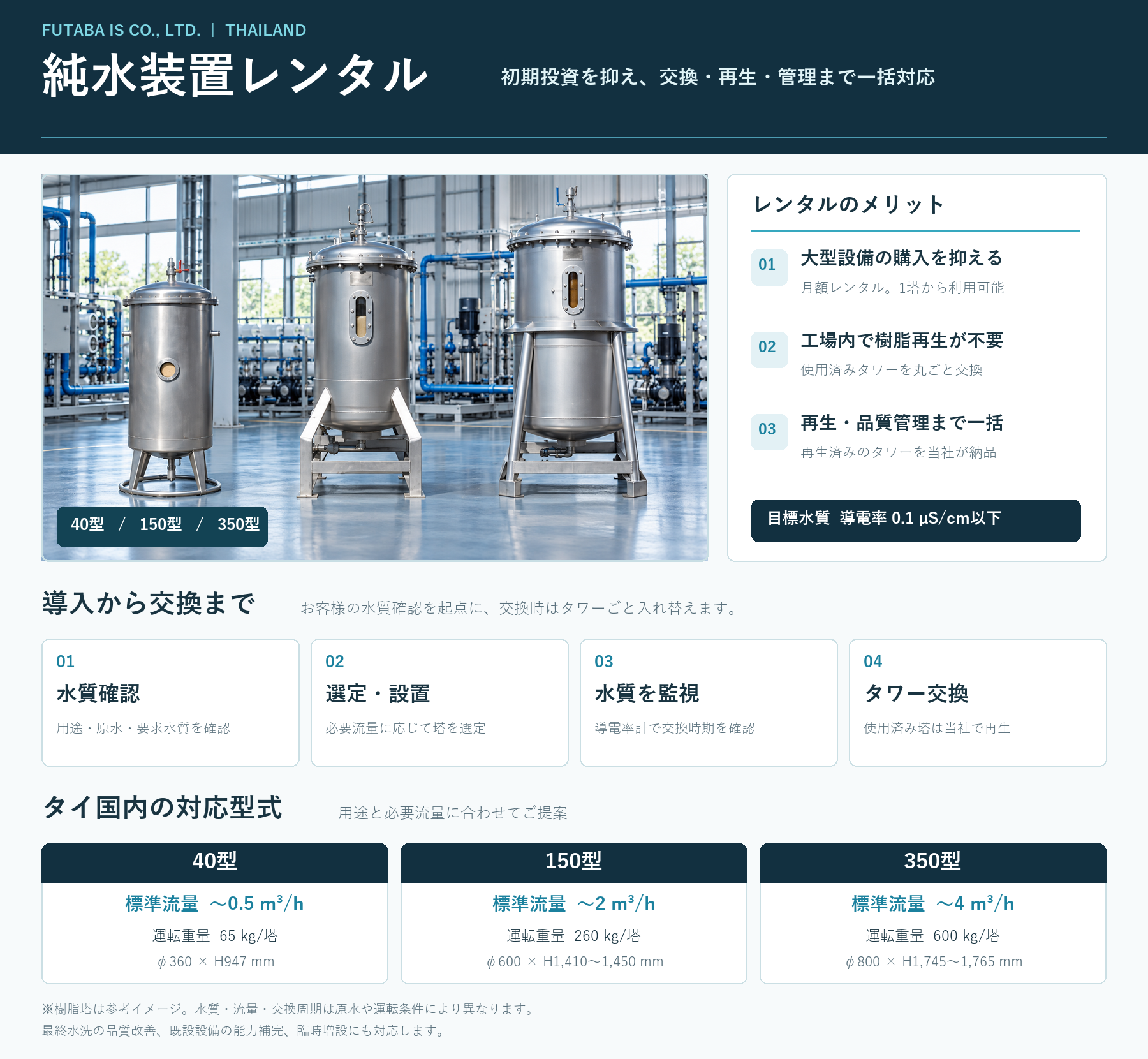
Our resin-based water treatment and recycling system removes impurities from rinse water. We operate on a consignment regeneration model — FUTABA IS handles the maintenance and regeneration of used resin itself, reducing customers' burden of managing chemicals or regenerating resin on their own.
For pure water production, we also offer resin-based systems, with published examples of 200μS/cm raw water treated down to below 0.1μS/cm. Actual results vary depending on raw water conditions, the resin used, and equipment configuration.
By treating water quality improvement and resin regeneration as one continuous operation, we help customers maintain ongoing water quality management while reducing their chemical-handling and regeneration burden.
※For more details, please see the PDF document attached to this article, or contact us via the form at the bottom of the page.
Frequently Asked Questions (FAQ)
Q1: When outsourcing resin regeneration in Thailand, is a Factory Type No.106 license enough?
A1: It's the first thing to check, but not sufficient alone. Verify the license documentation covers resin regeneration, and confirm the necessary treatment equipment and management systems are in place.
Q2: After handing off used resin to an outside contractor, does the generating factory still hold responsibility?
A2: Yes. Thailand's industrial waste regulations, in effect since 2023, establish under the Polluter Pays Principle that a waste-generating factory's responsibility doesn't end once waste is handed off — it continues until proper treatment is complete. So verify the contractor's license, treatment methods, and status before choosing one.
Q3: What should be checked when selecting a regeneration contractor?
A3: First, whether they hold a Factory Type No.106 license. Then check the scope of business stated in the license, their wastewater treatment equipment, how they manage sludge and other secondary waste, whether treatment is traceable, and whether they comply with DIW's waste management system.
Q4: Do FUTABA IS CO., LTD.'s customers need to regenerate resin themselves?
A4: No. Because FUTABA IS operates on a consignment regeneration model, customers never need to handle acid or alkali chemicals themselves — outsourcing the maintenance and regeneration of used resin removes that burden entirely.
※For more details, please see the PDF document attached to this article, or contact us via the form at the bottom of the page.
Company Information
Sales of materials for surface treatment and industrial chemicals / Sales and maintenance of surface treatment equipment / Regeneration treatment of ion exchange resins
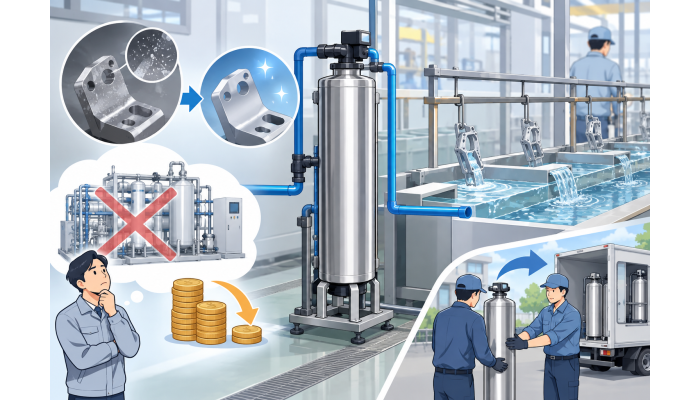
If water quality is improved, defects can be reduced. With the rental ion exchange resin system “Mini Cro-Pack,” wastewater treatment, water quality improvement, and environmental measures can be achi ...
PICKUP
Technology & Services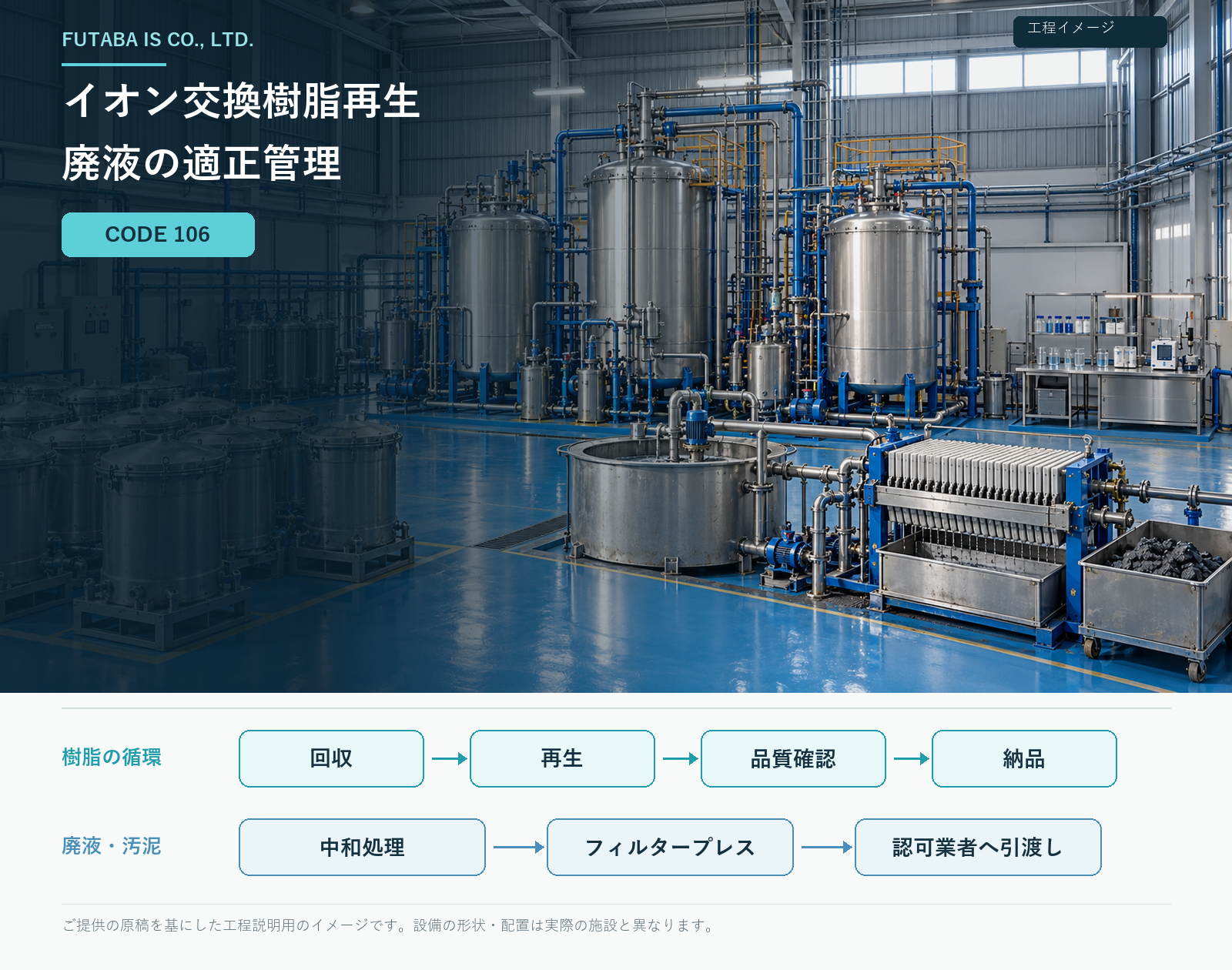
CONTACT
Contact