
KNOWLEDGE
Knowledge
Technology and Services
Bringing Ultra-Pure Water Into Your Production Line Without a Major Capital Investment | A Case Study in Water Quality Improvement Using a Rental Resin System
2026-09-23
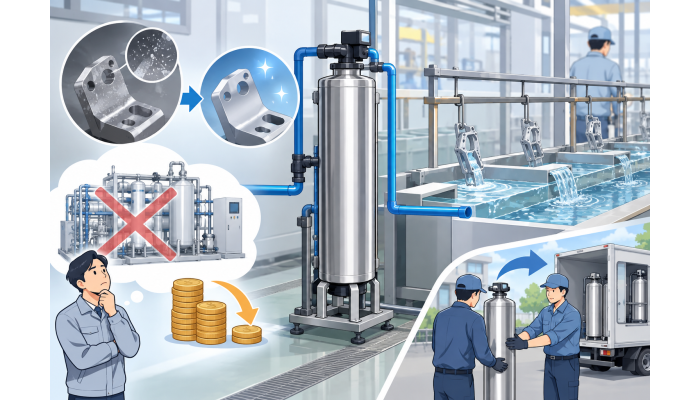
In surface treatment, plating, and coating operations in Thailand, raw water with hardness levels as high as 200-300 μS/cm is a root cause of water spots and rising defect rates in the rinsing process. On top of that, with wastewater and TDS regulations growing stricter, a pure water system costing several million Baht becomes a heavy cost burden. So how can a factory improve water quality and yield without making that kind of large investment?
Table of Contents
- On-Site Problems Caused by Poor Water Quality — The Root of Water Spots and Rising Defect Rates
- Operational Risks from High Equipment Investment, Wastewater Regulations, and TDS Management
- How Rental Ion Exchange Resin Improves Water Quality Without Upfront Investment
- Supplying 0.05μS/cm Ultra-Pure Water and a Regeneration System for Stable Operation
- What FUTABA IS CO., LTD. Can Support
- Frequently Asked Questions (FAQ)
On-Site Problems Caused by Poor Water Quality — The Root of Water Spots and Rising Defect Rates
In manufacturing, the quality of water used for surface treatment and precision cleaning is a key factor that determines both the appearance of the finished product and the yield rate achieved. Raw water quality varies by source and region in Thailand, but commonly contains impurities such as calcium and silica, resulting in conductivity around 200-300 μS/cm. If water like this is used directly for cleaning, or only passes through standard filtration, white residue or water spots can remain on the product surface after drying.
This is especially critical in processes such as pre-paint cleaning for automotive parts, precision cleaning of electronic and semiconductor components, or high-value surface treatments such as gold plating and hard chromium plating — even trace amounts of impurities left behind can cause poor paint adhesion or substandard plating. In some cases, workers must wipe products by hand with alcohol to remove these spots, adding to both labor cost and processing time. As defect rates from water-borne impurities rise, so does production cost, driven by both rework and scrapped parts.
Operational Risks from High Equipment Investment, Wastewater Regulations, and TDS Management
When considering a pure water system to improve product quality, purchasing and installing a large RO membrane system or a fixed pure water unit requires a substantial upfront investment. For factories with fluctuating order volumes or frequent line changes, this brings payback-period risk and reduced flexibility for future equipment changes. What's more, depending on raw water conditions and equipment specifications, an RO system alone may only bring conductivity down to around 20μS/cm, which can be insufficient for final rinse processes that demand extremely high water purity.
In addition, manufacturing sites in Thailand must also comply with wastewater discharge regulations and the specific wastewater standards set by each industrial estate, alongside managing water quality itself. Factory wastewater is subject to a range of quality standards, including TDS limits — exceeding these can result in corrective orders or penalties. Because wastewater standards and discharge conditions vary depending on a factory's location and discharge point, it's important to check the standards that apply specifically to your facility, and to consider a water treatment approach that addresses both process water quality and wastewater treatment together.
How Rental Ion Exchange Resin Improves Water Quality Without Upfront Investment
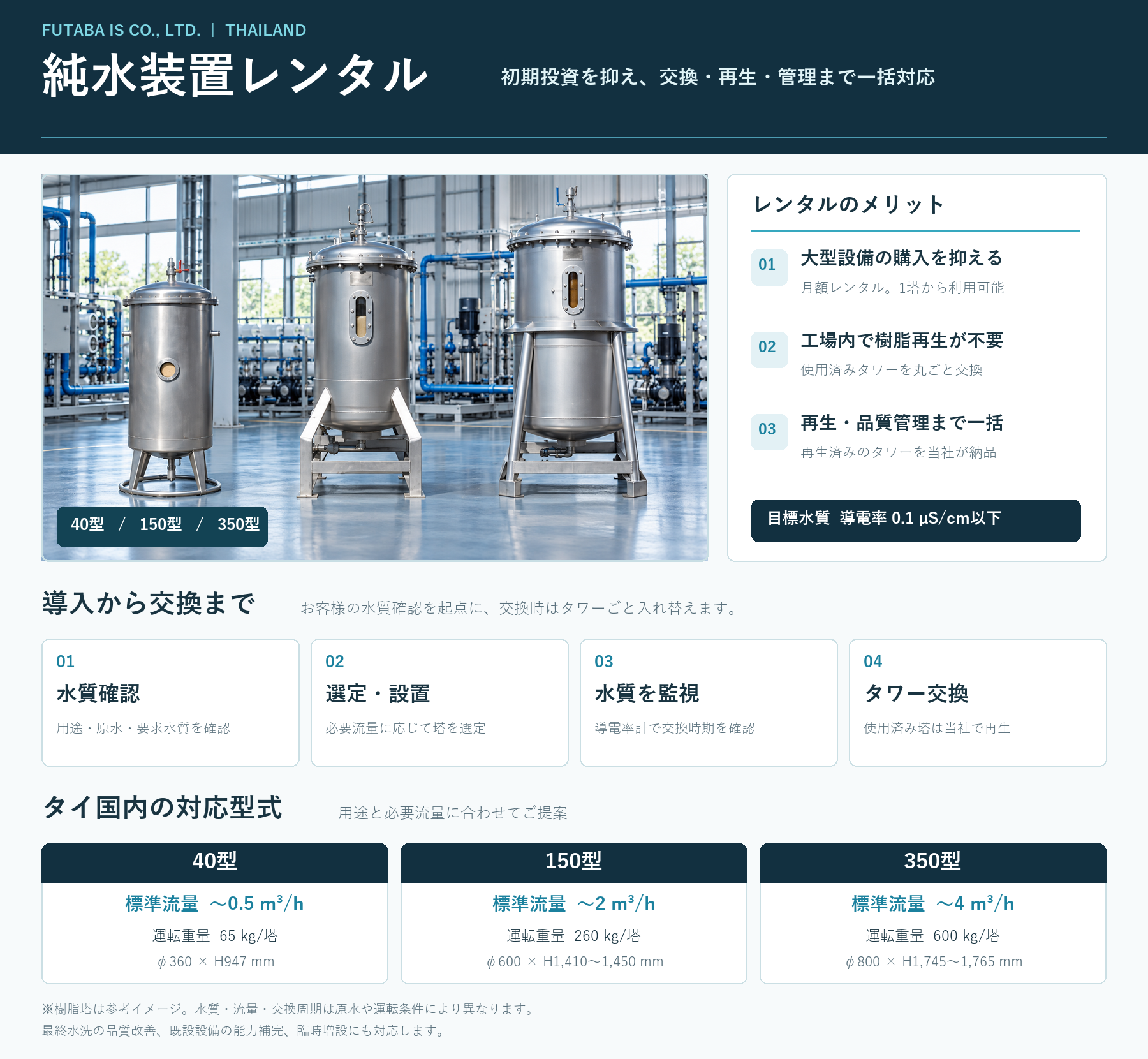
One way to achieve high water quality without a major capital investment is to rent an ion exchange resin cylinder on a monthly basis. With this approach, there's no need to purchase an expensive pure water system outright — simply connecting a pre-packed stainless steel resin cylinder to your existing rinse line or target tank is enough to get started. Since no major piping work or building renovation is required, a water treatment setup can be built quickly, even when investment budgets are limited or when production capacity needs to be increased temporarily.
This system is well suited for localized add-on installation at a specific rinse tank or final rinse tank where water quality directly affects product quality, rather than overhauling the water supply for the entire factory — circulating and treating water only where it's needed. The ion exchange resin adsorbs impurity ions present in the raw water or pre-treated water, effectively removing metal ions and delivering the water quality required.
Because this also shifts the cost structure from a large upfront investment to a monthly fee plus maintenance costs, operations can be adjusted flexibly in line with changing production plans or water demand. Choosing the right size and number of resin cylinders for a factory's production scale and water usage is key to avoiding unnecessary equipment investment.
Supplying 0.05μS/cm Ultra-Pure Water and a Regeneration System for Stable Operation
Depending on the application and raw water conditions, a rental ion exchange resin system can supply highly treated water with a conductivity as low as 0.05μS/cm to the process that needs it. Compared to typical water at around 1μS/cm or water treated by an RO membrane, water at this level contains far fewer impurity ions — helping reduce water spots and residue after cleaning, which in turn stabilizes quality and lowers defect rates in surface treatment processes. Selecting the right resin and cylinder size based on raw water quality and the volume to be treated also extends the amount of water that can be treated before an exchange is needed, making operations more efficient.
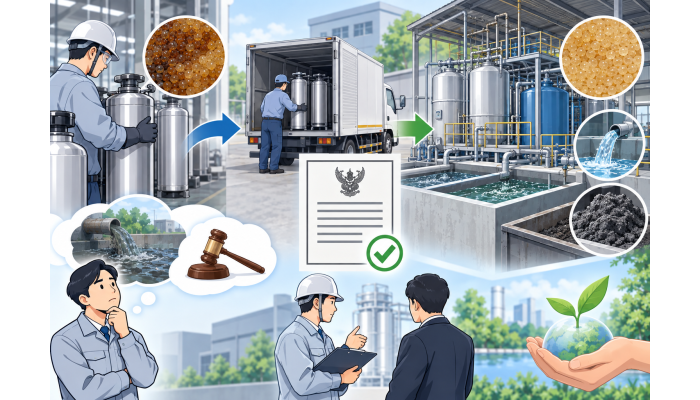
There's no need to store acid or alkaline chemicals on-site to regenerate resin yourself. When it's time for a change, the used cylinder or cartridge is simply swapped for a regenerated one, and the used one is collected — allowing water quality to be maintained continuously without any complex regeneration work on-site.
Collected ion exchange resin is regenerated at a facility with the necessary licenses and treatment equipment. Choosing a partner that can properly manage both the neutralization of wastewater and the handling of sludge generated during regeneration not only reduces the burden of managing chemicals and wastewater yourself, but also lowers environmental and compliance risk. When selecting a long-term partner, it's important to consider not just treatment cost, but also their regulatory compliance status and their system for managing regeneration and waste disposal.
What FUTABA IS CO., LTD. Can Support
FUTABA IS CO., LTD. provides ion exchange resin water treatment equipment and regeneration services for used resin in Thailand. We offer pure water production and treatment systems tailored to your application and required water quality, including add-on installation to existing equipment.
We use a consignment regeneration model: we collect used ion exchange resin and treat it at our own regeneration facility, so customers don't need to store regeneration chemicals or carry out resin regeneration themselves, reducing the on-site maintenance burden. FUTABA IS's pure water equipment also has published examples of treated water quality below 0.1μS/cm.
Installing this system at the point where it's needed — such as an existing cleaning process — allows water quality to be improved with a much smaller upfront investment compared to installing a new, large-scale pure water system. Reducing impurities in the rinse water also helps cut down on water spots and residue, contributing to more stable quality in surface treatment processes.
※For more details, please see the PDF document attached to this article, or contact us via the form at the bottom of the page.
Frequently Asked Questions (FAQ)
Q: Does adopting the ion exchange resin rental service require a large equipment investment or major construction work?
A: Because this is a rental model using a pre-packed resin cylinder, it significantly reduces upfront investment compared to purchasing a new, large-scale pure water system. Simply installing the cylinder at the existing rinse tank or line and connecting the necessary piping is enough to get started — allowing water quality to be improved without major equipment renovation.
Q: How is ion exchange resin exchanged and maintained?
A: The timing for resin replacement is determined based on raw water quality, the volume of water treated, and the conductivity of the treated water. Because this is a consignment regeneration model — where used cylinders are collected and swapped for regenerated ones — customers do not need to use acid or alkaline chemicals to regenerate the resin themselves.
Q: What level of water quality can be achieved?
A: Based on the water quality examples published by FUTABA IS, raw water with a conductivity of 200μS/cm can be treated down to below 0.1μS/cm. Actual treated water quality varies depending on raw water conditions, the type of resin used, and the equipment configuration, but the system is suitable for applications requiring high water quality, such as surface treatment and various cleaning processes.
※For more details, please see the PDF document attached to this article, or contact us via the form at the bottom of the page.
Company Information
Sales of materials for surface treatment and industrial chemicals / Sales and maintenance of surface treatment equipment / Regeneration treatment of ion exchange resins
If water quality is improved, defects can be reduced. With the rental ion exchange resin system “Mini Cro-Pack,” wastewater treatment, water quality improvement, and environmental measures can be achi ...
PICKUP
Technology & Services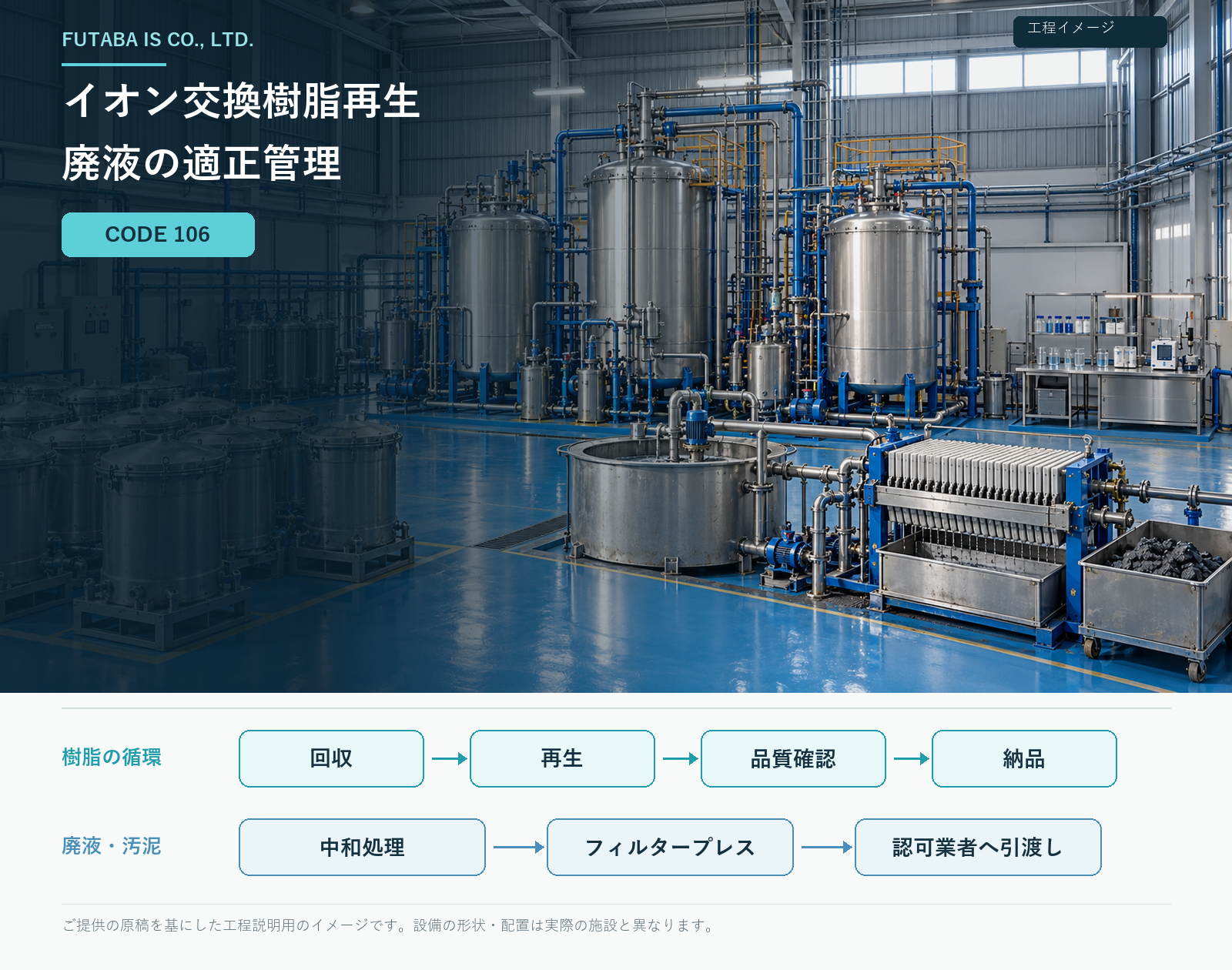
CONTACT
Contact