
SERVICES
Technology & Services
【Automation of Connector Assembly Processes】From Terminal and Pin Insertion to Bending, Rib Forming, and Housing Assembly
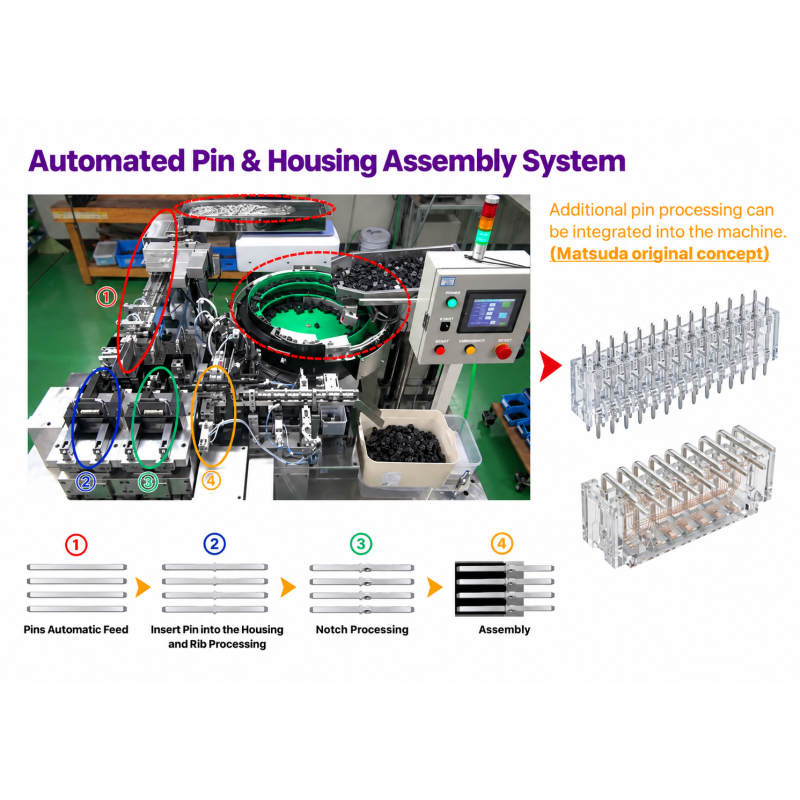
Connector manufacturing involves multiple processes, including terminal and pin alignment, additional processing, and insertion and assembly into housings. Particularly in mass production, it is important not only to reduce the number of process steps and processing time but also to maintain consistent processing conditions to ensure stable quality.
Matsuda (Thailand) Co., Ltd. takes an integrated approach to terminal and pin manufacturing and subsequent processes, proposing process improvements that combine pin geometry with automated machinery.
This article introduces how connector assembly processes can be automated, including approaches to pin feeding, processing, and insertion.
Table of Contents
- Automation Through Integrated Consideration of Pin Geometry and Subsequent Processes
- Processing Straight Pins into Required Shapes Within Dedicated Machines
- From Automatic Pin Feeding to Housing Insertion
- Simultaneous Processing and Insertion of Multiple Pins
- Automation Proposals from Japan Headquarters and Matsuda (Thailand)
- Frequently Asked Questions
■ Automation Through Integrated Consideration of Pin Geometry and Subsequent Processes
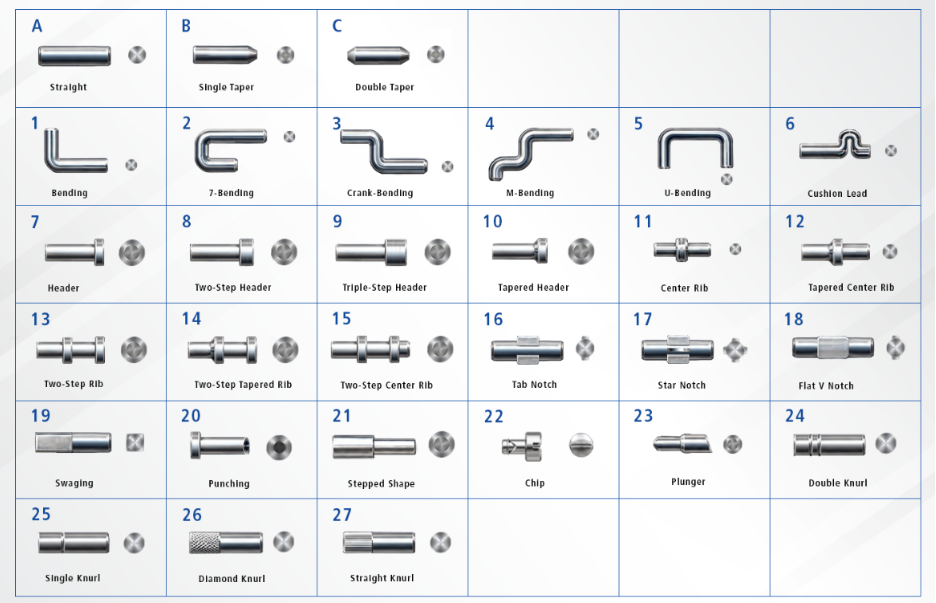
Connector assembly involves multiple processes, including pin alignment, bending, rib and notch forming, and insertion into housings.
In addition to feeding fully formed pins individually and processing them through separate operations, it is also possible to supply pins in a simpler shape and integrate the necessary processing steps into automated machinery used in subsequent processes.
At Matsuda, we consider not only the manufacturing of individual terminals and pins but also the shapes in which they should be supplied and how they will be processed and inserted during subsequent operations.
■ Processing Straight Pins into Required Shapes Within Dedicated Machines
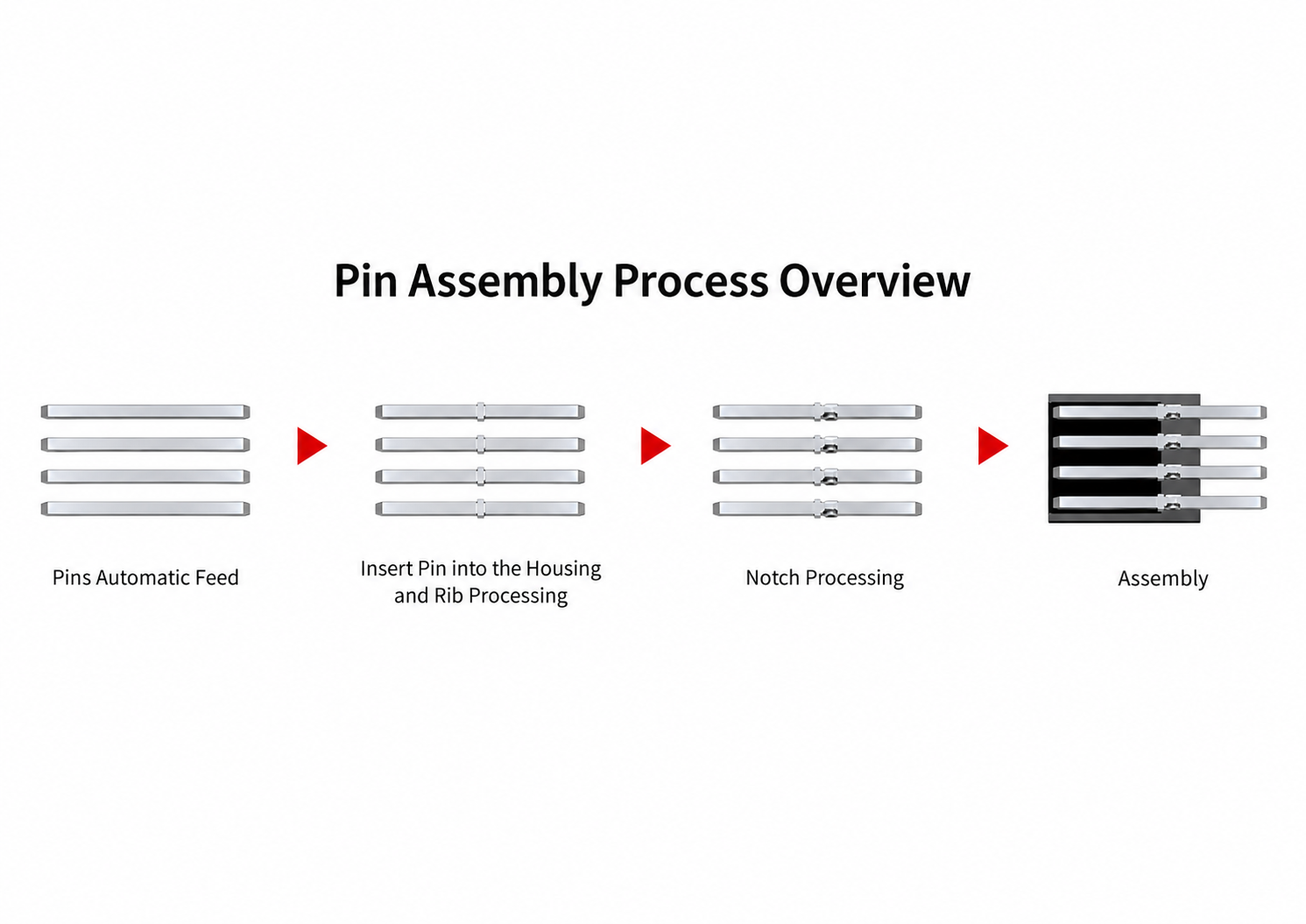
One example is supplying straight pins instead of pins that have already been processed into their final shapes.
Because straight pins have no specific top, bottom, left, or right orientation, they do not need to be oriented in a particular direction during feeding. After the pins are aligned inside a dedicated machine, additional processes such as bending and rib forming are performed according to the product specifications to achieve the required shape.
Rather than completing all shaping operations during the pin manufacturing stage, the necessary processing steps can be incorporated into automated machinery, allowing pin feeding, processing, and insertion to be organized as a continuous sequence of operations.
Process | When Supplying Fully Formed Pins | Straight Pins + Dedicated Machine |
Pin feeding | Pin orientation must be controlled according to the geometry | Pins can be supplied without requiring a specific top, bottom, left, or right orientation |
Bending and rib forming | Performed during pin manufacturing | Pins are processed into the required shapes inside a dedicated machine |
Handling multiple pins | Pins are processed at each separate stage | Multiple pins can be processed and inserted together |
Housing insertion | Performed as a separate process after pin processing | Processing and insertion can be integrated into a continuous operation |
■ From Automatic Pin Feeding to Housing Insertion
Our headquarters in Japan designs and develops automated machinery that handles processes ranging from automatic pin feeding and additional processing to insertion into housings.
The main processes that can be automated include:
- Automatic pin alignment and feeding
- Bending
- Rib forming
- Notch forming
- Insertion and assembly into housings
Rather than performing each operation separately, these processes can be integrated into a single automated machine according to the product specifications, enabling processing and assembly to be carried out as a continuous sequence.
■ Simultaneous Processing and Insertion of Multiple Pins
For connectors that use multiple pins, it is also possible to process and insert several pins together instead of handling them individually.
Matsuda supports a method in which multiple straight pins are aligned as a set and then simultaneously processed and inserted using a dedicated machine.
Processing multiple pins under the same conditions makes it easier to maintain consistent processing conditions compared with handling pins individually, contributing to more stable quality. Processing several pins at once can also help shorten overall processing time.
A key feature of our automation proposals is the ability to design processes that consider not only the shape of the pins themselves but also "how many pins should be processed, how they should be processed, and how they should be inserted into the housing."
■ Automation Proposals from Japan Headquarters and Matsuda (Thailand)
Our headquarters in Japan is responsible for the design and development of automated machinery, while Matsuda (Thailand) handles terminal and pin production in Thailand and provides local customer support.
By combining the automated machinery design and development technology of our Japanese headquarters with pin production and support capabilities in Thailand, we can propose process improvements that extend beyond the supply of terminals and pins to include subsequent processing, insertion, and assembly operations.
If your current assembly process involves handling pins individually, performing bending or rib forming as separate operations, or considering automation of the housing insertion process, you can consult us about improvement methods from both the pin geometry and automated machinery perspectives.
If you are considering solutions ranging from connector terminal and pin manufacturing to automation of subsequent processes, please contact Matsuda (Thailand) for further information.
■ Frequently Asked Questions
Q1: Can you propose automation solutions for connector assembly processes? A1: Yes. By combining the automated machinery design and development technology of our headquarters in Japan with Matsuda (Thailand)'s pin production and local customer support, we can propose solutions covering automatic pin feeding, additional processing, and insertion and assembly into housings.
Q2: Can straight pins be bent inside a dedicated machine? A2: Yes. We support a method in which straight pins are supplied and then processed through bending, rib forming, or other required operations inside a dedicated machine before being inserted into the housing.
Q3: Can rib forming and notch forming also be automated? A3: Yes. In addition to automatic pin feeding and housing insertion, we can propose automation solutions that incorporate rib forming and notch forming operations.
Q4: Can multiple pins be processed and inserted simultaneously? A4: Yes. We support methods in which multiple pins are aligned as a set and processed and inserted simultaneously. Processing multiple pins under the same conditions helps maintain stable quality and shorten processing time.
※For more details, please download the attached materials or contact us via the form below.
Company Information

Transportation equipment / Electrical component for transportation equipment / Electronic parts
Header pin / Connector Assembly / Cold forged product
Matsuda (Thailand) Co., Ltd. manufactures and supplies precision metal components, with a particular focus on connector pins and header pins. Building on the precision machining technology and experti ...
PICKUP
Technology & Services
CONTACT
Contact