
SERVICES
Technology & Services
【Mass Production of Connector Terminals and Connector Pins in Thailand】Integrated Proposals from Header Forming and Process Conversion to Assembly Automation
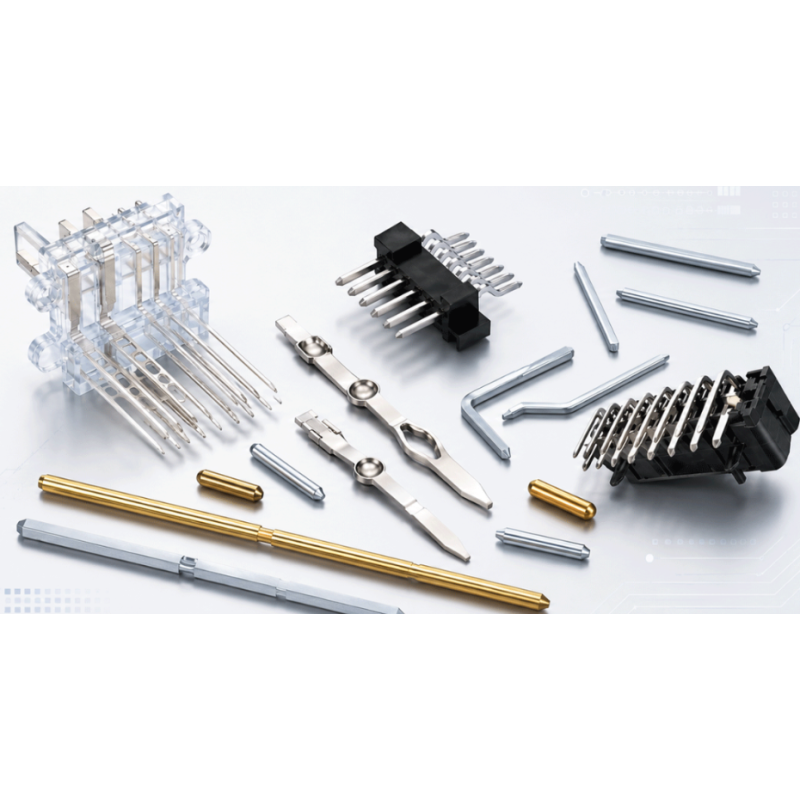
Matsuda (Thailand) Co., Ltd., based in Chonburi Province, Thailand, produces connector terminals and connector pins using header forming.
In addition to manufacturing straight pins and various bent pins, we can propose design changes from the drawing stage when converting from press forming or machining to header forming. We also work with our headquarters in Japan, which has automated machine design and development capabilities, to propose automation covering downstream processes such as pin insertion, additional processing, and assembly.
Table of Contents
- What Is Header Forming? Key Features
- Supported Pin Sizes, Materials, and Shapes
- Examples of Pins We Can Manufacture
- Process Conversion from Press Forming and Machining to Header Forming
- From Pin Manufacturing to Assembly Process Automation
- Production and Quality Systems in Thailand
- Frequently Asked Questions
- Glossary
■ What Is Header Forming? Key Features
Header forming is a processing method in which high pressure is applied to wire material and the material is plastically deformed using dies. Compared with machining and press forming, it tends to generate less material loss, and we achieve a material yield of more than 99%.
Pre-plated wire materials can also be processed, making it possible, depending on the specifications, to eliminate the plating process after forming. This allows customers to review not only material consumption but also processing costs associated with downstream processes.
Finished pins can also be cut and packed in boxes, which in many cases helps reduce shipping volume compared with reel-based stamped products.
■ Supported Pin Sizes, Materials, and Shapes
Whether header forming is suitable is evaluated based on wire size, material, shape, plating specifications, and other requirements.
Item | Supported Range |
Supported sizes | Round wire Φ0.09~2.5mm / Square wire □0.09~2.5mm |
Materials | Brass, copper alloys, phosphor bronze, stainless steel, Kovar, nickel-iron alloys |
Plating | Tin, gold, silver, pre-plated materials |
Main shapes | Straight, tapered, L-bent, crank-bent, offset-bent, notched, ribbed, press-fit |
We can handle a wide range of wire diameters, materials, and plating specifications, but actual manufacturability depends on the shape and required specifications. If an existing drawing is available, we review it and evaluate its suitability for header forming.
■ Examples of Pins We Can Manufacture
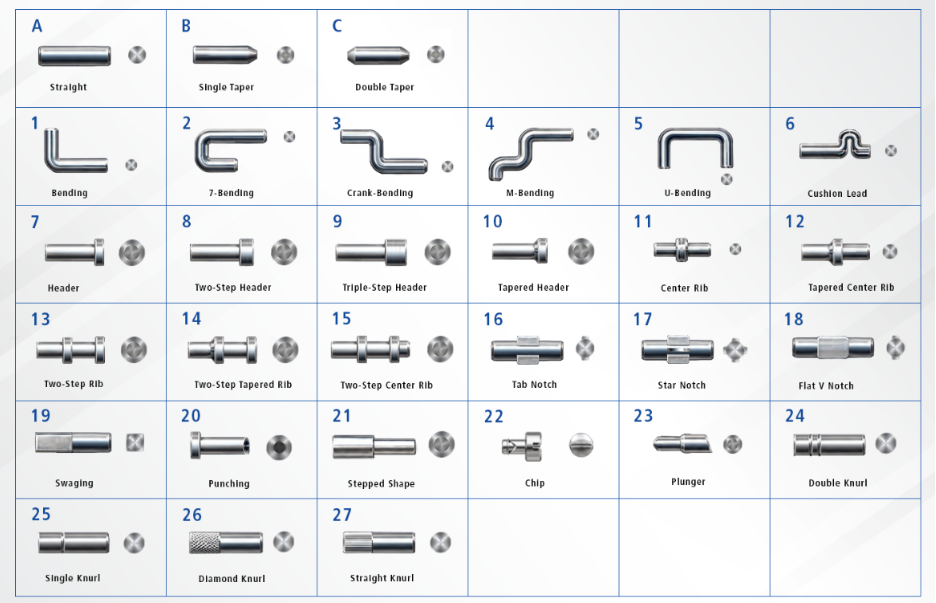
Matsuda (Thailand) manufactures a variety of connector terminals and pins, ranging from straight shapes to various bent configurations.
Examples include straight tapered pins, round straight pins, header pins with tapered tips, L-bent pins, crank-bent pins, offset-bent pins, notched pins, and press-fit pins with ribs and notches.
We have experience using materials such as C2600W, C1100W, SUS304W, and C2700W, and can also accommodate specifications including tin reflow, post-tin plating, and gold plating.
■ Process Conversion from Press Forming and Machining to Header Forming
Terminals and pins currently manufactured by press forming or machining can also be considered for conversion to header forming. However, drawings designed around these existing processes may not be suitable for header forming without modification.
Matsuda (Thailand) reviews existing drawings and proposes shape changes suitable for header forming. Features such as tapers and ribs can also be added to revise the design into a shape more suitable for mass production. After confirming whether such shape changes are feasible, we evaluate the appropriate manufacturing method while considering material yield, plating processes, dies, logistics, and downstream automation.
■ From Pin Manufacturing to Assembly Process Automation
Matsuda proposes automation covering not only the production of connector terminal pins but also subsequent alignment, additional processing, and insertion into housings. Our headquarters in Japan designs and develops dedicated automated machines for downstream processes, while Matsuda (Thailand) handles pin production and local support in Thailand.
For example, instead of supplying pins in their final processed shape, straight pins that do not depend on vertical or horizontal orientation can be supplied, with bending, rib forming, and other processing carried out inside a dedicated machine installed at the customer's factory. Supplying pins in a straight configuration makes them easier to align and feed, after which additional processing and insertion into the housing can be performed within the automated machine.
In addition, multiple pins can be aligned and processed or inserted simultaneously. Compared with processing pins one at a time, this makes it easier to maintain consistent processing conditions, contributing to more stable quality and shorter process times.
■ Production and Quality Systems in Thailand
Matsuda (Thailand) operates a production base in Chonburi Province, Thailand, and is certified to ISO 9001. We are also working toward IATF 16949 certification, with certification targeted for 2027.
Our headquarters in Japan is responsible for the design and manufacture of header machines and dies, while Matsuda (Thailand) handles mass production of terminals and pins, basic equipment maintenance, and local customer support. By combining equipment and die technologies developed in Japan with our production and support capabilities in Thailand, we can support projects from product launch through mass production.
If you are considering mass production of connector terminals or connector pins in Thailand, conversion to header forming, or automation of downstream processes, please contact us.
■ Frequently Asked Questions
Q1: What pin sizes can you handle?
A1: We can handle round wire from Φ0.09~2.5mm and square wire from □0.09~2.5mm. Actual manufacturability is evaluated based on the material, shape, and required specifications.
Q2: What materials can you handle?
A2: We handle brass, copper alloys, phosphor bronze, stainless steel, Kovar, and nickel-iron alloys.
Q3: Can you also handle plating?
A3: We can accommodate tin, gold, and silver plating. Header forming using pre-plated materials is also possible.
Q4: Can you manufacture shapes other than straight pins?
A4: Yes. In addition to straight pins, we have manufacturing experience with L-bent, crank-bent, offset-bent, tapered, notched, ribbed, and press-fit products.
Q5: Can parts currently manufactured by press forming or machining be converted to header forming?
A5: Conversion can be considered. However, existing drawings may not be suitable for header forming as they are. We review the drawing and, where necessary, propose shape changes such as adding tapers or ribs.
■ Glossary
- Terminal pin: A metal component that provides an electrical connection inside a connector
- Connector pin: A pin-shaped component that forms the contact point of a connector
- Header forming: A processing method in which pressure is applied to wire material and the material is plastically deformed using dies
- Cold heading: A forming method in which pressure is applied to material at or near room temperature without heating
- Pre-plated material: Wire material that has already been plated before the forming process
- Press-fit: A terminal configuration that connects to a circuit board or other component by press-fitting
※For more details, please download the attached materials or contact us via the form below.
Company Information

Transportation equipment / Electrical component for transportation equipment / Electronic parts
Header pin / Connector Assembly / Cold forged product
Matsuda (Thailand) Co., Ltd. manufactures and supplies precision metal components, with a particular focus on connector pins and header pins. Building on the precision machining technology and experti ...
PICKUP
Technology & Services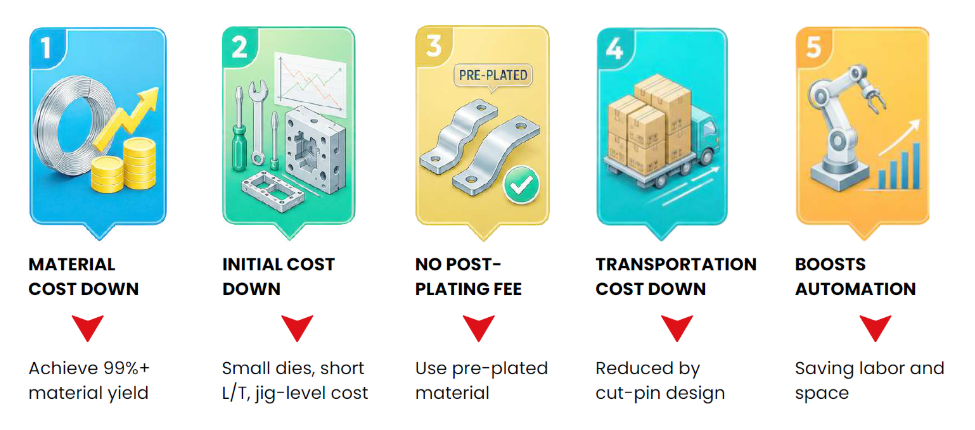
CONTACT
Contact