


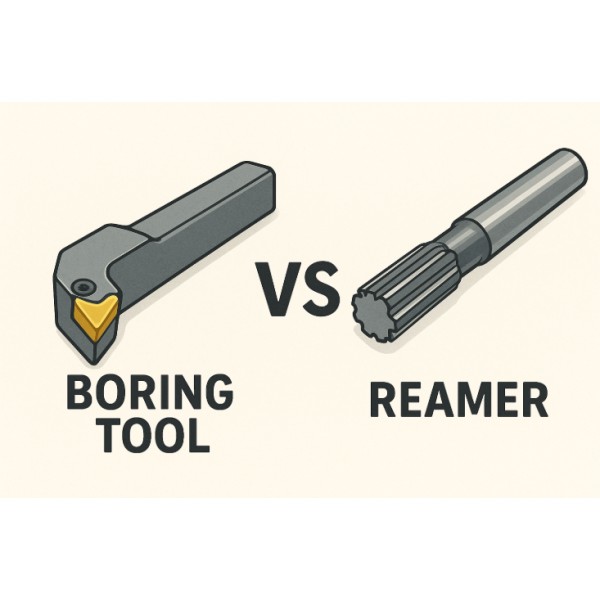
Comparison: Boring Tool vs. Reamer – When Should You Use Each?
Although both tools are used for sizing existing holes, the boring tool and reamer each have distinct characteristics and advantages suited for different tasks. Selecting the right tool can help achieve greater accuracy, lower costs, and enhance manufacturing efficiency.
■ Introduction: What Are Boring Tools and Reamers?
• Boring Tool
A boring tool is a cutting tool used for boring or enlarging pre-drilled holes. It can precisely adjust hole diameter and correct the hole’s center position. It is suitable for both rough boring and fine boring operations.
• Reamer
A reamer is used for finishing the interior surface of an already drilled or bored hole. It has multiple cutting edges arranged around the tool, providing a smooth surface finish and micron-level accuracy. It’s ideal for final finishing work that requires high smoothness.
■ Key Feature Comparison
▪️ Dimensional Accuracy
* Reamer: Highly accurate, within ±0.005 mm. Best for holes that do not require center correction but demand a fine surface finish.
* Boring Tool: Also offers high accuracy and allows for fine adjustment—typically in increments of 0.01 mm or even finer for precision work.
▪️ Hole Centering Control
* Boring Tool: Can correct holes that are misaligned or off-center.
* Reamer: Cannot correct hole center. Should only be used for holes that are already well-centered.
▪️ Surface Finish
* Reamer: Produces a consistently smooth and fine finish, ideal for parts requiring tight fits.
* Boring Tool: Can also produce a good finish, but results depend on the cutting edge and machine settings.
▪️ Adjustable Sizing
* Boring Tool: Offers great flexibility, as the cutting diameter can be adjusted as needed.
* Reamer: Fixed size; multiple reamers are required for different hole sizes.
■ When to Use Each Tool? Choose for the Job
* If the drilled hole is off-position or not perfectly centered:
→ Use a boring tool, as it can correct the hole’s center.
* If the hole requires a highly smooth internal surface:
→ Use a reamer; its fine cutting edges provide a very uniform finish.
* If you need flexibility to adjust hole size or are working with various hole diameters:
→ Use a boring tool, since it allows for easy diameter adjustments.
* If you are mass-producing parts with the same hole size:
→ Use a reamer for fast, consistent, and precise results.
* If the job demands both high dimensional and surface accuracy:
→ Use a boring tool for rough sizing, then follow with a reamer for final finishing.
■ Practical Summary
* Boring tools are ideal for tasks that require size adjustment, center correction, and precise cutting control.
* Reamers are perfect for the final finishing step to achieve exact size and superior surface finish.
* For ultimate precision, it is often best to bore the hole first, then ream it for the best possible finish and accuracy.
Choosing the right tool according to the hole’s characteristics and job requirements will improve product quality, reduce scrap rates, and extend tool life.
CONTACT
Contact FormCompany Information
Jigs and tools
Turning Tools / Rotary Tools / Drilling Tools
Mitsubishi Materials carbide tools provide innovative cutting tools and solutions to customers worldwide.