


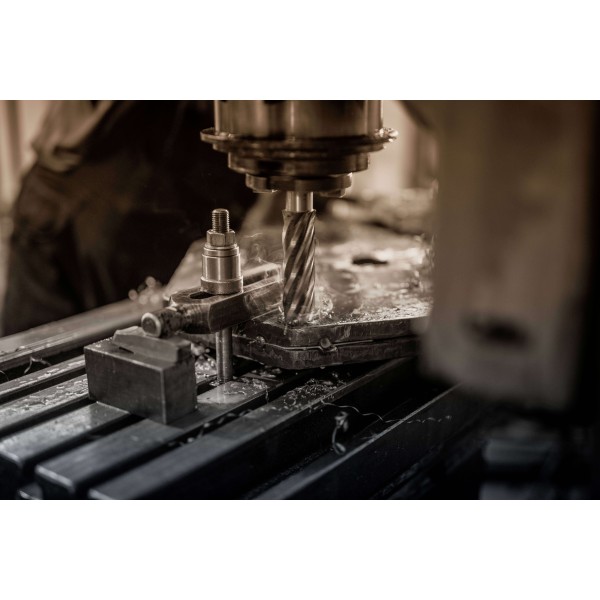
Differences and Applications of Turning, Milling, and Drilling
1. What is Machining?
Machining is a technology that processes the shape and dimensions of materials such as metals and resins using methods like cutting and grinding. With the advancement of automation through CNC (Computer Numerical Control), and the current demand for high-precision and high-efficiency processing, the selection of machining methods has become a crucial factor in terms of both quality and cost. Among these, the three representative machining methods are "turning," "milling," and "drilling."
2. Characteristics and Applications of Turning
Turning is a machining method that shaves material by applying a fixed cutting tool (lathe tool) while rotating the workpiece. It uses a lathe and is suitable for machining cylindrical shapes such as shafts.
Main Applications:
- Finishing of outer and inner diameters
- Facing
- Stepped machining and taper machining of cylindrical parts
Features:
- High concentricity can be achieved for symmetrical shapes
- High machining efficiency, suitable for mass production
- Continuous machining of outer diameter, inner diameter, and face is possible
Points to Note:
- Not suitable for non-rotationally symmetrical shapes
- Consideration for tool wear and thermal deformation is necessary
3. Characteristics and Applications of Milling
Milling is a method where the workpiece is fixed, and cutting is performed with a rotating milling cutter. It is a highly versatile machining method that can handle not only surface machining but also groove and contour machining.
Main Applications:
- Surface finishing
- Keyway machining, T-slot machining
- Machining of parts with irregular shapes or steps
Features:
- Complex shapes can be machined with multi-axis control (especially with machining centers)
- High-efficiency machining is possible by optimizing cutting conditions
- Good chip evacuation and easy to extend tool life
Points to Note:
- Setup tends to be complex
- Machining quality tends to vary depending on tool selection and cutting conditions
4. Characteristics and Applications of Drilling
Drilling is one of the most basic machining methods, using a drill tool to create holes perpendicularly in a workpiece. It is frequently used for pilot holes and mounting holes.
Main Applications:
- Through-hole machining for bolt holes, pin holes, etc.
- Pilot hole machining before reaming
- Creation of center holes
Features:
- Simple structure and efficient
- Low machining cost, wide variety of tools
- Easy to mechanize and automate
Points to Note:
- Limitations in the accuracy of hole depth and diameter
- For deep holes, attention to chip evacuation and runout is necessary
- High-precision holes may require post-processing (reaming, boring, etc.)
5. Selection of Machining Methods and Process Design Philosophy
The selection of machining methods is not merely based on shape and dimensions but requires consideration of the overall balance of the process design. In most cases, multiple machining methods are combined to complete a part, and the following perspectives are important:
- Select machining methods suitable for the workpiece material and shape
- Set the process sequence according to machining accuracy and tolerances
- Understand equipment capabilities (lathes, machining centers, drilling machines, etc.)
- Setup with an awareness of reducing man-hours and improving yield
For example, a common flow involves performing outer diameter machining by turning, followed by side machining by milling in the next step, and finally creating screw holes by drilling. This achieves both stable quality and improved productivity.
CONTACT
Contact FormCompany Information

Machine Tools / Electronics Products / Watches
Our precision metal parts processing technology is centered on the manufacturing of parts through cutting, a technique cultivated in the processing of watch components. In addition, we provide compreh ...