


How Does a Cold Roll Former (CRF) Work
🌟 Key Takeaways
• Cold Roll Former (CRF) is a metal forming process that uses rolling without heat treatment
• Reduces post-machining processes, minimizes material loss, and improves metal utilization efficiency
• Suitable for round parts, thin-wall components, and complex-shaped products
• Supports mass production with consistent quality across all parts
ーーーーーーーーーーーーーーーーーーーーーーーーーーーーーーー
In the automotive and machinery industries, many components require high dimensional accuracy while
maintaining controlled cost per unit. Cold Roll Former (CRF) is a forming process adopted to address these
requirements by reducing machining operations and improving material efficiency.
🔷 What Is CRF
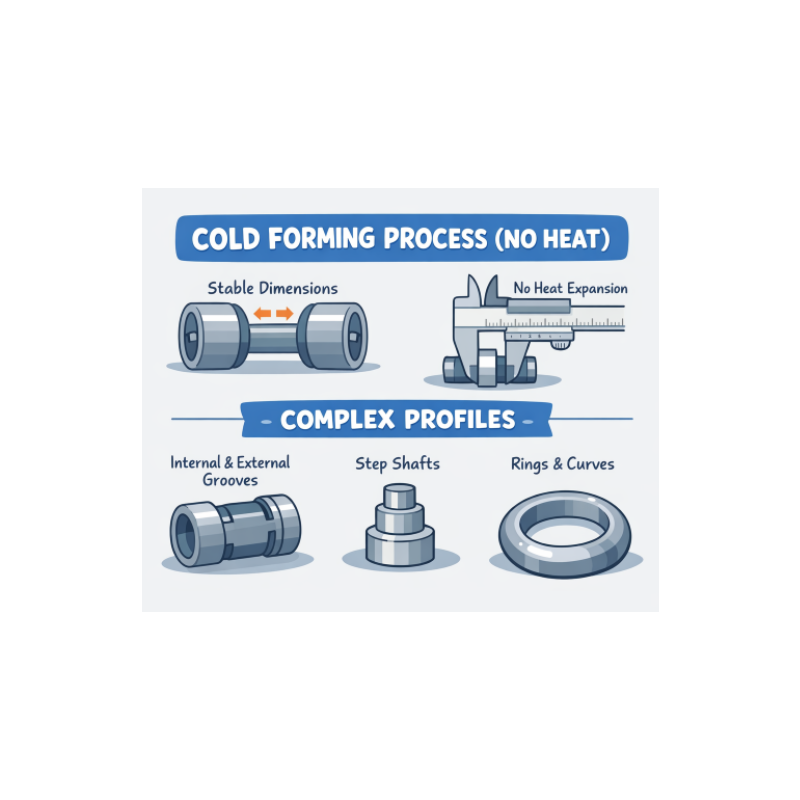
Cold Roll Former is a cold metal forming process that does not use heat. Pre-formed metal materials are fed into a
set of rollers with specially designed profiles, which gradually shape the workpiece into the required final geometry.
🔷 Operating Principle of Cold Roll Former
Cylindrical rollers progressively roll and reshape the workpiece from its initial dimensions to the final size in a
continuous process. Instead of removing material, CRF relies on controlled metal flow to create the desired
geometry.
Key characteristics of the process include:
• Continuous metal flow throughout the forming operation
• No cutting or drilling as in machining processes
The result is a component with high consistency in both inner diameter (ID) and outer diameter (OD).
🔷 Dimensional Accuracy Control
Because no heat is applied, thermal expansion or contraction of the metal is minimal, resulting in highly stable
dimensional control. In addition, roller profiles can be designed to accommodate complex geometries such as:
• Internal and external grooves
• Stepped profiles
• Ring-shaped or cylindrical forms
This significantly reduces the need for post-forming machining operations.
🔷 Application Suitability
CRF is suitable for parts that require high precision and repetitive high-volume production. However, it is not ideal
for low-volume production or frequent design changes. Designing components to match the CRF process from the
initial stage helps maximize its benefits.
📘 Summary
Cold Roll Former is a cold metal forming process that emphasizes forming rather than cutting. It reduces material
waste, improves dimensional accuracy, and ensures production consistency for industrial components.
To further expand your understanding, Daido Steel (Thailand) Co., Ltd., with experience in metal forming
processes, recommends exploring related Advance Knowledge topics or consulting the production engineering
team for practical applications.
ーーーーーーーーーーーーーーーーーーーーーーーーーーーーーーー
❓ FAQ
Q: How is CRF different from machining?
A: CRF forms parts by rolling without removing material, reducing material loss and providing better surface and
dimensional consistency.
Q: What types of parts are suitable for CRF?
A: Cylindrical components such as donut-shaped parts, tubes, and rings, as well as thin-wall or complex-grooved
parts requiring high precision.
📚 Glossary (Key Terms)
• Cold Roll Former (CRF): A cold metal forming process using rollers at room temperature
• Cold Forming: Metal forming without heat application
• ID (Inner Diameter): The internal diameter of a component
• OD (Outer Diameter): The external diameter of a component
• Dimension Accuracy: The precision of part dimensions
📖 Reference
Company Profile & CRF Process Overview – Daido Steel (Thailand) / Engineering Department (N/A) — Internal
Validation
🔒 Trust
This content has been reviewed by Daido Steel (Thailand) Co., Ltd. to confirm the academic and technical
accuracy of the information.
#ColdRollFormer #CRF #ColdForming #MetalForming #ManufacturingIndustry
#PrecisionParts #DimensionAccuracy #ReducedMachining #MetalProcessing #ManufacturingProcess
📆 Updated: 2025-12-18
📆 Updated: 2025-12-18
CONTACT
Contact FormCompany Information
Industry Classification
Industrial machinery
Main 3 Products
die forgings / Support for companies expanding into TH
Phone Number
Homepage URL
Manufacturing and sales of die forgings