Reducing Downtime from Frequent Relubrication: Component Selection for Stable Equipment Utilization in Thailand
On manufacturing floors in Thailand, line shutdowns associated with frequent relubrication and component replacement are critical factors that suppress overall production efficiency and equipment utilization rates. Mechanical components, particularly in rotating and sliding sections, serve as pivotal elements directly determining maintenance frequency and the duration of unplanned downtimes. What analytical perspective should engineers adopt when choosing mechanical components to mitigate maintenance requirements and guarantee highly stable operations?
Table of Contents
The Dilemma of "Line Downtime Costs" Facing Manufacturing Floors
How Relubrication and Component Replacement Affect Equipment Utilization Rates
Technological Approaches to Achieving Maintenance-Free Performance
The "Total Cost of Ownership" Concept to Consider in Component Selection
What IKO THOMPSON ASIA Can Do
Frequently Asked Questions (FAQ)
Key Terminology in This Article
■ The Dilemma of "Line Downtime Costs" Facing Manufacturing Floors
On Thai manufacturing floors, unexpected equipment failure and downtime represent a major risk factor that dramatically impairs throughput. Particularly, the lifecycle of essential rotating and sliding mechanical parts dictates the functional limit of equipment utilization. While shop managers understand the value of preventative maintenance, short-term budget constraints often lead to the procurement of cheaper components that demand continuous lubrication. Over time, when line downtime expenses and secondary labor costs are fully tabulated, they frequently dwarf any minor savings achieved during initial part acquisition.
■ How Relubrication and Component Replacement Affect Equipment Utilization Rates
Selecting components based strictly on the upfront purchase price exposes high-mix or high-volume lines to long-term utilization hazards. For instance, traditional moving parts that require manual grease management can wear out prematurely if a scheduled relubrication cycle is missed. In Thailand's harsh shop environments, the intrusion of ambient dust and elevated moisture further accelerates mechanical wear. Because a high frequency of maintenance directly translates to more frequent plant line shutdowns, evaluating a component's capacity to minimize manual servicing during the design stage becomes a crucial decision parameter.
■ Technological Approaches to Achieving Maintenance-Free Performance
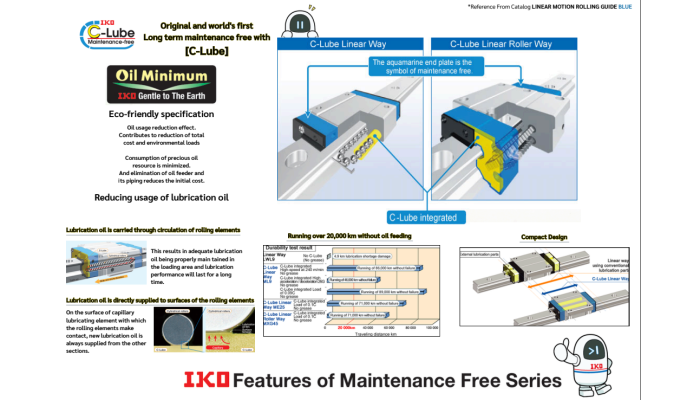
To radically lower maintenance workloads, deploying self-lubricating "maintenance-free" components on critical machine axes has proven highly effective. For example, IKO's proprietary "C-Lube" technology integrates capillary-action lubricating elements directly inside linear ways and needle roller bearings, maintaining stable lubrication performance over extended operation. This self-contained structure eliminates the need for complex external lubrication piping, simplifies initial machine design, and completely eradicates the ongoing labor of manual grease replenishment.
■ The "Total Cost of Ownership" Concept to Consider in Component Selection
Shifting the component evaluation standard from "per-unit cost" to "total cost of ownership" is key to unlocking sustainable profitability. Although standard components may appear inexpensive initially, repeated shutdowns for lubrication and replacement accumulate massive financial penalties over a machine's lifetime. Conversely, long-life, maintenance-free parts minimize downtime, extending substitution intervals. The resulting reduction in line stoppages frees up valuable personnel hours and machine capacity, providing a concrete path to enhanced production output.
■ What IKO THOMPSON ASIA Can Do
IKO THOMPSON ASIA CO., LTD. supplies a broad catalog of advanced motion components embedded with our maintenance-free C-Lube technology, successfully eliminating manual greasing workloads even under harsh industrial conditions to minimize line downtime. The company provides detailed product specifications, selection methodologies, and technical insights regarding maintenance-free technologies.
※For detailed information, please contact us directly.
■ Frequently Asked Questions (FAQ)
Q. How much can we expect to reduce our maintenance frequency by introducing maintenance-free motion components?
A. While precise intervals depend on the specific operation profile, our internal durability evaluations demonstrate that these parts can endure over 20,000 km of travel without external relubrication.
Q. What is the fundamental mechanism behind C-Lube lubrication technology?
A. It is a technical design where a lubricant-impregnated component is placed inside the bearing or linear way. By continuously supplying micro-amounts of oil to the rolling elements, it ensures long-term performance and completely eliminates manual greasing tasks.
■ Key Terminology in This Article
C-Lube : IKO's proprietary lubrication technology that holds oil internally to achieve long-term, maintenance-free performance.
Total Cost of Ownership : The comprehensive cost assessment including initial part price, secondary maintenance expenses, and line downtime losses.
Maintenance-Free : A mechanical design allowing continuous, stable component operation without the need for periodic manual lubrication.
※For detailed information, please contact us directly.