_3b6a9329-60a8-415a-934a-e9e2c353feb2.png)
SERVICES
Technology & Services
【Metallic Finishes Without Painting】Reduce Costs and Environmental Impact with High-Brightness Aluminum Masterbatch
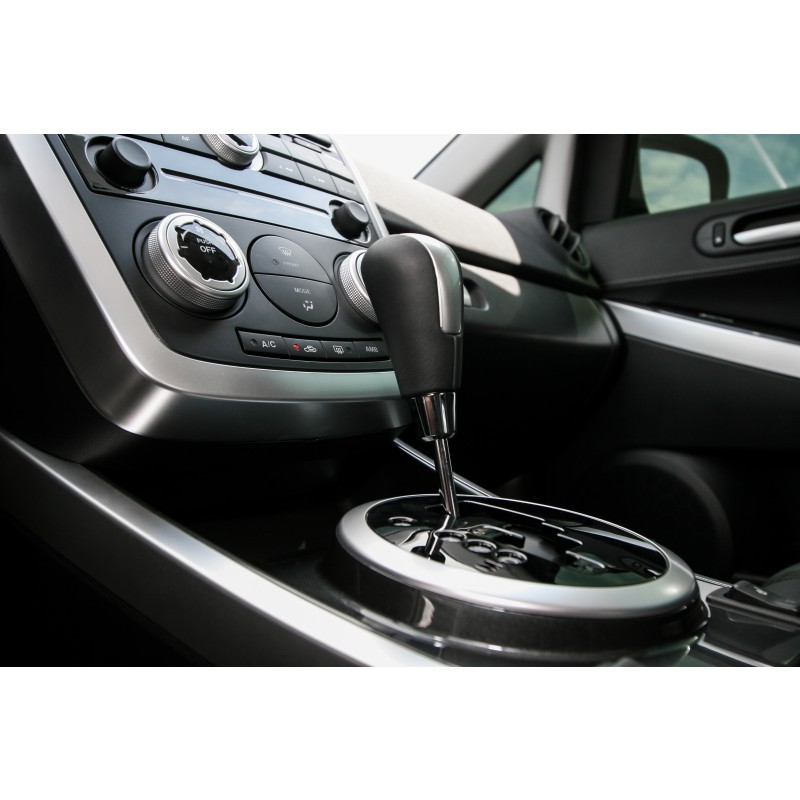
Painting and plating are widely used to give plastic molded parts a metallic appearance. However, these secondary finishing processes often increase manufacturing costs and add complexity to production. They also create environmental management requirements, including the use of organic solvents and the treatment of wastewater.
Many manufacturers are therefore looking for ways to achieve an attractive, metal-like finish while reducing or eliminating painting and plating processes.
This article explains how high-brightness aluminum masterbatch can be incorporated directly into plastic resin to create a metallic appearance during molding. It also outlines the key factors that can help reduce manufacturing costs and environmental impact.
Table of Contents
- The Cost and Environmental Burden of Painting and Plating
- Production Efficiency and Appearance Challenges in Metallic-Finish Parts
- Creating Metallic Finishes by Incorporating High-Brightness Aluminum Directly into Resin
- Particle Size Options for Fine Metallic Finishes and More Pronounced Sparkle Effects
- Cost and Environmental Benefits of Paint-Free Molding
- Highly Dispersed, High-Concentration Aluminum Masterbatch from RESINO COLOR INDUSTRY CO., LTD.
- Frequently Asked Questions
- Key Terms Used in This Article
■ The Cost and Environmental Burden of Painting and Plating
Painting and plating have long been used for automotive interior and exterior components, home appliances, and consumer products to give plastic molded parts a premium metallic luster.
However, these finishing processes involve a range of expenses, including paints, chemicals, line maintenance, and labor. Paint booths, drying processes, and plating equipment must also be managed separately from molding operations, increasing the overall complexity of production.
Dust and other contaminants may adhere to the surface during processing, causing appearance defects and reducing yield. Manufacturers must also manage environmental compliance requirements, including VOC emissions from organic solvents and the treatment of wastewater generated by plating processes.
■ Production Efficiency and Appearance Challenges in Metallic-Finish Parts
One reason painting and plating can limit production efficiency is that they must be carried out as separate processes after injection molding.
Molded parts must be transferred to painting or plating lines and then pass through several stages, including fixture loading, processing, drying, and inspection. These additional steps extend production lead times and require space for storing work in progress.
For parts with complex shapes, deep bosses or ribs, or finely textured surfaces, paint may not coat the entire surface evenly, while plating thickness may vary. These factors can make it difficult to maintain consistent appearance quality.
Depending on the conditions of use, coatings may also peel over time, while plated layers may deteriorate through wear. Maintaining long-term appearance quality is therefore another challenge associated with secondary finishing processes.
■ Creating Metallic Finishes by Incorporating High-Brightness Aluminum Directly into Resin
One way to address these issues is to incorporate high-brightness aluminum masterbatch directly into the molding resin, creating a metallic appearance during injection molding without the need for painting.
Because the metallic finish is formed during molding, secondary processes such as painting and plating can be eliminated. Reducing the number of production steps can shorten lead times, lower processing costs, and simplify work-in-progress management.
Uniform dispersion of the aluminum flakes is essential for high-brightness aluminum masterbatch. Poor dispersion may lead to particle agglomeration, uneven appearance, or a rough surface.
RESINO COLOR INDUSTRY CO., LTD. provides masterbatch in which aluminum flakes are evenly dispersed throughout the resin using proprietary formulation and dispersion technologies. This helps make coarse particles less noticeable on the molded surface and produces a smooth metallic appearance similar to a painted finish.
■ Particle Size Options for Fine Metallic Finishes and More Pronounced Sparkle Effects
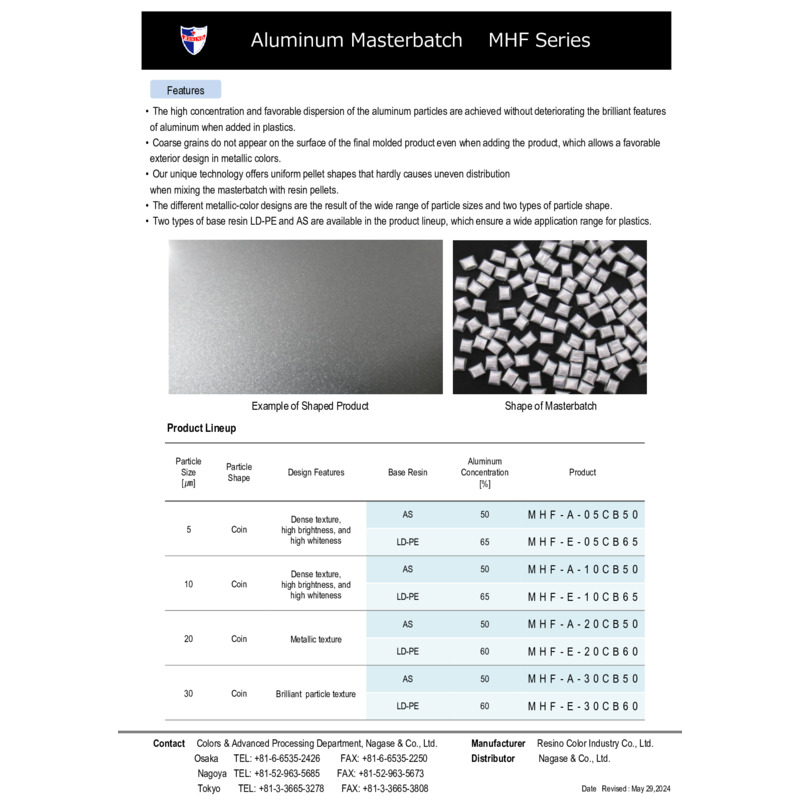
High-brightness aluminum masterbatch can be formulated with different aluminum flake sizes according to the desired appearance. Options range from a fine metallic finish with high whiteness to designs that emphasize particle definition, sparkle, and brightness.
■ Particle Size Options for High Brightness Aluminum Masterbatch
| Design Features / Appearance Characteristics | Base Resin | Aluminum Content (%) |
5 | Delivers a fine metallic appearance with high brightness and high whiteness. | AS Resin (Acrylonitrile-Styrene Resin) | 50 |
LDPE Resin (Low-Density Polyethylene Resin) | 40 | ||
10 | Suitable for metallic finishes with an excellent balance of fine metallic texture and brightness. | AS Resin (Acrylonitrile-Styrene Resin) | 50 |
LDPE Resin (Low-Density Polyethylene Resin) | 40 | ||
20 | Suitable for applications requiring a more pronounced metallic appearance. | AS Resin (Acrylonitrile-Styrene Resin) | 50 |
LDPE Resin (Low-Density Polyethylene Resin) | 40 | ||
30 | Suitable for designs that emphasize particle texture and brilliance. | AS Resin (Acrylonitrile-Styrene Resin) | 50 |
LDPE Resin (Low-Density Polyethylene Resin) | 40 |
■ Cost and Environmental Benefits of Paint-Free Molding
Using high-brightness aluminum masterbatch to transition to paint-free molding allows manufacturers to review and simplify several aspects of their production processes.
First, reducing processes associated with painting and plating lines can lower process management costs, equipment maintenance expenses, energy consumption, and labor costs. Transportation, fixture loading, drying, and inspection processes can also be reduced, helping to shorten production lead times and decrease work in progress.
Paint-free molding can also reduce common causes of appearance defects, such as dust contamination, uneven coating, and variations in plating thickness. This may improve the percentage of acceptable parts while reducing the time required for inspection and rework.
From an environmental perspective, reducing painting and plating processes can lower the use of organic solvents, VOC emissions, and the burden of treating plating wastewater. Reduced operation of paint booths and drying ovens may also decrease energy consumption and CO2 emissions.
Paint-free molding is therefore a practical option for reviewing manufacturing processes from both cost and environmental perspectives.
■ Highly Dispersed, High-Concentration Aluminum Masterbatch from RESINO COLOR INDUSTRY CO., LTD.
RESINO COLOR INDUSTRY CO., LTD. specializes in dispersion technologies for uniformly incorporating a wide range of pigments and high-performance fillers into resins and liquids.
The company’s high-brightness aluminum masterbatch contains aluminum particles at concentrations of up to 50% while retaining the natural beauty and metallic luster of aluminum. Despite the high concentration, the masterbatch is designed for convenient handling during molding and supports a consistent appearance in the finished part.
■ Frequently Asked Questions
Q1. What types of resin can be used?
A1. The standard product range includes masterbatches based on AS resin and LD-PE resin. Formulations for other engineering plastics and specialty resins can be developed individually after compatibility with the base resin has been confirmed. Please contact the technical consultation service for further details.
Q2. Will weld lines be noticeable on the molded part?
A2. Weld lines may become more visible when injection molding resins that contain metallic powders. Because the aluminum flakes in the company’s masterbatch are finely and evenly dispersed, it is easier to reduce orientation irregularities and appearance variations than when conventional aluminum powder is added directly to the resin. Adjusting molding conditions such as mold temperature and injection speed can also help minimize the effect on appearance.
Q3. Is it possible to achieve brightness and gloss similar to a painted finish?
A3. Fine, coin-shaped aluminum flakes with particle sizes of 5–10 μm can create a refined metallic appearance with high brightness. When combined with a mirror-finished mold surface and suitable molding conditions, they can produce a smooth texture similar to a painted finish.
However, the final appearance will vary depending on the resin, part geometry, mold surface, addition rate, and molding conditions. Prototype production and evaluation based on the actual product specifications are therefore recommended.
■ Key Terms Used in This Article
- Masterbatch: A pelletized material in which pigments or other additives are incorporated into resin at a high concentration. It is blended with the base resin at a specified ratio before molding.
- High dispersion: A technology used to distribute fine particles, such as metal powders and pigments, evenly throughout a resin without allowing them to agglomerate. It is important for reducing variations in appearance and physical properties.
- Paint-free molding: A molding method in which the material itself provides the required color and appearance, eliminating secondary processes such as painting or plating. This helps reduce production steps and environmental impact.
- High-brightness aluminum flakes: Aluminum particles that reflect light effectively and create a metallic appearance. By selecting the appropriate particle size and shape, manufacturers can produce finishes ranging from fine metallic effects to more pronounced sparkle and brightness.
※If you are reviewing the costs and environmental impact associated with painting or plating, or are considering paint-free molding to create a metallic appearance, please contact RESINO COLOR INDUSTRY CO., LTD.
Company Information
Colorants / Functional Materials
Since its establishment in 1928, Reginocolor Industry Co., Ltd. has upheld the philosophy of “One Color, One Heart” while continuously refining the advanced dispersion technologies developed through i ...
CATALOG
Related Catalogs
PICKUP
Technology & Services
CONTACT
Contact