_a406b398-c083-44ed-9e0e-5bed44afda38.png)
NISSEI INTERNATIONAL (THAILAND) CO., LTD.
PRODUCT
Production Goods
What is GFRP (Glass Fiber Reinforced Plastic)?|Why It’s Popular in Automotive Applications
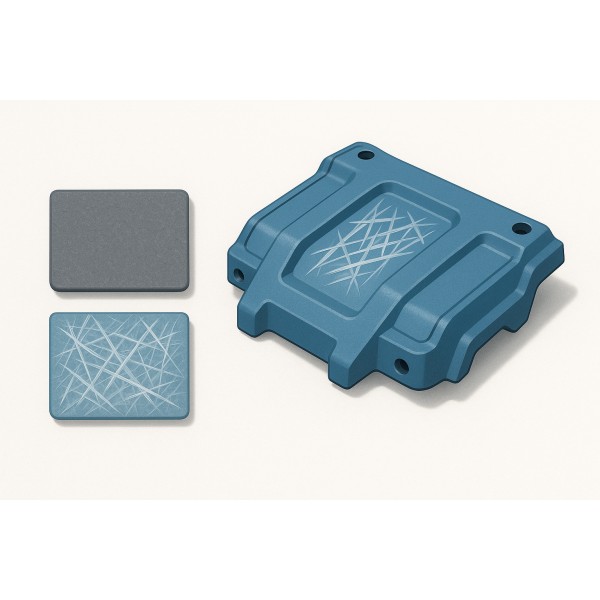
GFRP is a composite material made of plastic reinforced with glass fibers. Known for its high strength-to-weight ratio and durability, it has become a material of choice in the automotive and industrial sectors. This article outlines what GFRP is, its key benefits, and why it’s widely adopted across industries.
---
1. What is GFRP?
GFRP stands for Glass Fiber Reinforced Plastic – a composite made by combining:
- Matrix Resin (e.g., PP, PA) – provides shape and impact absorption
- Glass Fibers – deliver tensile strength and rigidity
By integrating these two components, GFRP offers mechanical properties superior to regular plastics while significantly reducing weight.
---
2. Key Advantages of GFRP
- Up to 70% lighter than steel with comparable strength
- Excellent chemical and heat resistance
- Reduces inertia in moving parts, improving energy efficiency
- Process-friendly – suitable for injection molding, extrusion, and compression molding
These properties make GFRP a cost-effective and efficient solution for demanding applications.
---
3. Why is GFRP Popular in Automotive?
The automotive industry is under pressure to reduce vehicle weight for fuel efficiency and emission control. GFRP enables this by replacing heavy metal parts with lighter yet strong composite components. Common automotive GFRP applications include:
- Engine covers, fuel tanks, door structures
- Bumpers, brackets, and exterior body panels
- Under-the-hood components requiring heat and chemical resistance
Its versatility makes it ideal for both structural and non-structural parts.
---
4. How to Improve GFRP Performance?
A known challenge in GFRP production is achieving strong adhesion between the non-polar resin (e.g., PP) and polar glass fibers.
To solve this, Nissei International (Thailand) Co., Ltd. offers Kayabrid, a high-performance MAPP (Maleic Anhydride grafted Polypropylene) that:
- Enhances fiber-matrix bonding
- Increases impact strength
- Provides stable dispersion of fillers like CNF
Kayabrid is ideal for manufacturers seeking consistent and reliable composite performance.
---
5. Considerations When Using GFRP
- Select appropriate resin based on process (injection, compression, etc.)
- Fiber content must be optimized – too much can cause brittleness
- Use coupling agents (e.g., Kayabrid) to enhance interfacial strength
Proper formulation and processing are key to achieving the best results.
---
6. Conclusion
GFRP is a smart material choice for industries aiming to balance strength, weight, and cost. With growing demand for lightweight materials in automotive and industrial engineering, GFRP continues to play a central role in next-generation product design.
For enhanced adhesion and improved performance, contact Nissei International (Thailand) Co., Ltd. to learn more about Kayabrid and other advanced materials.
#WhatIsGFRP #GlassFiberPlastic #AutomotiveMaterials #CompositeTechnology #GFRPApplications #LightweightEngineering #HighStrengthPlastic #PPGlassFiber #IndustrialComposites #NisseiThailand
---
1. What is GFRP?
GFRP stands for Glass Fiber Reinforced Plastic – a composite made by combining:
- Matrix Resin (e.g., PP, PA) – provides shape and impact absorption
- Glass Fibers – deliver tensile strength and rigidity
By integrating these two components, GFRP offers mechanical properties superior to regular plastics while significantly reducing weight.
---
2. Key Advantages of GFRP
- Up to 70% lighter than steel with comparable strength
- Excellent chemical and heat resistance
- Reduces inertia in moving parts, improving energy efficiency
- Process-friendly – suitable for injection molding, extrusion, and compression molding
These properties make GFRP a cost-effective and efficient solution for demanding applications.
---
3. Why is GFRP Popular in Automotive?
The automotive industry is under pressure to reduce vehicle weight for fuel efficiency and emission control. GFRP enables this by replacing heavy metal parts with lighter yet strong composite components. Common automotive GFRP applications include:
- Engine covers, fuel tanks, door structures
- Bumpers, brackets, and exterior body panels
- Under-the-hood components requiring heat and chemical resistance
Its versatility makes it ideal for both structural and non-structural parts.
---
4. How to Improve GFRP Performance?
A known challenge in GFRP production is achieving strong adhesion between the non-polar resin (e.g., PP) and polar glass fibers.
To solve this, Nissei International (Thailand) Co., Ltd. offers Kayabrid, a high-performance MAPP (Maleic Anhydride grafted Polypropylene) that:
- Enhances fiber-matrix bonding
- Increases impact strength
- Provides stable dispersion of fillers like CNF
Kayabrid is ideal for manufacturers seeking consistent and reliable composite performance.
---
5. Considerations When Using GFRP
- Select appropriate resin based on process (injection, compression, etc.)
- Fiber content must be optimized – too much can cause brittleness
- Use coupling agents (e.g., Kayabrid) to enhance interfacial strength
Proper formulation and processing are key to achieving the best results.
---
6. Conclusion
GFRP is a smart material choice for industries aiming to balance strength, weight, and cost. With growing demand for lightweight materials in automotive and industrial engineering, GFRP continues to play a central role in next-generation product design.
For enhanced adhesion and improved performance, contact Nissei International (Thailand) Co., Ltd. to learn more about Kayabrid and other advanced materials.
#WhatIsGFRP #GlassFiberPlastic #AutomotiveMaterials #CompositeTechnology #GFRPApplications #LightweightEngineering #HighStrengthPlastic #PPGlassFiber #IndustrialComposites #NisseiThailand
Company Information

Main 3 Products
Inorganic chemical products / Raw materials for skincare and haircare / Environmental safety products
Phone Number
Homepage URL
Nissei International (Thailand) Co., Ltd. Established in 2006 and incorporated in 2012, Nissei International (Thailand) Co., Ltd. is a subsidiary of the Nissei Sangyo Group of Japan. We specialize in ...
CATALOG
Related Catalogs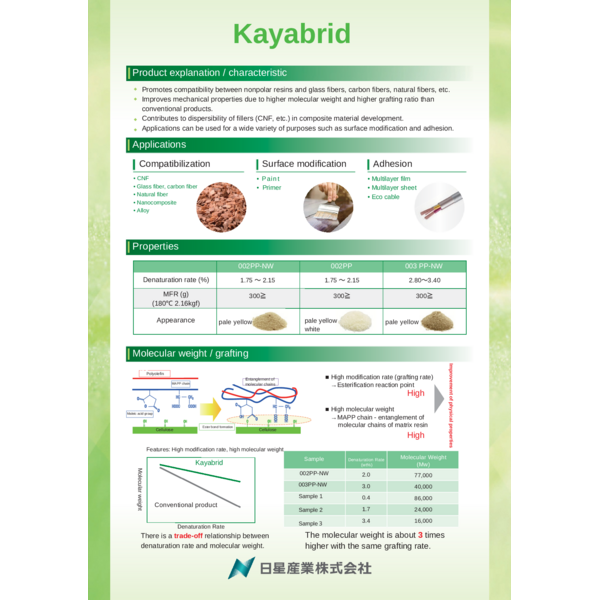
CONTACT
Contact