
HAKKAI PRECISION (THAILAND) CO., LTD.
PRODUCT
Production Goods
Understanding Melt Flow in Injection Molding|Reduce Waste and Optimize Plastic Processing
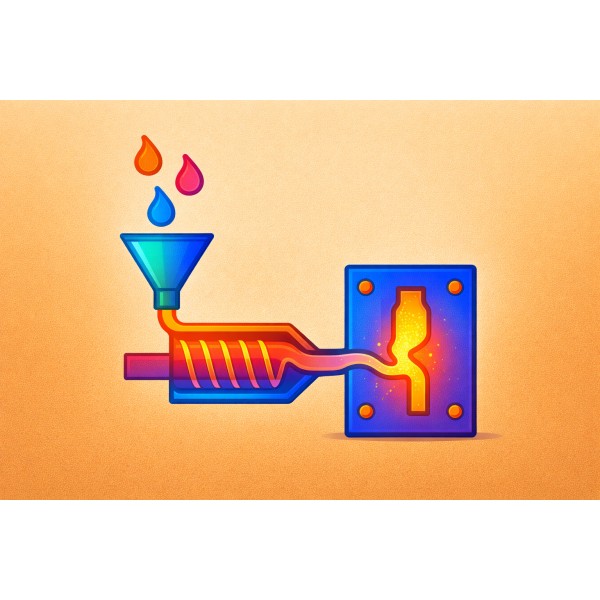
Key Takeaways
• The flow behavior of molten plastic determines part quality and molding stability.
• Molecular structure and molecular weight strongly influence flow characteristics.
• Molten plastics are non-Newtonian and exhibit shear thinning—viscosity decreases as shear rate increases.
• Proper temperature control improves flow but excessive heat causes material degradation.
• Fountain flow and gate design significantly affect how uniformly plastic fills the mold cavity.
Understanding how molten plastic behaves during injection molding is essential for controlling part quality and achieving stable production. Manufacturers who master flow behavior can set process parameters more accurately, reduce scrap, shorten trial cycles, and improve long-term production efficiency. This article summarizes key engineering concepts related to polymer flow to support better decision-making on the shop floor.
Polymer Molecular Structure and Flow Behavior
Different polymers have different molecular structures, which directly affect their ability to flow:
• PP (Polypropylene): Linear molecular chains allow easy flow under heat.
• PC (Polycarbonate): Rigid ring structures require higher temperature and pressure for flow.
Molecular weight also plays a major role:
• High molecular weight: Better mechanical properties but poor flowability.
• Low molecular weight: Easier flow but lower strength.
Selecting the correct material grade for part geometry and flow requirements is therefore critical.
Temperature and Polymer Flow
Temperature control in the barrel and mold is directly tied to viscosity:
• Higher temperature: Lower viscosity → improved flow
• Excessive temperature: Risk of material degradation → discoloration, reduced mechanical properties
A precise temperature profile in each barrel zone is essential for maintaining proper viscosity and avoiding thermal damage.
Flow Patterns Inside the Mold (Fountain Flow)
As molten plastic enters the cavity through runners and gates, fountain flow occurs:
• The material at the center advances forward
• Material near the wall slows down and is pushed outward
This influences:
• Surface quality of the part
• Weld line formation
• Cavity filling uniformity
Therefore, gate size and positioning are key factors in achieving stable and predictable flow behavior.
Summary
A clear understanding of polymer flow behavior is fundamental to achieving high-quality injection molding. By controlling factors such as molecular structure effects, shear behavior, temperature, and flow patterns, manufacturers can reduce defects, improve efficiency, and extend mold life.
ーーーーーーーーーーーーーーーーーーーーーーーーーーーーーーーーーーーーーーーーーーー
❓ FAQ
Q: Why are molten plastics considered non-Newtonian?
A: Because their viscosity changes with shear rate, unlike Newtonian fluids which have constant viscosity.
Q: How does increasing injection speed improve flow?
A: It increases shear rate, which decreases viscosity due to shear thinning behavior.
Q: What happens when melt temperature is too high?
A: Material degradation, reduced strength, and possible discoloration.
📚 Glossary
Shear Thinning: Behavior in which viscosity decreases as shear rate increases
Non-Newtonian Fluid: Fluid whose viscosity varies with shear rate
Fountain Flow: Flow pattern where center material moves forward faster than near-wall material
Molecular Weight: A key determinant of polymer strength and flowability
Company Information

Industry Classification
Industrial machinery / Home electrical appliances / Electronic parts
Main 3 Products
Auto parts / Camera parts
Phone Number
Homepage URL
We are a specialized manufacturer of small precision plastic products. It is to stick to a mold making, and has excels at technology to produce on the scale of microns. Also our feature is a integrate ...
CONTACT
Contact