
DAIWA FINE CHEMICALS (THAILAND) CO., LTD.
PRODUCT
Production Goods
Controlling Tin Plating Film Thickness for High-Speed Production Lines
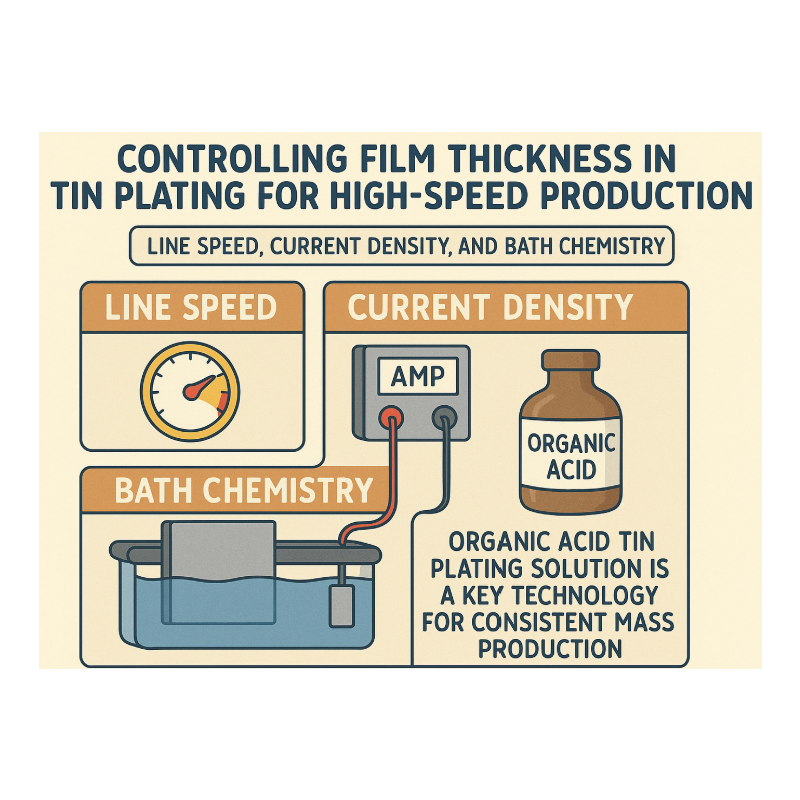
🌟 Key Takeaways• Uniform tin plating thickness is a critical KPI affecting quality, conductivity, and reliability.
• High-speed lines require precise balance between line speed, current density, and bath chemistry.
• Organic acid tin plating widens the process window and reduces thickness variation.
• Effective thickness control lowers NG rate, reduces rework, and improves yield.
ーーーーーーーーーーーーーーーーーーーーーーーーーーーーーーー
Importance of Film Thickness in High-Speed Tin Plating
Film thickness control is essential in high-speed tin plating to maintain quality and productivity, directly affecting appearance, electrical performance, and long-term stability of electronic components.
________________________________________
Why Film Thickness Is a Critical KPI
Tin plating thickness directly impacts conductivity, solderability, heat resistance, and lot-to-lot stability, while shorter plating time in high-speed lines increases sensitivity to current and bath fluctuations.
________________________________________
Main Causes of Thickness Variation
In high-speed production, thickness variation arises from excessive line speed, narrow current density ranges, and unstable bath conditions, leading to thickness drift, uneven surfaces, and higher defect rates.
________________________________________
Key Control Strategies for High-Speed Lines
Stable thickness control requires simultaneous management of three elements:
• Line speed aligned with tin deposition efficiency
• A wide, stable current density range that tolerates load fluctuation
• Bath chemistry with strong crystallization control and low sensitivity to process changes
Organic acid tin plating solutions are designed to meet these requirements, enabling uniform film buildup even under continuous high-speed conditions.
________________________________________
General Lines vs. High-Speed Lines
Compared with general lines, high-speed lines allow less flexibility for frequent adjustment. They require a wider parameter window to avoid stoppages and tuning.
Highly stable plating chemistry helps maintain thickness within specification as speed and production volume increase.
________________________________________
Process Control in Reel-to-Reel Production
In reel-to-reel systems, factories that achieve consistent thickness focus on proactive process control, select chemistry suited for long-term operation, and minimize line interruptions.
This approach delivers higher yield and stable surface quality in mass production.
________________________________________
Risks of Poor Thickness Control
Poor thickness control can cause soldering defects, reduced contact reliability, and hidden costs from scrap and rework.
As a result, film thickness control is both a technical and strategic manufacturing priority.
________________________________________
📘 Summary
Stable tin plating thickness in high-speed lines depends on controlling the interaction between line speed, current density, and bath chemistry.
Organic acid tin plating provides a strong foundation for consistent quality in high-volume production.
📥 CTA
Learn more from the related topics below to deepen understanding of high-speed tin plating control.
ーーーーーーーーーーーーーーーーーーーーーーーーーーーーーーー
❓ FAQ
Q1: Why is thickness harder to control in high-speed lines?
A1: Shorter plating time increases sensitivity to process variation.
Q2: What most strongly affects film thickness?
A2: The balance between line speed, current density, and bath stability.
Q3: How does chemistry influence thickness stability?
A3: Stable crystallization chemistry enables uniform film buildup under high-speed conditions.
________________________________________
📚 Glossary (Key Terms)
• Film Thickness: Thickness of the deposited tin layer (information not specified).
• Line Speed: Production speed per unit time (information not specified).
• Current Density: Electrical current applied during plating (information not specified).
• Bath Chemistry: Chemical composition affecting tin crystallization behavior.
________________________________________
📖 Reference
Article: “Controlling Tin Plating Film Thickness for High-Speed Production Lines”
________________________________________
🔗 Cluster Internal Link
• Core Content: https://prime.nc-net.com/94425/en/product_others/detail_goods/27323
• Basic Knowledge: https://prime.nc-net.com/94425/en/product_others/detail_goods/27677
________________________________________
🔒 Trust
This content has been reviewed and validated by Daiwa Fine Chemical (Thailand) Co., Ltd. for alignment with real industrial applications.
________________________________________
#TinPlating #FilmThicknessControl #HighSpeedProductionLine #ReelToReel #PlatingProcess
#SurfaceTreatment #ManufacturingProcess #Electroplating #ProcessControl #MassProduction
📆 Updated: 2025-12-12
Company Information
Industry Classification
Heavy electric machinery / Electronic parts / Transportation equipment
Main 3 Products
Corrosion Inhibitor / Copper Plating Solution / Non-Cyanide Silver Plating Solution
Phone Number
Homepage URL
Our Slogan: We are Chemical Innovators Daiwa Kasei Group follows the three pillars of creativity: innovation, originality, and collaboration because we are a company that takes up the challenge to pur ...
CONTACT
Contact