
KNOWLEDGE
Knowledge
Technology and Services
How Much Dimensional Change from Moisture Absorption Can PA Screws Tolerate? PC Screws as an Alternative
2026-08-04
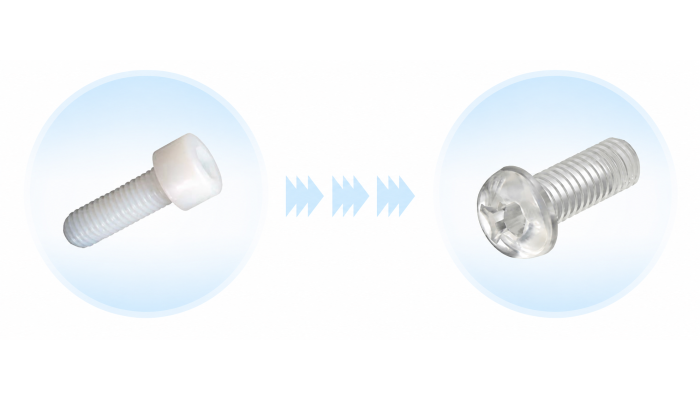
When selecting resin screws, it's important to consider not only strength and heat resistance, but also how dimensions and mechanical properties change with temperature and humidity. PA in particular has a relatively high water absorption rate, and depending on the operating environment, moisture absorption can cause changes in dimensions and mechanical properties. For this reason, in high-humidity environments or applications requiring dimensional precision, PC screws — which have a lower water absorption rate — become a strong alternative to consider.
This article compares PA and PC screws based on their physical properties, and explains the usage conditions where PC screws are worth considering.
Table of Contents
- Why PA Screws Are Susceptible to Temperature and Humidity
- Comparing the Physical Properties of PC and PA Screws
- Usage Conditions Where PC Screws Are Worth Considering
- Why Nippon Chemical Screw Focuses on PC Screws
- FAQ
Why PA Screws Are Susceptible to Temperature and Humidity
Resin materials can change in dimension and mechanical properties depending on the operating environment, such as temperature and humidity. Dimensional change from temperature relates to the material's linear expansion coefficient, while change from humidity relates to the material's water absorption rate.
PA is an engineering plastic with excellent mechanical properties and wear resistance, but it has a relatively high water absorption rate, making it prone to absorbing moisture from its surroundings.
When PA absorbs moisture, not only dimensions but also mechanical properties such as strength and stiffness can change. For screws, this requires consideration of effects on the outer diameter of the thread, thread profile, fit with mating parts, and fastening condition.
The actual degree of change varies depending on the type and grade of PA, molding conditions, temperature, humidity, and duration of use. This doesn't mean PA will always cause problems, but in high-humidity environments or applications requiring tight dimensional precision, material selection needs to account for water absorption.
Comparing the Physical Properties of PC and PA Screws
When examining the differences between PA and PC, water absorption rate is especially worth focusing on.
The representative values from the reference material are as follows:
PC vs. PA Property Comparison Table
Property | PC | PA6 | PA66 |
Water Absorption Rate | 0.15% | 1.1% | 1.5% |
Linear Expansion Coefficient [×10⁻⁵/K] | 5.6 | 8 | 9 |
Continuous Use Temperature | 115°C | 65°C | ― |
According to the reference material, PC's water absorption rate is 0.15%, lower than PA6's 1.1% and PA66's 1.5%. The linear expansion coefficient is also lower for PC at 5.6, compared to 8 for PA6 and 9 for PA66.
This comparison shows that PC is less affected by moisture absorption than PA, and based on the representative values in the reference material, dimensional change from temperature is also relatively small. In terms of continuous use temperature, PC is rated at 115°C, higher than PA6's 65°C, giving it an advantage in heat resistance as well.
That said, water absorption rate and linear expansion coefficient can vary depending on material grade, measurement method, and measurement conditions. When actually selecting a material, it's important to check not just representative values but also product specifications and the actual operating environment.
Usage Conditions Where PC Screws Are Worth Considering
PC screws are especially worth considering for the following applications:
- Use in high-humidity environments
- Use where temperature and humidity fluctuate significantly
- Applications requiring tight dimensional tolerances
- Applications requiring long-term fastening stability
- Locations requiring electrical insulation
- Locations requiring thermal insulation
- Locations requiring non-magnetic properties (e.g., around electronic devices or measuring instruments)
- Applications requiring weight reduction
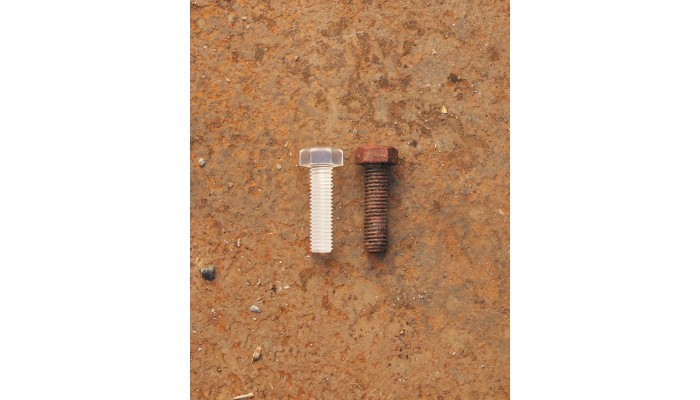
- Applications requiring corrosion resistance (where rust/corrosion of metal screws should be avoided)
In particular, for applications where even slight dimensional change affects assembly precision or fit, PC screws — with a lower water absorption rate than PA — are a strong alternative. Compared to PA screws, PC screws also show less dimensional change and less strength reduction from moisture absorption, and their transparency offers an added benefit for applications requiring visual inspection.
However, when evaluating long-term fastening stability, factors beyond water absorption rate — such as operating temperature, load, creep, and chemical exposure — also need to be considered.
Nippon Chemical Screw's PC products have a continuous use temperature of approximately 115°C. Compared to PA6's 65°C, this makes PC a material better suited to higher-temperature environments. Regarding flame retardancy, the standard-color transparent product is rated UL94 V-2, while white and black products are rated equivalent to UL94 V-2.
Why Nippon Chemical Screw Focuses on PC Screws
The company has the technical capability to manufacture PA screws, but has chosen not to actively produce them. One reason is PA's high water absorption and the resulting changes in dimensions and mechanical properties.
In particular, for applications where dimensional change from humidity needs to be minimized, or where dimensional precision is required, the company proposes PC screws — with their lower water absorption rate — as one option.
That said, PC is not necessarily superior to PA for every application. Depending on the use case, PA or other resin materials may be more suitable.
It's important to review usage conditions — temperature, humidity, load, chemical exposure, flame retardancy, insulation requirements — and select the material that fits the application.
※ The figures in this article are reference values, not guaranteed values.
※ For more details, please refer to the PDF document attached to this article, or contact us via the inquiry form at the bottom of the page.
FAQ
Q1: Why does Nippon Chemical Screw focus on PC screws rather than PA screws?
A1: PA has a relatively high water absorption rate, and moisture absorption can cause changes in dimensions and mechanical properties. Especially for applications requiring dimensional precision, the company proposes PC screws, which have a lower water absorption rate, as an alternative.
Q2: Under what conditions should PC screws be considered?
A2: They can be considered for high-humidity environments, environments with significant temperature and humidity fluctuation, or applications requiring tight dimensional tolerances. However, actual material selection should be made comprehensively, taking into account operating temperature, load, creep, and chemical exposure as well.
※ For more details, please refer to the PDF document attached to this article, or contact us via the inquiry form at the bottom of the page.
Company Information

Measuring machinery / Industrial machinery / Medical equipment
Plastic Screw / Resin Screw / Plastic Spring / Resin Spring / Resin Molded Product
Nippon Chemical Screw Co., Ltd. specializes in the development and production of plastic fasteners made from high-performance resins. Our products are designed for environments that demand insulation, ...

PICKUP
Technology & Services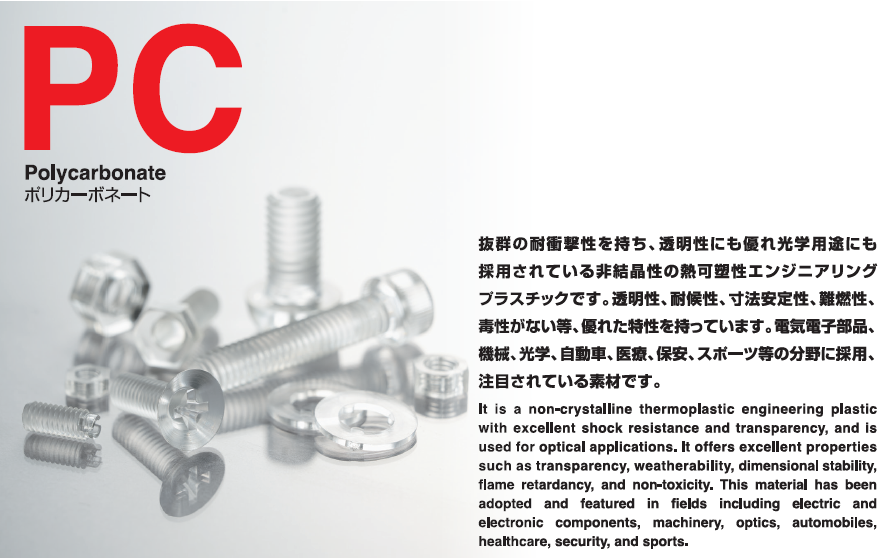
CONTACT
Contact