
KNOWLEDGE
Knowledge
Technology and Services
【PEEK Screws M2-M12】Corrosion and Salt Damage Prevention with Total Cost Reduction by Replacing Metal Screws
2026-02-17
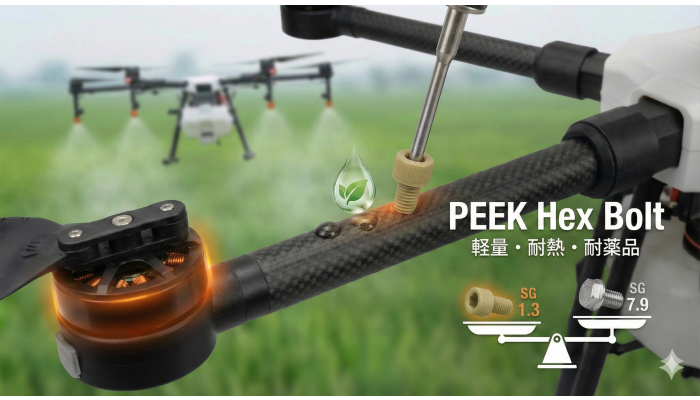
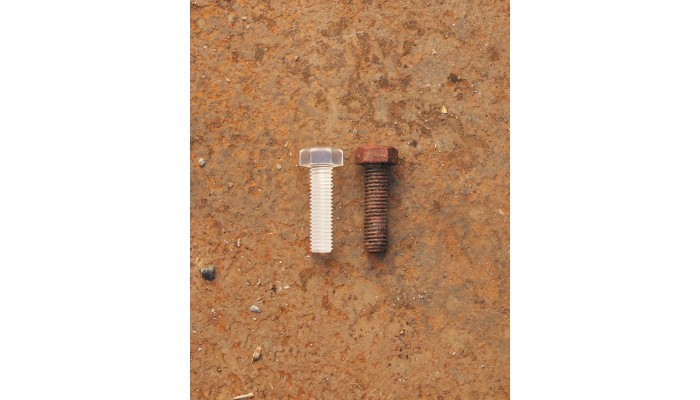
In manufacturing sites across Thailand, year-round high humidity and salt damage are major factors driving up maintenance costs through the corrosion of metal parts, especially in outdoor equipment and processes that use chemicals. Many of you have likely faced rust and galvanic corrosion issues with stainless steel screws. This article summarizes the key points on corrosion prevention and cost management by replacing metal screws with PEEK (Polyetheretherketone) screws, which withstand heat up to 240°C.
Table of Contents
- The Limits of Corrosion Prevention | Factors Causing Metal Screws to Corrode in Thailand's Hot, Humid Climate
- Heat Resistance Up to 240°C | Decision Criteria for PEEK Material in Harsh Chemical and Temperature Environments
- From M2 to M12 | Replacing Metal Screws with High-Precision Injection Molding
- Case Studies and Track Record | Considerations for Metal Replacement in Semiconductor and Exhaust Equipment Applications
- What Nippon Chemical Screw Can Solve
The Limits of Corrosion Prevention | Factors Causing Metal Screws to Corrode in Thailand's Hot, Humid Climate
In Thailand's coastal areas and industrial estates, corrosion of metal screws is an unavoidable challenge. Even with commonly used SUS304 or SUS316, the hot and humid climate tends to break down the passive film on the surface, creating conditions prone to pitting and crevice corrosion. This is especially true near coastlines or around acid-alkali cleaning processes, where corroded and broken screw heads can bring equipment to a halt. Once rust sets in, screw heads often collapse and become difficult to remove, requiring bolts to be destroyed for extraction during maintenance — adding to the workload on site.
Galvanic corrosion, caused by contact between dissimilar metals (for example, stainless steel screws on an aluminum frame), is another issue specific to metal screws, with moisture acting as the medium that accelerates corrosion. While painting or plating are sometimes considered as countermeasures, scratches from tightening tools can allow corrosion to progress, and removing bolts seized by rust takes considerable time — directly driving up total cost of maintenance (TCO).
Switching the material itself from metal to a super engineering plastic with high heat and chemical resistance is an effective way to break this corrosion cycle, reducing replacement frequency and laying the groundwork for extending the service life of equipment overall.
Heat Resistance Up to 240°C | Decision Criteria for PEEK Material in Harsh Chemical and Temperature Environments
PEEK has a continuous use temperature of up to 240°C, making it well-suited to areas around drying ovens or locations exposed to high-temperature cleaning fluid splashes. Because its coefficient of linear expansion differs from that of metal, dimensional control needs to be considered during design. PEEK also has flame-retardant properties equivalent to UL94 V-0 (varying by thickness), making it suitable for fastening components inside electrical and electronic equipment where safety is a priority.
In terms of chemical resistance, PEEK withstands a wide range of acids, alkalis, and organic solvents, with the exception of certain special chemicals such as concentrated sulfuric acid. This makes it suitable for corrosive gas exhaust ducts and chemical cleaning equipment, including environments with hydrochloric acid or caustic soda that severely corrode metal.
Because plastic screws have lower tensile strength than metal, replacement requires calculating torque and stress distribution at the fastening point — referencing specifications such as a flexural strength of 174 MPa and a tensile strength of 98 MPa against actual on-site loads. Periodic re-tightening checks should also be considered when used at high temperatures under high loads, given a heat deflection temperature of 140°C–160°C (varying with load conditions).
From M2 to M12 | Replacing Metal Screws with High-Precision Injection Molding
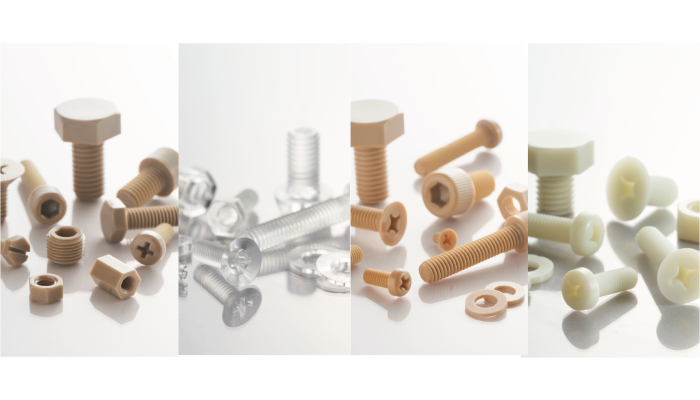
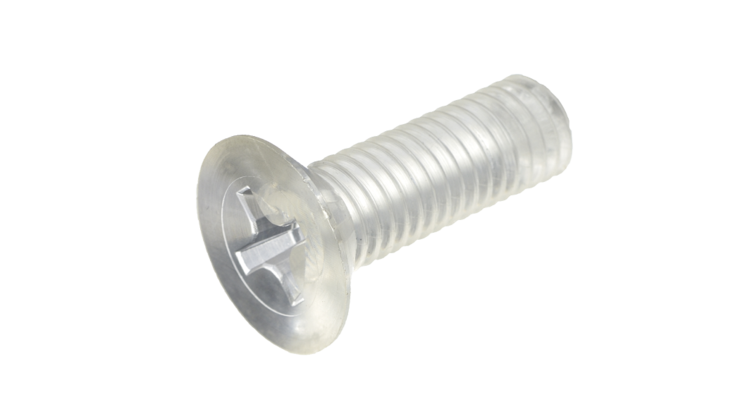
Nippon Chemical Screw offers PEEK screws ranging from the ultra-small M2 up to M12. Sizes such as M2 and M2.6 are important considerations for precision instruments, semiconductor manufacturing equipment, and medical devices. Founded in 1965 as a specialist plastic screw manufacturer, the company relies mainly on high-precision injection molding, which generates far less material loss than machining and allows large volumes to be molded at once — helping lower unit costs, particularly for a high-cost material like PEEK.
The company keeps over 3,000 standard items in stock, with supply into Thailand arranged through trading companies. Orders are accepted from as little as one piece, suitable for both prototype testing and urgent needs. Sizes follow JIS standards, allowing replacement without major changes to existing designs, and the company can also produce custom lengths and special shapes beyond the standard lineup.
Case Studies and Track Record | Considerations for Metal Replacement in Semiconductor and Exhaust Equipment Applications
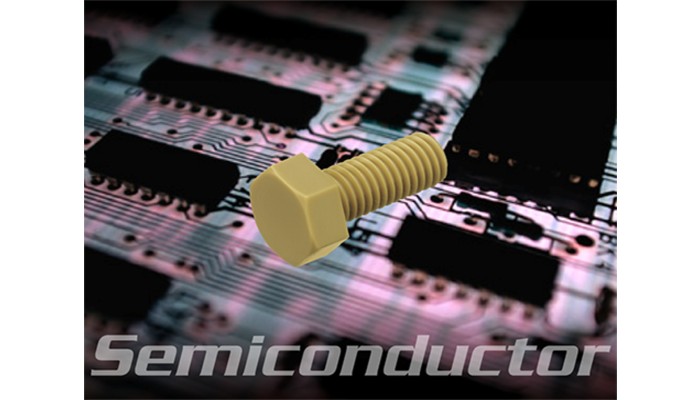
In semiconductor and LCD manufacturing equipment, PEEK's chemical resistance and purity (no metal ion leaching) are essential in pure water cleaning lines and etching processes. Its non-magnetic property has also made it increasingly used as a fastening component in inspection equipment and medical devices such as MRI machines, where it must not interfere with magnetic fields.
In Thailand, demand is particularly high for exhaust, ducting, and gas treatment equipment. A broken metal screw in a corrosive atmosphere can risk toxic gas leaks, and replacing it with PEEK strengthens corrosion-related safety design. This requires understanding the "torsional breaking torque" specific to plastic, rather than tightening to the same torque as the original metal bolt — using the company's size-specific breaking load data to set appropriate control values on site.
Weight reduction is another important consideration. PEEK has a specific gravity of about 1.3, roughly six times lighter than stainless steel (about 7.9). This makes it well-suited to applications where reducing moment of inertia matters, such as aerospace, drones, or robotic arm tips — also helping shorten cycle times and extend motor life.
What Nippon Chemical Screw Can Solve
Founded in 1965, Nippon Chemical Screw brings over half a century of plastic screw manufacturing experience to support material selection and specification decisions for replacing metal screws — minimizing the risk of screw corrosion and production line stoppages caused by Thailand's hot, humid climate. With high-precision injection molding technology for mass production, the company helps maintain quality stability while controlling costs.
Beyond the standard M2–M12 sizes, the company can accommodate custom shapes and specific strength requirements, and offers guidance based on long-accumulated know-how on strength calculation — often a sticking point in selecting plastic screws — as well as measures against loosening from temperature changes. In Thailand, a distribution network through major Japanese trading companies is already in place, allowing Japanese companies to source products under the same quality control standards as in Japan.
The information needed to make a decision includes the operating environment temperature, the type of chemicals in contact, and the tensile/torque load required at the fastening point. Please inquire for further details if these conditions are not yet clear.
*For further details, please download the PDF document attached to this article, or contact us via the form at the bottom of the page.
FAQ
Q1: Can PEEK screws be tightened to the same torque as metal screws?
A1: No — tightening to the same torque as metal screws can exceed the strength of PEEK and cause it to break. Since plastic is weaker than metal, we recommend checking the "torsional breaking torque" listed in the catalog for each product and controlling tightening at approximately 50%–70% of that value.
Q2: Can PEEK screws be used outdoors in Thailand where they are exposed to direct sunlight?
A2: PEEK has good weather resistance compared to general plastics, but prolonged UV exposure may cause slight surface degradation over time. For applications directly tied to structural strength, please inquire further about periodic inspection or grades with enhanced weather resistance.
Q3: Are small sizes such as M2 readily available in Thailand?
A3: Nippon Chemical Screw keeps ultra-small sizes from M2 as standard stock. In Thailand, stock is sold through partner trading companies, allowing for relatively short delivery times. For specific stock status and local delivery timing, please inquire via the form at the bottom of the page.
Key Terms for Understanding This Article
- Polyetheretherketone (PEEK): A high-performance super engineering plastic with a continuous use temperature of 240°C, excellent chemical resistance, and strong flame retardancy.
- High-Precision Injection Molding: A method of molding melted resin using a mold. It generates less material loss than machining, enables efficient mass production, and helps reduce costs.
- Galvanic Corrosion: A phenomenon where dissimilar metals in contact develop a potential difference — influenced by factors such as moisture — causing one metal to corrode. Using plastic screws as an insulator is an effective countermeasure.
*For further details, please download the PDF document attached to this article, or contact us via the form at the bottom of the page.
Company Information
Measuring machinery / Industrial machinery / Medical equipment
Plastic Screw / Resin Screw / Plastic Spring / Resin Spring / Resin Molded Product
Nippon Chemical Screw Co., Ltd. specializes in the development and production of plastic fasteners made from high-performance resins. Our products are designed for environments that demand insulation, ...
PICKUP
Technology & Services
CONTACT
Contact