
NIPPON CUTTING & WELDING EQUIPMENT CO., LTD.
SERVICES
Technology & Services
Line Regulator for Piping | Stable Pressure Control in Piping Systems for Industrial Applications
Key Takeaways
• Line Regulator for Piping maintains stable downstream pressure in factory gas piping systems
• Reduces pressure fluctuation and improves operational stability of equipment
• Supports Oxygen, Acetylene, LPG, and Hydrogen
• Ideal for factories requiring high safety standards and consistent process quality
ーーーーーーーーーーーーーーーーーーーーーーーーーーーーーーー
In factory gas piping systems, supply pressure often fluctuates depending on usage conditions. Without proper control, this can lead to equipment malfunction or inconsistent process quality. Line Regulator for Piping is specifically designed for installation within piping systems to control pressure directly at the point of use, ensuring each workstation operates under safe and appropriate pressure conditions.
Many factories find that even when the main supply pressure is correctly set, pressure fluctuations still occur at downstream points, causing unstable flames or inconsistent equipment performance. Installing a Line Regulator near the point of use allows for “secondary pressure control,” minimizing the impact of fluctuations in the main piping and improving production continuity.
The operating principle of a Line Regulator is to receive pressure from the main piping system, then reduce and maintain a constant outlet pressure. It responds quickly to changes in flow demand, making it suitable for continuous operation in industrial piping systems.
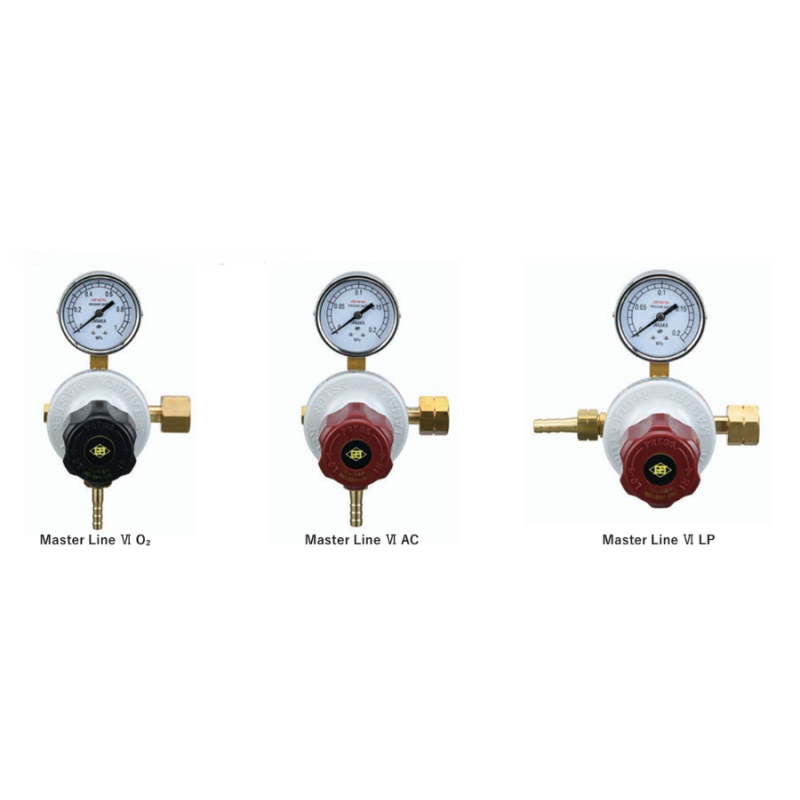
🔷 Line Regulator (Master Line VI Series)
• Master Line VI O₂
Gas: Oxygen
Inlet pressure gauge: Nil (Maximum inlet pressure 0.99 MPa)
Outlet pressure gauge: 1 MPa
Maximum working pressure: 0.7 MPa
Flow rate: 24 Nm³/h (P2 = 0.4 MPa)
Weight: 1 kg
• Master Line VI AC
Gas: Acetylene
Inlet pressure gauge: Nil (Maximum inlet pressure 0.098 MPa)
Outlet pressure gauge: 0.2 MPa
Maximum working pressure: 0.07 MPa
Flow rate: 4.2 Nm³/h (P2 = 0.05 MPa)
Weight: 1 kg
• Master Line VI LPG
Gas: LPG
Inlet pressure gauge: Nil (Maximum inlet pressure 0.15 MPa)
Outlet pressure gauge: 0.2 MPa
Maximum working pressure: 0.07 MPa
Flow rate: 3.2 Nm³/h (P2 = 0.05 MPa)
Weight: 1 kg
• Master Line VI H₂
Gas: Hydrogen
Inlet pressure gauge: Nil (Maximum inlet pressure 0.99 MPa)
Outlet pressure gauge: 1 MPa
Maximum working pressure: 0.7 MPa
Flow rate: 68 Nm³/h (P2 = 0.4 MPa)
Weight: 1 kg
In practical use, Line Regulators are commonly installed in gas piping systems for cutting and welding facilities, production lines with multiple usage points, factories requiring individual pressure control per station, and piping systems demanding high safety and stability. Installing the regulator close to the point of use ensures stable downstream pressure, reduces risk, and enables smooth and reliable production processes.
Summary
Line Regulator for Piping is a critical component of factory gas supply systems. Selecting the appropriate model based on gas type and flow rate enhances long-term stability, safety, and process quality.
ーーーーーーーーーーーーーーーーーーーーーーーーー
❓ FAQ
Q: How is a Line Regulator different from a cylinder-mounted regulator?
A: A Line Regulator controls pressure within the piping system near the point of use, rather than being installed directly on the gas cylinder.
Q: Is it necessary to install a Line Regulator at every point of use?
A: It is recommended in systems with multiple stations or varying pressure requirements to ensure stability and safety.
Q: Which gases are supported by Line Regulators?
A: Oxygen, Acetylene, LPG, and Hydrogen.
📚 Glossary (Key Terms)
• Line Regulator for Piping: A pressure control device installed in piping systems near the point of use to maintain stable downstream pressure
• Piping System: Industrial gas distribution piping within a factory
• Nm³/h: Unit of gas flow rate
Company Information
Main 3 Products
Industrial gas pressure regulator / Gas cutting equipment
Phone Number
With 36 years of experience in Thailand, NIPPON CUTTING & WELDING EQUIPMENT CO., LTD. has continued to manufacture related equipment based on gas cutting technology. In recent years, in addition to pl ...
CATALOG
Related Catalogs
PICKUP
Technology & Services
CONTACT
Contact