_1276f2af-bafd-441a-a1dd-e6cadf2019a2.png)
PRODUCT
Production Goods
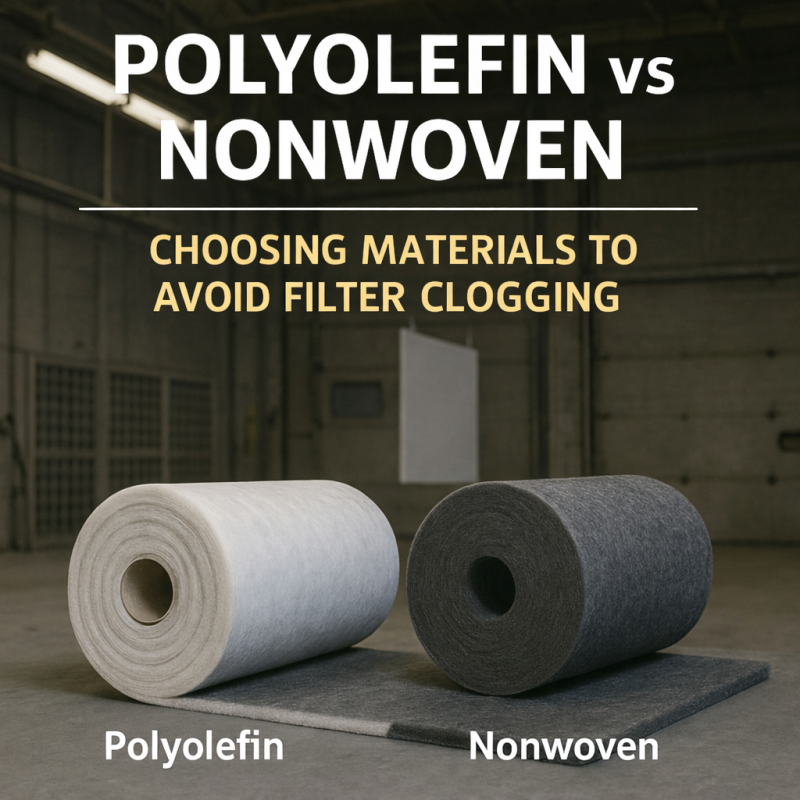
Polyolefin vs Nonwoven in Roll-type Carbon Filters|How to Prevent Early Clogging
Key Takeaways
- Filter material directly affects service life, pressure stability, and VOC breakthrough risk
- Polyolefin (TS5000S) is suitable for high VOC load / long operating hours / continuous production
- Nonwoven (TS5000K) is suitable for moderate load / cost-focused projects / flame-retardant needs
- Choosing the wrong material leads to early clogging and frequent auto-switch operation
- Both materials achieve ≥85% filtration efficiency (ASHRAE); the difference lies in clogging behavior
In Roll-type Carbon Filter systems, many factories focus on roll length or the auto-switch mechanism.
In reality, the support material holding the activated carbon is a key factor that determines system stability under high VOC load and multi-shift operation.
This article explains, in a clear and practical way, how Polyolefin and Nonwoven differ—and how to choose the right one.
■ Why Filter Material Causes “Early Clogging”
Even with a roll-type structure and auto-switch system, using the wrong material can cause:
- Rapid increase in pressure drop
- Auto-switch activating too frequently
- VOC breakthrough before the intended switching point
The root cause lies in how each material handles paint mist and maintains airflow paths.
■ Key Differences Between Polyolefin and Nonwoven
Polyolefin (TS5000S)
- High structural stability, resists deformation
- Handles overspray and humidity well
- Maintains open airflow channels → stable pressure
- Ideal for high VOC load and long-term operation
Nonwoven Fabric (TS5000K)
- Flexible compressed fibers, lower cost
- Flame-retardant
- Suitable for general applications
- May saturate faster under continuous heavy overspray
■ How to Choose the Right Material (Simple Rules)
- High VOC + 16–24 h operation → Polyolefin
- Moderate VOC + cost control → Nonwoven
- Do not judge by efficiency alone
Both materials meet ≥85% (ASHRAE)
The real difference is slow vs fast clogging
■ Comparison Summary
Polyolefin (TS5000S)
- High shape stability
- Low deformation
- Very stable pressure
- Less frequent auto-switch
- Higher cost
Nonwoven (TS5000K)
- Flexible structure
- Higher deformation risk
- Stable pressure (moderate)
- More frequent auto-switch
- About half the cost
- Flame-retardant
■ What Happens When the Wrong Material Is Chosen
Plastic parts paint shop, 3-shift operation, solvent-based paint
Chose Nonwoven for cost reasons
Results:
- Auto-switch activated too frequently
- Pressure fluctuation at end of shifts
- VOC leakage observed
After switching to Polyolefin:
- Pressure stabilized
- Switching frequency reduced
- VOC control improved
■ Summary
Polyolefin and Nonwoven differ not only in price, but in how they behave under real VOC load.
Selecting the correct material allows the roll-type filter and auto-switch system to operate at full efficiency—maintaining stable pressure, preventing early clogging, and ensuring effective VOC control.
※ Download the Carbon Filter Series Catalogue to support material selection based on VOC load
■ FAQ
Q1: Do both materials remove VOCs equally?
A: Yes. Both meet ASHRAE ≥85%, but service life differs.
Q2: Which material is better for cost control?
A: Nonwoven (TS5000K) for moderate load conditions.
Q3: Which material is recommended for 3-shift operation?
A: Polyolefin (TS5000S) provides better long-term stability.
■ Cluster Internal Link
• Basic Knowledge: https://prime.nc-net.com/100377/en/product_others/detail_goods/27604
• Core Content: https://prime.nc-net.com/100377/en/product_others/detail_goods/27577
■ Glossary
- Polyolefin: High-stability material for continuous operation
- Nonwoven Fabric: Compressed fiber material, cost-effective
- VOC Load: Amount of VOC the system must handle
- Auto-switch: Automatic filter media switching mechanism
- VOC Breakthrough: VOC leakage when the filter is saturated
■ Reference
• Carbon Filter Series – Product Catalogue (TS5000S / TS5000K)
■ Trust
Reviewed by Yuki Okuno – Project Leader, TS COATING (THAILAND) CO., LTD.
Based on: Carbon Filter Series – Product Catalogue
#RollTypeCarbonFilter #Polyolefin #Nonwoven #MaterialEngineering #VOCLoad #AutoSwitch #CarbonFilter #PaintBooth #IndustrialCoating #VOCControl
Updated: 2025-12-12
Company Information
Painting System Installation / Odor & Spray Mist Treatment / Painting Sludge Chemical Treatment
TS COATING (THAILAND) CO., LTD. was established in 2004 in Bangkok, Thailand. We are a specialist company in industrial painting systems and environmental solutions. Our parent company, TS COATING TEC ...
CATALOG
Related Catalogs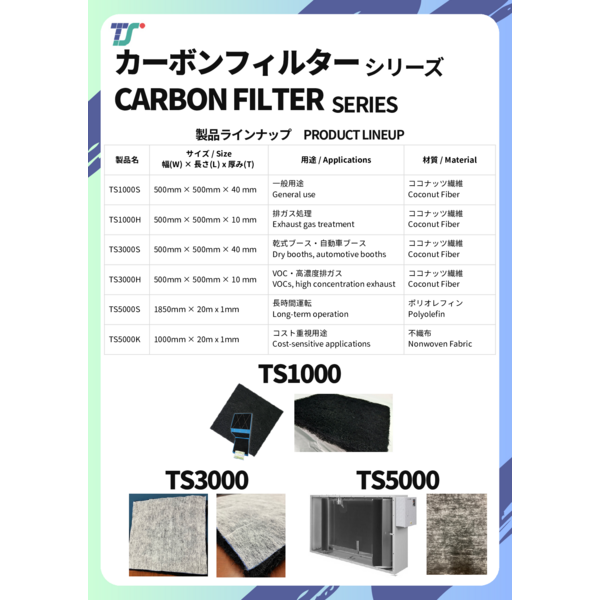
CONTACT
Contact