
SHOWA SOKKI CORPORATION
PRODUCT
Production Goods
Vibration Sensor Installation Techniques | Accurate Measurement for Predictive Maintenance
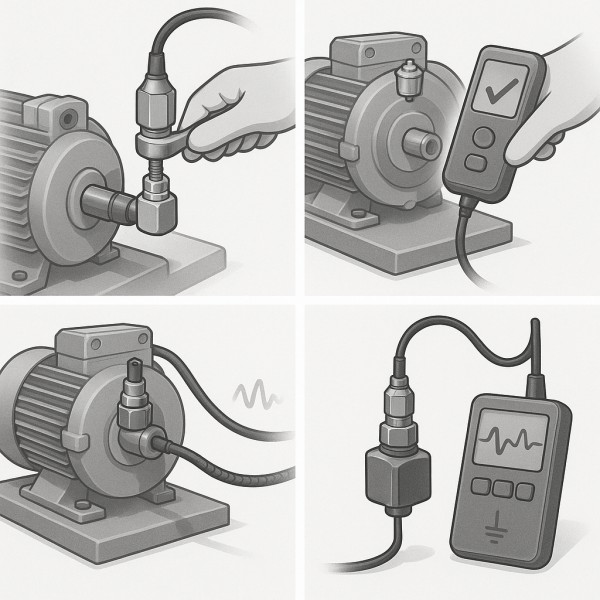
Proper installation of vibration sensors is crucial to ensure reliable data, prevent equipment failures, and extend machine lifespan. This article outlines practical techniques for engineers and maintenance teams.
========================
■ Best Practices for Installing and Using Vibration Sensors
1. Sensor Placement: Accuracy Starts at the Mounting Point
Mount the sensor close to key vibration sources like bearings or motor housings. Avoid weak or thin surfaces.
2. Mounting Method: Reliable Signal Requires Firm Contact
Use stud mounting or epoxy for stable installation. Magnetic mounts are convenient but less accurate.
3. Surface Prep: A Flat, Clean Surface Is Essential
Grind, clean, and ensure no rust or oil. Structural integrity matters.
4. Cabling: Shielded and Grounded
Use shielded cables and avoid running near power lines. Fix the cables to avoid interference.
5. Choose the Right Frequency Range
Match sensor capability to your machine’s vibration type. IEPE sensors are ideal for general machinery.
6. Know the Measurement Units
- Acceleration (g): Impact detection
- Velocity (mm/s): Overall condition
- Displacement (μm): Shaft misalignment
Use velocity (mm/s RMS) for predictive maintenance (ISO 10816 standard).
7. Calibration: At Least Once Per Year
Routine sensor calibration ensures ongoing measurement accuracy.
8. Recommended Sensor: SHOWA SOKKI MODEL 1018
Reliable for motors, fans, and general equipment. Also compatible with portable and fixed systems.
🔍For technical inquiries or detailed specs, contact us directly.
========================
#vibrationsensor #predictivemaintenance #IEPEsensor #industrialmonitoring #machinemaintenance #calibration #conditionmonitoring #SHOWASOKKI
========================
■ Best Practices for Installing and Using Vibration Sensors
1. Sensor Placement: Accuracy Starts at the Mounting Point
Mount the sensor close to key vibration sources like bearings or motor housings. Avoid weak or thin surfaces.
2. Mounting Method: Reliable Signal Requires Firm Contact
Use stud mounting or epoxy for stable installation. Magnetic mounts are convenient but less accurate.
3. Surface Prep: A Flat, Clean Surface Is Essential
Grind, clean, and ensure no rust or oil. Structural integrity matters.
4. Cabling: Shielded and Grounded
Use shielded cables and avoid running near power lines. Fix the cables to avoid interference.
5. Choose the Right Frequency Range
Match sensor capability to your machine’s vibration type. IEPE sensors are ideal for general machinery.
6. Know the Measurement Units
- Acceleration (g): Impact detection
- Velocity (mm/s): Overall condition
- Displacement (μm): Shaft misalignment
Use velocity (mm/s RMS) for predictive maintenance (ISO 10816 standard).
7. Calibration: At Least Once Per Year
Routine sensor calibration ensures ongoing measurement accuracy.
8. Recommended Sensor: SHOWA SOKKI MODEL 1018
Reliable for motors, fans, and general equipment. Also compatible with portable and fixed systems.
🔍For technical inquiries or detailed specs, contact us directly.
========================
#vibrationsensor #predictivemaintenance #IEPEsensor #industrialmonitoring #machinemaintenance #calibration #conditionmonitoring #SHOWASOKKI
Company Information

Main 3 Products
Vibration Meters / Accelerometers / Sensors
Phone Number
Homepage URL
■ Overview Since its founding in 1968, SHOWA SOKKI CORPORATION has been a pioneer in vibration measurement technology, supplying products across a wide range of industries. By utilizing precise vibrat ...
CONTACT
Contact