
MURAKAMI (THAILAND) CO., LTD.
KNOWLEDGE
Knowledge
Technology and Services
Selecting the Right Inkjet Printer for Material Surfaces | Reducing Manufacturing Rejects
2026-02-16
🌟 Key Takeaways
- Material surface characteristics are a primary cause of printing-related rejects
- Selecting the right inkjet printer reduces smudging, ink adhesion failure, and unreadable codes
- Proper ink and printhead technology selection significantly minimizes line stops
- Industrial CIJ systems are designed to support a wide range of material surfaces
🔷 Why Coding Quality Has a Direct Impact on Manufacturing KPIs
In many manufacturing plants, issues such as faint codes, unreadable markings, or ink peeling are often perceived as minor problems.
However, from a KPI perspective, these issues directly affect:
- Reject rate
- Rework time
- Line efficiency
- Traceability capability
In practice, the root cause is rarely equipment failure.
More commonly, it is the mismatch between the inkjet printer, ink formulation, and the actual material surface.
🔷 How Material Surface Properties Affect Print Quality
Material surfaces used in industrial production vary significantly in their characteristics.
- Plastics: Smooth surfaces with low ink adhesion
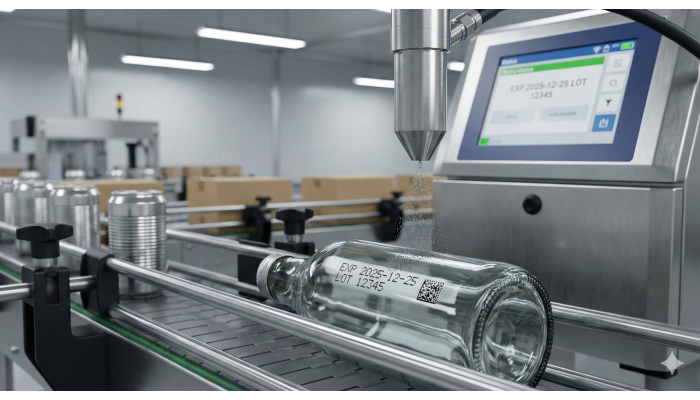
- Glass / Metal: Flat, non-porous surfaces requiring fast-drying inks
- Packaging films: Thin materials running at high line speeds
When the same ink or printing system is used across all surfaces, the ink fails to set properly.
This leads to smearing, poor readability, and ultimately product rejection.
🔷 The Right Approach to Inkjet Printer Selection
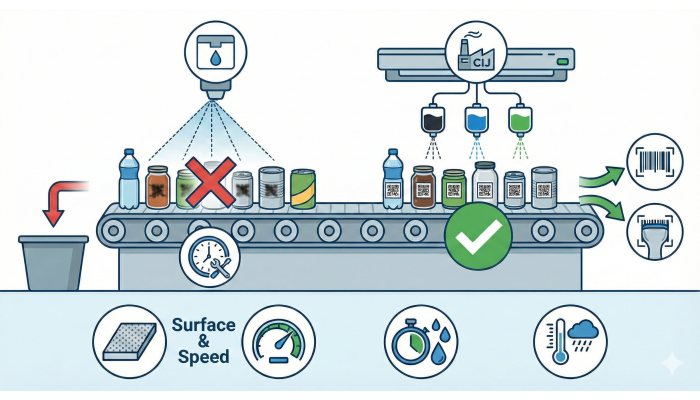
Inkjet printer selection should be based on
“material surface characteristics + production line speed”, not solely on equipment price.
Key evaluation factors include:
1. Surface type (porous / non-porous)
2. Production line speed
3. Ink drying time
4. Environmental conditions such as humidity, dust, and temperature
Industrial CIJ systems from specialists such as Domino Printing Sciences
are designed to allow flexible selection of printheads and ink formulations tailored to specific materials.
🔷 Comparison: Incorrect vs Correct Printer Selection
> When selection is incorrect
- One ink used for all material types
- Codes appear faint or peel off
- Frequent production line stoppages
> When selection is optimized
- Ink formulated for specific surface adhesion
- Clear, high-contrast, readable codes
- Continuous reduction in rejects and rework
As a result, total cost of ownership (TCO) decreases, even if the initial equipment cost is higher.
🔷 Practical Insight from the Production Floor
Based on technical field experience, factories that optimized inkjet printer and ink selection according to actual material surfaces achieved a noticeable reduction in coding defects.
This also enabled smoother and more reliable traceability operations.
🔷 Risks of Overlooking Proper Printer Selection
- Increased risk of customer rejection
- Incomplete traceability
- Hidden losses in line efficiency
For these reasons, inkjet printers should not be treated as auxiliary equipment,
but as an integral part of the manufacturing quality system.
📘 Summary
Selecting inkjet printers that match material surfaces and production conditions reduces rejects, improves code quality, and strengthens overall manufacturing quality control.
📥 CTA
You can further deepen your understanding by exploring related core content on industrial coding systems.
❓ FAQ
Q1: Why does changing ink reduce rejects?
A1: Because the ink is engineered to provide appropriate adhesion and drying performance for the actual material surface.
Q2: Is CIJ suitable for all material surfaces?
A2: CIJ can support a wide range of materials when the correct ink and printer specifications are selected.
📚 Glossary
- Inkjet Printer: An industrial device used for coding and marking products with ink
- Continuous Inkjet (CIJ): An industrial printing technology that ejects ink continuously for high-speed coding
- Reject: A product that fails to meet defined quality standards
- Traceability: The ability to track and verify product history throughout production
📖 Reference
[1] Inkjet Coding Application Guide – Murakami (Thailand) Co., Ltd. / Technical Support Dept. (N/A) — *Internal Validation*
🔗 Cluster Internal Link
• Core Content: “Industrial Coding Systems | Reducing Rejects and Improving Line Efficiency”
• Basic Knowledge: “What Is Continuous Inkjet (CIJ)? | Coding Principles in Production Lines”
🔒 Trust
This content is based on CIJ printer technology documentation and industrial application guidelines
from Murakami (Thailand).
#InkjetPrinter #ContinuousInkjet #Manufacturing #QualityControl #RejectReduction #IndustrialCoding
#Traceability #LineEfficiency #ProductionEngineering #FactoryOperations
📆 Updated: 2025-12-26
Company Information
Main 3 Products
Industrial chemicals / Agricultural materials / Various equipment and others
Phone Number
Homepage URL
🏢 About Murakami (Thailand) Co., Ltd. Murakami (Thailand) Co., Ltd. is committed to being a trusted partner for Thailand’s industrial sector, offering high-quality products and Japanese solutions that ...
CONTACT
Contact