_c48a6530-5ad9-4822-8ab9-adb3caa40a6a.png)
HITACHI ASIA (THAILAND) CO., LTD.
PRODUCT
Production Goods
Calculating Energy Savings of Two-Stage Screw Compressors in 24/7 Industrial Air Systems
🌟 Key Takeaways• Accurate energy saving analysis should compare Specific Power (kW per air volume) or annual kWh, not nameplate data
• In 24/7 systems, Base load and Peak load must be separated to avoid calculation errors
• A practical model uses five variables: kW, operating hours, electricity rate, air demand, and average load (%)
• Results support ROI, Payback, and CO₂ estimation (if an emission factor is available)
ーーーーーーーーーーーーーーーーーーーーーーーーーーーーーーー
In 24/7 compressed air systems, energy cost is a major operating expense. Incorrect evaluation methods often produce attractive “on-paper savings” that do not support real investment decisions. Typical issues include rising electricity costs despite unstable pressure, or compressors running at excessive load due to conservative pressure settings and lack of load zoning. Clear problem definition is therefore essential.
🔷 Common issues in 24/7 systems
• Electricity costs increase while pressure remains unstable
• Compressors operate above necessary load due to pressure margin or poor load separation
Key KPIs to track include:
• Specific Power (energy per air volume)
• Annual kWh and electricity cost
• Actual high-load hours, not just total runtime
🔷 Why Two-Stage systems may save energy
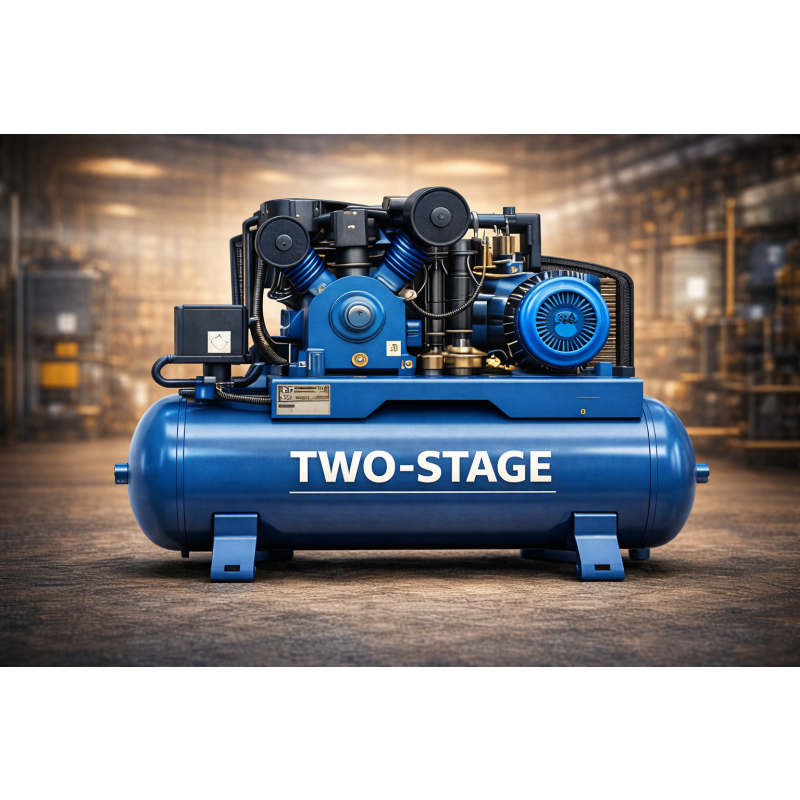
Two-Stage compression splits the compression process into two steps and is typically paired with improved thermal management. Product documentation references two-stage cooling structures that enhance reliability. The objective is to reduce losses from single-step high compression and improve efficiency in continuous, high-load operation. Actual savings, however, must be calculated from real load data.
🔷 Method: Practical calculation approach
Assumptions:
Before = existing Single-Stage system
After = Two-Stage system
Required inputs:
• P_avg = actual average power (kW)
• H = annual operating hours (24/7 = 8,760 h)
• R = electricity rate
• LF = average load factor (if available)
• (Optional) average air flow for Specific Power
1. Annual energy consumption
E = P_avg × H
2. Annual electricity cost
Cost = E × R
3. Energy savings
Saving (%) = (E_before − E_after) / E_before × 100
Saving (currency/year) = (E_before − E_after) × R
4. Higher accuracy using load separation
E = (P_base × H_base) + (P_peak × H_peak)
🔷 Options to evaluate together
Real savings usually come from a combination of measures:
• Replacing the compressor with a Two-Stage unit
• Optimizing pressure setpoints
• Applying demand control, zoning, or leak reduction
System-level optimization often delivers greater impact than equipment replacement alone.
🔷 Next steps for decision-ready results
• Measure actual kW for 7–14 days
• Create a Base/Peak load profile
• Compare before–after results using the same method
• Calculate ROI and Payback from energy cost differences
📘 Summary
Energy saving calculations for Two-Stage compressors in 24/7 systems must be based on actual power, real operating hours, and load profiles, not rated data. Consistent before–after comparison is essential for reliable investment decisions.
📥 CTA
For real-world application, Hitachi Asia (Thailand) Co., Ltd. has experience in industrial compressed air systems and screw compressors. You may review the related Core Content or consult the Assistant Administration & Marketing Manager for further guidance.
🔗 Cluster Internal Link
• Core Content: https://prime.nc-net.com/103667/en/product_others/detail_goods/18386
• Basic Knowledge: https://prime.nc-net.com/103667/en/product_others/detail_goods/27688
ーーーーーーーーーーーーーーーーーーーーーーーーーーーーーーー
❓ FAQ
Q: Does a 24/7 system always require 8,760 hours per year?
A: If it truly operates all year, yes—but calculations must still use actual average kW, not rated kW.
Q: Why is Base/Peak separation necessary?
A: It provides kWh estimates closer to real operation and supports more accurate sizing and control strategies.
Q: What does the documentation mention about Two-Stage systems?
A: It references two-stage cooling structures that contribute to operational reliability.
📚 Glossary (Key Terms)
• Specific Power: Energy consumption per unit of air delivered
• kWh/year: Annual electrical energy consumption (E = P_avg × H)
• Load factor (LF): Average load ratio (0–1), if available from meters or SCADA
• Base load: Constant load throughout the day
• Peak load: Additional load during specific periods
• P_avg: Actual average power, not nameplate kW
• ROI / Payback: Metrics used for investment decisions (numerical values not specified)
📖 Reference
[1] Oil-free Screw Compressors Catalog (Two-Stage cooling / reliability context) – Hitachi (N/A) — Internal Validation
🔒 Trust
This content has been reviewed by Ms. Thitima Bunnag,
Assistant Administration & Marketing Manager, Hitachi Asia (Thailand) Co., Ltd.,
to verify the accuracy of the technical information.
#CompressedAirSystem #TwoStage #ScrewCompressor #EnergySaving #SpecificPower
#IndustrialPlant #DemandControl #LeakReduction #ROI
📆 Updated: 2025-12-19
Company Information
Industry Classification
Home electrical appliances / Electronic parts / Furniture
Main 3 Products
Air Compressor related products / Breakers & Switches/Motors & Blowers / Inverter
Phone Number
Homepage URL
Industrial Components & Equipment (ICE) Group is a bridge to a sustainable future, expanding business possibilities with Hitachi technology.
CATALOG
Related Catalogs
CONTACT
Contact