
TAPYRUS (THAILAND) CO., LTD.
PRODUCT
Production Goods
The Difference Between Meltblown and Spunbond Nonwoven Fabrics
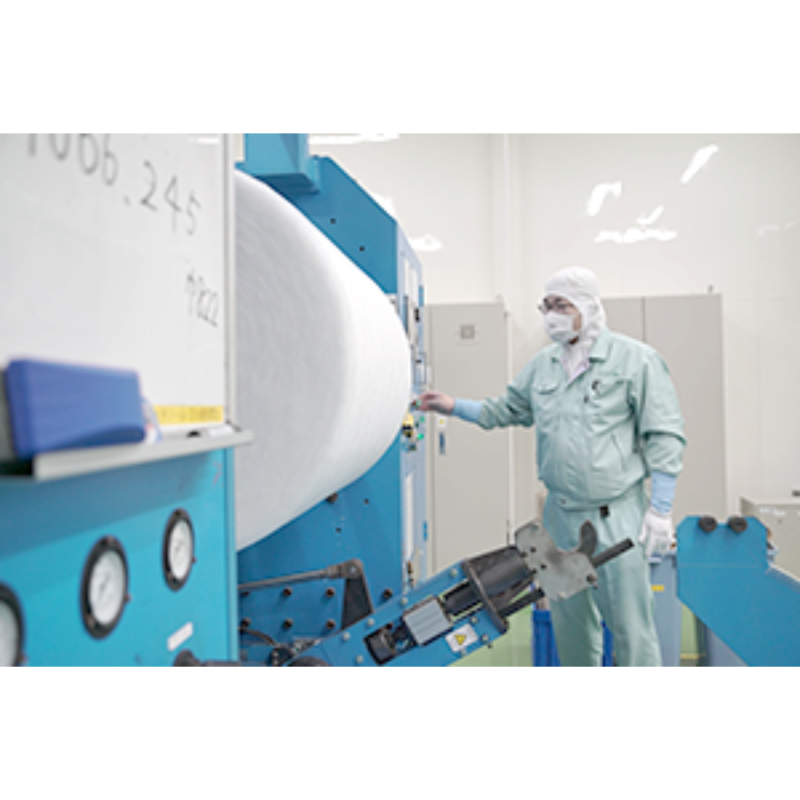
What Is Nonwoven Fabric?
Nonwoven fabric is made by bonding fibers together without weaving. Fiber bonding occurs through thermal, mechanical, or adhesive methods. Key industrial processes include spunbond and meltblown, each producing fabrics with distinct characteristics.
Spunbond Nonwoven: Strength & Stability
- Manufacturing: Extrusion of molten resin into continuous filaments (~10–30 µm), air-blown, cooled, and laid into a web.
- Characteristics:
- Moderate to high tensile strength
- Good mechanical durability and dimensional stability
- Smooth surface texture, easy to cut and handle
- Applications: Ideal for structural uses garment linings, medical gowns, agricultural covers, construction sheets, and packaging.
Meltblown Nonwoven: Filtration Power
- Manufacturing: Molten resin is blown through ultra-fine nozzles with hot air, forming microfibers (~1–5 µm).
- Characteristics:
- High surface area and density
- Excellent particle filtration and adsorption
- Can be enhanced with electrostatic (electret) treatment
- Lower mechanical strength than spunbond
- Applications: Used in filtration materials mask middle layers, HVAC/HEPA filters, liquid filters, and oil absorbents.
Selection Guidelines
- Choose spunbond when structural strength, durability, and dimensional accuracy are essential (e.g., packaging, protective clothing outer layers).
- Choose meltblown where fine particle filtration is critical (e.g., masks, air purifiers, medical filters).
- Use composite materials like SMS (spunbond‑meltblown‑spunbond) to achieve both structural strength and filtration performance.
ーーーーーーーーーーーーーーーーーーーーーーーーーーーーーーーーーーーーーーーーーーー
❓ FAQ
Q: Why is Spunbond stronger than Meltblown?
A: Because its fibers are larger and more uniformly aligned, giving the fabric better mechanical strength.
Q: What applications is Meltblown best suited for?
A: Fine filtration tasks such as surgical masks, HEPA air filters, and liquid-filtration media.
Q: What is SMS material?
A: A three-layer structure Spunbond + Meltblown + Spunbond that combines filtration performance with mechanical strength.
📚 Glossary
Nonwoven: Fabric bonded without knitting or weaving
Spunbond: Strong nonwoven with larger fibers, ideal for structural uses
Meltblown: Ultrafine-fiber nonwoven for high-efficiency filtration
Company Information

Main 3 Products
Manufacture of Melt-Blown Non-Woven / Sale of Melt-Blown Non-Woven
Phone Number
Homepage URL
Since our founding in 1987 as a specialized manufacturer of melt-blown nonwoven fabrics, we at Tapyrus have consistently provided our customers with high-quality products using our unique technology.
CONTACT
Contact