
HAKKAI PRECISION (THAILAND) CO., LTD.
PRODUCT
Production Goods
Understanding Plastic Injection Molding|Mechanism and Key Process Parameters for Mass Production
Key Takeaways
• Injection molding is a highly accurate, fast, and scalable plastic manufacturing process suitable for mass production.
• The process consists of five main steps: melting → injection → packing → cooling → part ejection.
• Key machine units include the hopper, screw, injection unit, mold, and clamping system.
• Critical parameters such as injection speed, pressure, mold temperature, and melt quality directly affect product accuracy and defect rates.
• Injection molding is used widely across automotive, electronics, medical devices, and packaging industries.
Injection molding is a precise and rapid manufacturing technology that enables the production of complex plastic components with consistent quality. Its ability to support continuous, high-volume production makes it one of the most important processes in modern manufacturing. This article summarizes the core mechanisms, machine structure, and quality control factors essential for understanding the injection molding process.
Principles of the Injection Molding Process
Injection molding involves heating thermoplastic resin until molten, injecting it into a mold under high pressure, cooling it, and allowing it to solidify into the final shape. Key advantages include:
• Dimensional accuracy up to ±0.01 mm
• Ability to form complex geometries in a single cycle
• Short cycle times (seconds to minutes)
• Reduced scrap and improved yield
• Reusability of leftover materials
These advantages make the process widely used in automotive, electronics, medical, and packaging applications.
Basic Structure of an Injection Molding Machine
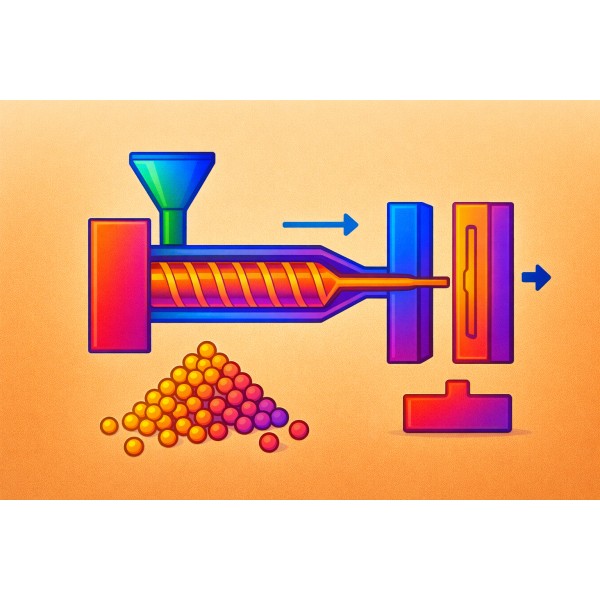
The main components of an injection molding machine include:
• Hopper: Feeds plastic pellets
• Screw & Cylinder: Heats, mixes, and melts the resin
• Injection Unit: Injects molten resin into the mold
• Mold: Defines the shape and surface quality of the product
• Clamping Unit: Holds the mold closed during injection
The coordination of these systems ensures stable and precise processing.
Steps of the Injection Molding Cycle
• The process consists of five essential stages:
• Feeding and Melting: Resin is heated and melted by the screw
• Injection: Molten resin is injected into the mold under high pressure
• Packing: Pressure is maintained to minimize shrinkage
• Cooling: Heat is removed through the mold to solidify the part
• Mold Opening & Ejection: The mold opens and the part is released once fully solidified
A full cycle takes just seconds to minutes and supports fully automated production.
Key Parameters Affecting Product Quality
Product quality depends on accurate control of several critical parameters:
• Injection Speed & Pressure
Too fast/high → may cause flash or burn marks
Too slow/low → may cause short shot
• Mold Temperature & Cooling Time
Affect shrinkage, warpage, and dimensional stability
• Screw Speed & Back Pressure
Influence melt uniformity and mixing quality
• Packing Time & Transfer Position
Affect internal stress and dimensional accuracy
Each parameter must be optimized according to the material and part geometry.
Summary
Injection molding is a highly efficient and versatile manufacturing method capable of producing complex parts with precision and stability. Understanding machine structure, process stages, and key parameters helps improve product quality, reduce defects, and support large-scale production.
ーーーーーーーーーーーーーーーーーーーーーーーーーーーーーーーーーーーーーーーーーーー
❓ FAQ
Q: Why is injection pressure control important?
A: It affects cavity filling and can prevent defects such as flash or short shot.
Q: Why must mold temperature be controlled?
A: Because it influences shrinkage, warpage, and final part surface quality.
Q: What types of products are suitable for injection molding?
A: High-precision, large-volume, and complex-shaped parts.
📚 Glossary
Injection Molding: Process of melting and injecting plastic into a mold
Clamping Unit: Mechanism that keeps the mold closed during injection
Packing Pressure: Pressure applied to reduce shrinkage after injection
Short Shot: Incomplete filling of the mold cavity
Flash: Excess plastic escaping at the mold parting line
Company Information

Industry Classification
Industrial machinery / Home electrical appliances / Electronic parts
Main 3 Products
Auto parts / Camera parts
Phone Number
Homepage URL
We are a specialized manufacturer of small precision plastic products. It is to stick to a mold making, and has excels at technology to produce on the scale of microns. Also our feature is a integrate ...
CONTACT
Contact