
HAKKAI PRECISION (THAILAND) CO., LTD.
PRODUCT
Production Goods
Differences and Appropriate Use of POM and PBT|Choosing the Best Material for Automotive Parts
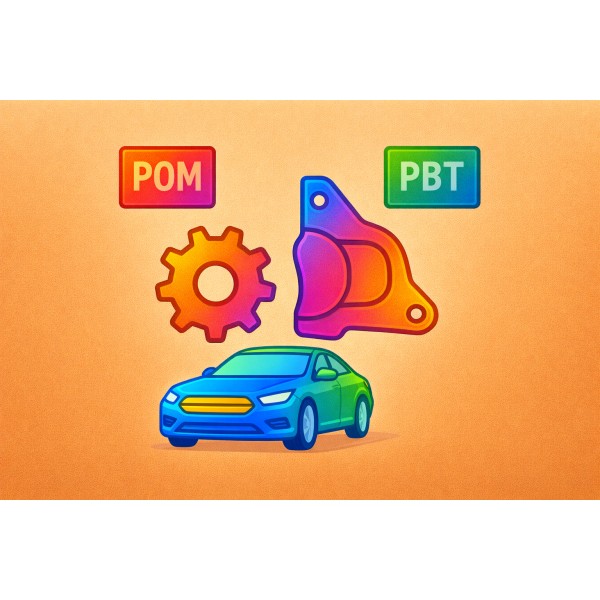
Key Takeaways
• POM is ideal for components requiring smooth movement, low friction, and high wear resistance, such as gears and mechanisms.
• PBT is suitable for applications that require heat resistance, dimensional precision, and electrical insulation, such as connectors and sensors.
• POM resists oils and alkalis but is less suitable for high-temperature environments. PBT can operate continuously at 120–150°C and has UL flame-retardant grades.
• Material selection must consider the operating environment, part geometry, and durability requirements.
• In the EV era, demand for PBT is increasing due to its flame resistance and insulation, while POM remains essential in mechanical systems requiring strength, smooth motion, and low weight.
In automotive manufacturing, selecting the right engineering plastic is critical because parts must function under varying conditions, including heat, humidity, vibration, and friction. This article explains the differences between POM and PBT two widely used engineering plastics and provides guidance on choosing the most suitable material for each application.
Performance and Suitability of Each Material
- POM is ideal for components that require continuous motion, low friction, and quiet operation, such as seat adjustment mechanisms.
- PBT is suitable for thin or complex parts that require high dimensional accuracy even in hot and humid environments, such as sensor housings.
Summary of Material Selection
- For smooth movement and wear resistance → Choose POM
- For rigidity and high molding precision → Choose PBT
Thermal, Chemical, and Electrical Comparison
- POM is resistant to oils and alkalis, making it suitable for fuel-system components, but caution is required in high-temperature environments.
- PBT can operate continuously at 120–150°C, offers UL-rated flame-retardant grades, and provides excellent electrical insulation ideal for ECUs and sensor modules.
Examples of Automotive Applications
- POM: Power window gears, seat-adjustment mechanisms, throttle valves
- PBT: Under-hood connectors, sensor housings, headlight adjustment mechanisms
Current Trends
In the EV era, the use of PBT has increased due to its flame resistance and electrical insulation properties. Meanwhile, POM remains essential for drivetrain and mechanical systems where high strength and lightweight performance are required.
Summary
POM and PBT offer distinct advantages. Selecting the right material depends on part functionality, environment, and required durability. Understanding the performance differences helps manufacturers design and produce automotive components with higher efficiency and long-term reliability.
ーーーーーーーーーーーーーーーーーーーーーーーーーーーーーーーーーーーーーーーーーーー
❓ FAQ
Q: What is the main difference between POM and PBT?
A: POM excels in low friction and wear resistance, while PBT offers superior heat resistance and electrical insulation.
Q: Why is PBT gaining popularity in EV components?
A: Because of its flame-retardant properties and strong electrical insulation, making it suitable for high-voltage and electronic modules.
Q: What types of parts are best suited for POM?
A: Moving components such as gears, mechanisms, and low-friction assemblies.
📚 Glossary
POM (Polyacetal): Engineering plastic with low friction and high mechanical strength
PBT (Polybutylene Terephthalate): Heat-resistant, electrically insulating engineering plastic
UL Flame Rating: Standard for material flame retardance
Dimensional Stability: Ability of a part to maintain size and shape under heat/humidity
Company Information

Industry Classification
Industrial machinery / Home electrical appliances / Electronic parts
Main 3 Products
Auto parts / Camera parts
Phone Number
Homepage URL
We are a specialized manufacturer of small precision plastic products. It is to stick to a mold making, and has excels at technology to produce on the scale of microns. Also our feature is a integrate ...
CONTACT
Contact