
SHOEI TRADING (THAILAND) CO., LTD.
PRODUCT
Production Goods
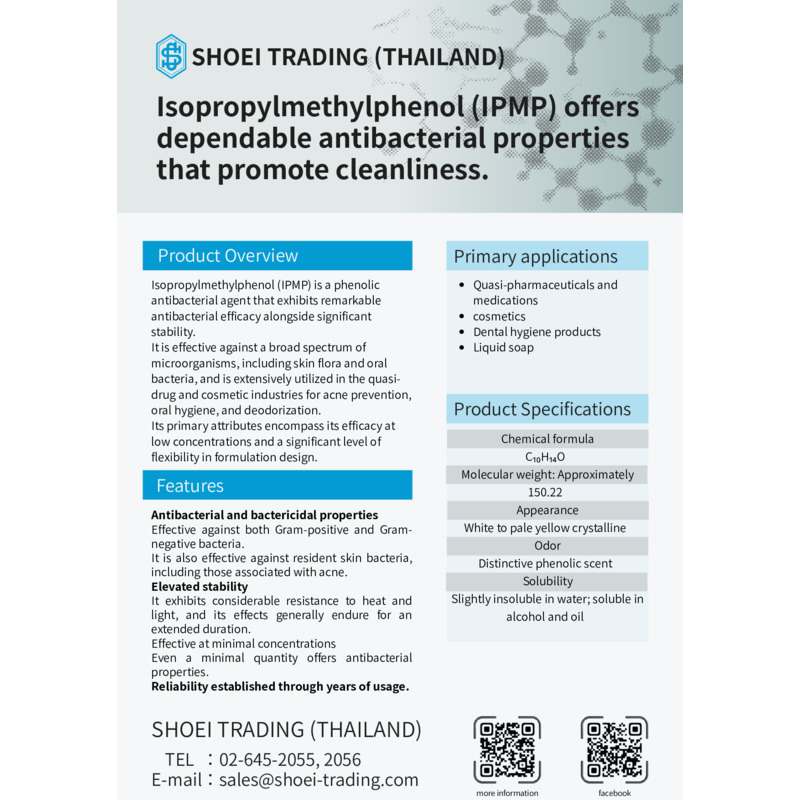
Phenolic disinfectant IPMP
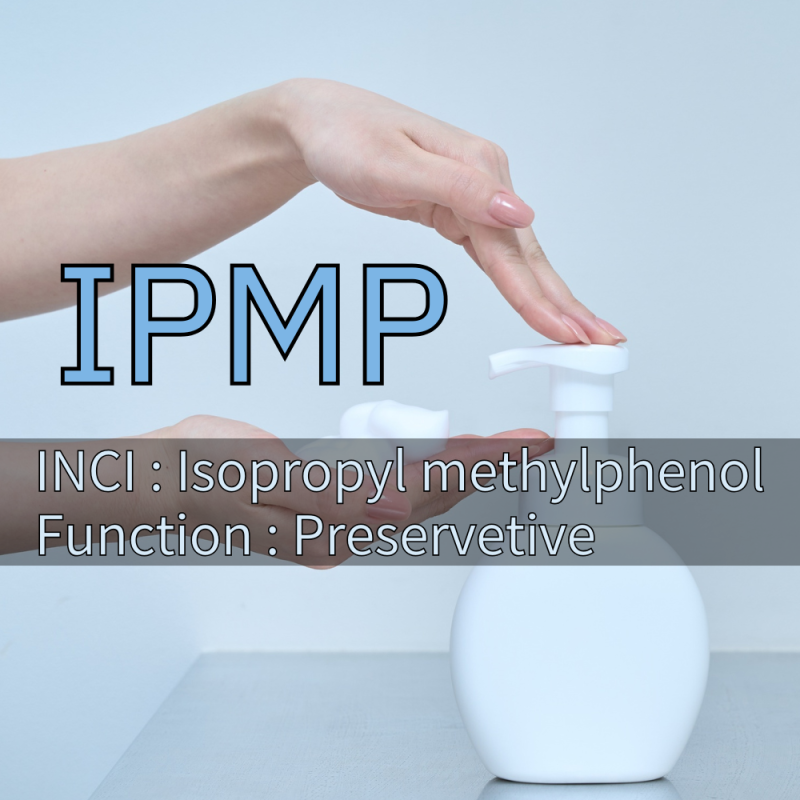
IPMP (Isopropyl Methylphenol)
Basic Information
| Item | Content |
| :--- | :--- |
| Chemical Name | 4-Isopropyl-3-methylphenol |
| English Name | Isopropyl Methylphenol |
| Abbreviation | IPMP |
| Classification | Phenolic bactericidal ingredient |
| Chemical Formula | C₁₀H₁₄O |
| Molecular Weight | Approx. 150.22 |
| Appearance | White to pale yellow crystals |
| Odor | Characteristic phenolic odor |
| Solubility | Slightly soluble in water, soluble in alcohol and oil |
It is a very common bactericidal ingredient for quasi-drugs and cosmetics in Japan.
Main Bactericidal/Antimicrobial Effects
IPMP has the following characteristics:
Effective against both Gram-positive and Gram-negative bacteria
* **Strong antibacterial activity, especially against Gram-positive bacteria**
* Examples: resident skin bacteria, P. acnes (acne-causing bacteria)
* **Kills bacteria by destroying their cell membranes**
* **Shows effectiveness at relatively low concentrations**
* **Low irritation among phenolic compounds**
Main Uses
✅ Daily necessities/Consumer goods
* Hand soap
* Body soap
* Shampoo
* Deodorant products
✅ Oral care products
* Toothpaste
* Mouthwash (for periodontal disease bacteria and bad breath-causing bacteria)
✅ Quasi-drugs/Cosmetics
* Medicated facial cleanser
* Acne prevention products
* Medicated lotion
※ In Japan, it is widely used as an "active ingredient" in quasi-drugs.
---
Comparison with other bactericides (representative examples)
| Ingredient | Characteristics |
| :--- | :--- |
| IPMP | Low irritation, suitable for daily use |
| Benzalkonium chloride | Fast-acting, slightly irritating |
| Ethanol | Volatile, no sustained effect |
| Triclosan | Strong antibacterial power but with usage restrictions |
👉IPMP's strength is its "mild and sustained bactericidal action."
Safety and Regulations
ASEAN (Southeast Asia) Regulatory Framework
ASEAN Cosmetic Directive (ACD)
* Ingredients are regulated based on Annexes II-VII
* Each country (e.g., Thailand, Indonesia) establishes its own domestic laws.
ASEAN Cosmetic Directive
A 0.10% limit is generally common, equivalent to Japan and the EU.
USA (Reference)
FDA: No pre-market approval (self-responsibility model)
CIR (Cosmetic Ingredient Review): Concluded safe at 0.1% or less
EC Cosmetic Regulation (Regulation (EC) No 1223/2009)
INCI Name: o-Cymen-5-ol
Listed: Preservative (Annex V)
Maximum concentration: 0.10%
(Japan)
* Can be used in quasi-drugs and cosmetics
* Usage concentration is regulated by the Pharmaceuticals and Medical Devices Act
* Evaluated as very safe under normal use
* Relatively low skin irritation and sensitization
EU (European Union)
Regulatory Framework
* Cosmetic Regulation: Regulation (EC) No. 1223/2009
* Ingredients are regulated based on prohibitions (Annex II) / restrictions (Annex III) / preservatives (Annex V), etc.
IPMP's Positioning
* Not listed in Annex II (Prohibited)
* No clear individual listing in Annex III (Restricted)
* Not designated as a preservative (Annex V)
👉 Treated as a general ingredient in the EU
* Used as an antimicrobial aid/functional ingredient, not as a preservative
* Sufficient data presentation in the Cosmetic Product Safety Report (CPSR) is mandatory
Practical Considerations
* As it is phenolic, emphasis is placed on skin irritation data.
* For oral products, evaluation of accidental ingestion/mucosal exposure is important.
China (NMPA/CSAR)
Regulatory Framework
* Cosmetic Supervision and Administration Regulation (CSAR)
* Registration in IECIC (Inventory of Existing Cosmetic Ingredients in China) is most important
IPMP's Positioning
* Listed in IECIC
* → Not treated as a new ingredient
* Usable (including cosmetics and toothpaste)
Restrictions / Management Points
* There is no nationwide unified regulation on maximum concentration
* However, a safety assessment report based on the Cosmetic Safety Technical Standards (STSC) is mandatory
* For claims regarding antimicrobial properties, pay attention to "efficacy advertising" regulations
Practical Considerations
* For use in toothpaste, "Toothpaste Management Requirements" apply separately.
* Raw material safety information: Compliance with Annex 14 (Submission of Raw Material Safety Information)
IPMP's Positioning (for ASEAN)
* Not listed in Annex II (Prohibited)
* Not listed in Annex III (Restricted)
* Not listed in Annex VI (Preservative List)
👉 Generally usable in ASEAN
Practical Considerations
* Since it is not classified as a preservative, the INCI name (O-Cymen-5-Ol) is used for labeling.
* Differences may arise depending on the country regarding: * Irritation assessment * Interpretation regarding oral products
USA (FDA)
Regulatory Framework
* Cosmetics: FDA Cosmetic Act (no pre-market approval)
* Drugs, OTC drugs, and oral drugs are evaluated individually
IPMP's Positioning
* Cosmetics: * Not subject to the prohibited ingredients list
* Manufacturers are responsible for ensuring safety
* Food-related: * Related cymene compounds have a history of use in food under 21 CFR 172.515
Practical Considerations
* Claims of antimicrobial/bactericidal action pose a classification risk as an OTC drug.
* For deodorants and oral products, it is important to distinguish efficacy claims.
Overview of Major Country Comparison
| Region | Usability | Key Points |
| :--- | :--- | :--- |
| European Union | ✅ Possible | CPSR is mandatory, and it is not treated as a preservative. |
| China | ✅ Possible | Listed in IECIC, with emphasis on safety assessment. |
| ASEAN | ✅ Possible | Differences in application methods by country |
| United States | ✅ Possible | Claims of antimicrobial action require caution for OTC drugs. |
Summary
* IPMP = Isopropyl Methylphenol
* A classic, low-irritation bactericidal ingredient used in daily necessities and pharmaceuticals
* Widely used in acne, oral care, skin cleansing, etc. Usable in major countries
Created: March 19, 2026
Updated: April 2, 2026
Company Information

Industry Classification
Machine tools / Industrial machinery / Office appliances
Main 3 Products
Cleaning Agent / Chemical Raw Materials
Phone Number
Homepage URL
We have reached our 14th year since establishment. 🔹Business Activities SHOEI TRADING (THAILAND) specializes in providing high-quality cleaning agents and chemical raw materials. We particularly focus ...
CATALOG
Related Catalogs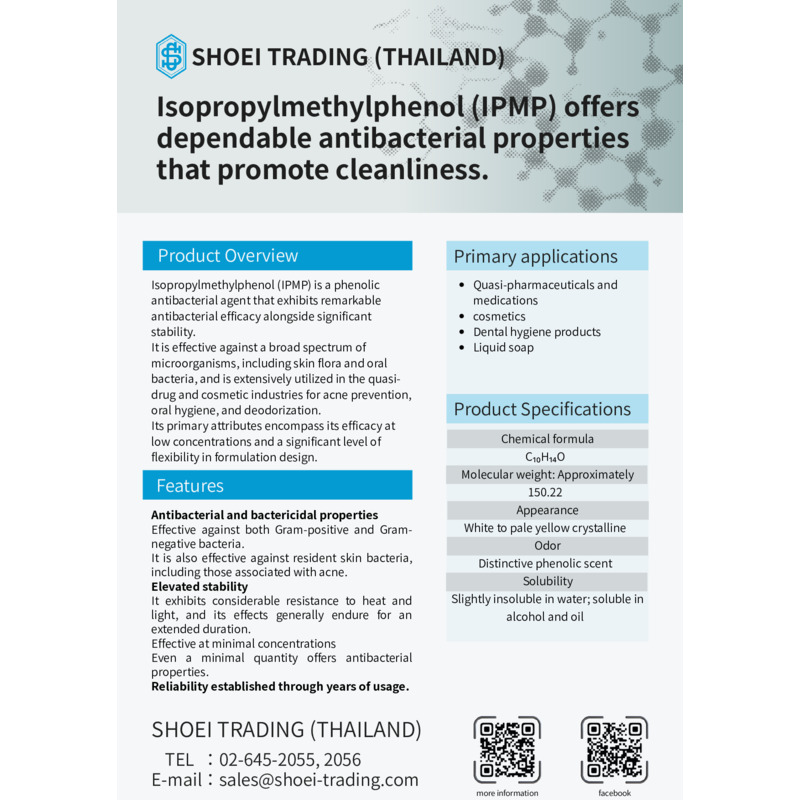
CONTACT
Contact