
RYOHSHIN CO.,LTD Thailand Representative Office
PRODUCT
Production Goods
AI for Waste Sorting|Boost Recycling Accuracy & Cut Labor with Ryohshin’s Smart System
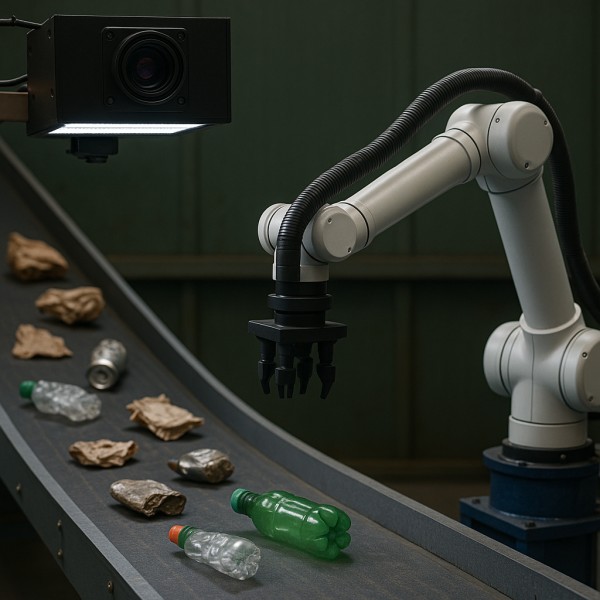
AI waste sorting technology transforms industrial recycling by automating material classification and reducing labor costs while boosting sorting accuracy.
1. The Role of AI in Waste Sorting
Traditional waste sorting systems depended on manual labor or basic mechanical separation by weight or size. However, with more complex waste streams and stricter recycling standards, AI has emerged as a transformative technology.
AI uses computer vision and sensor data to automatically detect and classify waste materials, enhancing speed, accuracy, and operational efficiency while reducing human dependency.
2. Key AI Technologies in Industrial Sorting
- Image Recognition:
AI uses high-speed cameras to analyze shapes, colors, and patterns for real-time material identification.
- Deep Learning:
Trained on vast waste datasets, deep learning models can recognize and categorize even new or ambiguous materials.
- Near-Infrared Spectroscopy (NIR):
NIR sensors distinguish material properties, enabling precise separation of plastics, paper, and similar materials.
- Robotics Integration:
After classification, robotic arms sort waste items into designated categories with high speed and reliability.
3. System Architecture of an AI Waste Sorting Line
3.1. Conveyor Belt: Moves waste into the scanning and sorting zone
3.2. Sensors & Cameras: Capture image and material data
3.3. AI Processor: Classifies materials using trained algorithms
3.4. Sorting Units: Robotic arms or air jets separate items based on AI decisions
These fully automated systems complete identification and sorting in seconds, ideal for high-throughput operations.
4. Benefits and Challenges of AI Waste Sorting
> Benefits:
- Significant reduction in labor costs
- Improved accuracy and sorting efficiency
- Data logging and traceability of materials
- Higher material recovery and recycling rates
> Challenges:
- High upfront investment
- Requires continuous AI model updates
- Needs ongoing technical support and maintenance
5. Why Choose RYOHSHIN for AI Sorting Solutions
RYOHSHIN, the local branch of a Japanese recycling technology leader, offers AI-powered waste sorting solutions tailored for the Thai industry:
- Custom sensor and vision setups for Thailand-specific waste
- AI trained on actual waste datasets from the region
- Turnkey systems including conveyors, sensors, and robotic sorters
- Local installation, technical support, and AI tuning services
AI waste sorting isn’t just a tech upgrade—it’s a sustainable strategy aligned with ESG and circular economy goals.
#AIWasteSorting #SmartRecycling #IndustrialAI #RyohshinThailand #WasteToResource #CircularEconomy #DeepLearningAI #NIRtechnology #RoboticSorting #SmartFactory
Company Information
Main 3 Products
Shredders & Crushers / Various Sorting Equipment / Various Waste Recycling Plants
Phone Number
Homepage URL
RYOHSHIN Co., Ltd. is a company providing waste treatment solutions aimed at reducing environmental impact and promoting efficient use of resources. We offer customized recycling systems by combining ...
CONTACT
Contact