_c48a6530-5ad9-4822-8ab9-adb3caa40a6a.png)
HITACHI ASIA (THAILAND) CO., LTD.
PRODUCT
Production Goods
Single-Stage vs Two-Stage Air Compressors|How to Choose for Industrial Use
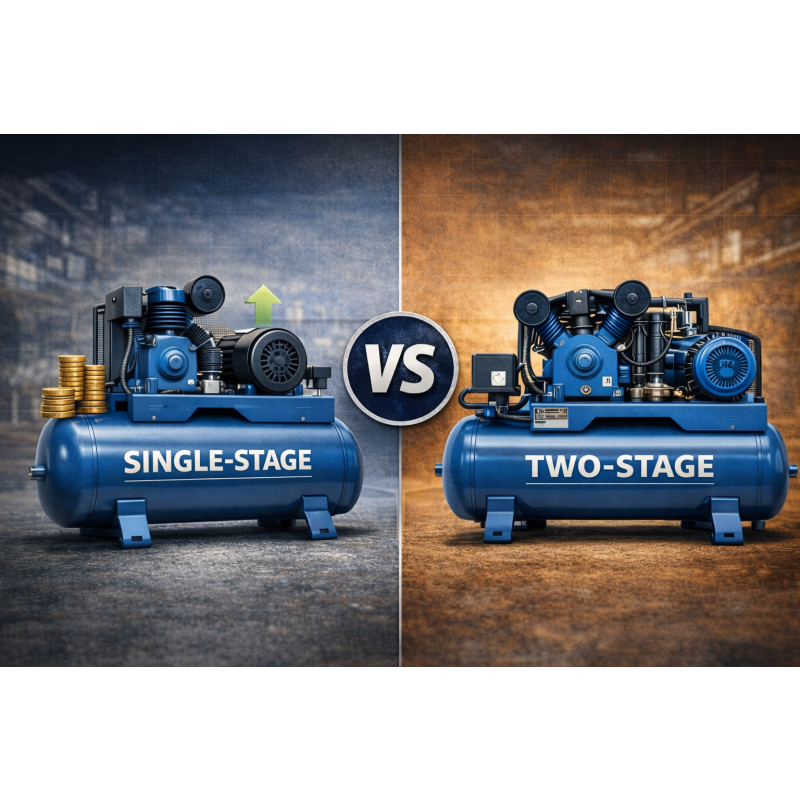
🌟 Key Takeaways• Single-Stage compressors have a simple structure and typically lower initial cost, suitable for intermittent use or fluctuating loads
• Two-Stage compressors compress air in two steps, reducing stress on each stage and improving stability during continuous operation
• Applications running 24/7 or requiring high air demand with stable pressure are generally better suited to Two-Stage systems
• Compressor selection should be based on actual load behavior and operating hours, not only on kW rating
ーーーーーーーーーーーーーーーーーーーーーーーーーーーーーーー
In industrial plants, compressed air is one of the most energy-intensive utilities. Selecting a compressor that does not match the actual usage profile often leads to higher electricity costs, unstable pressure, and frequent maintenance—especially in applications that require continuous air supply.
🔷 Single-Stage
Single-Stage compressors compress air only once to reach the required pressure. Their structure is relatively simple with fewer components. As a result, initial investment is typically lower, and in some model ranges, overhaul costs may also be reduced due to having fewer main components such as air-ends. This design is suitable for factories with intermittent air usage or unstable load conditions.
🔷 Two-Stage
Two-Stage compressors compress air in two consecutive stages, from the first stage to the second stage. The main purpose is to distribute the compression load so that no single stage is overloaded. When combined with effective heat management and inter-stage cooling, this structure enhances operational stability and is well suited for high-demand applications. Product documentation references the Two-Stage cooling structure as a concept that supports long-term reliability during continuous operation.
🔷 Selection should be based on actual load characteristics
■ Single-Stage is suitable when air demand is intermittent, load fluctuates, and minimizing initial investment is a priority, even if overall efficiency is not maximized
■ Two-Stage is suitable when continuous operation is required, such as 24/7 systems, stable pressure is necessary, air demand is high, and reducing thermal stress and mechanical load on components is important
A common misconception is that Two-Stage compressors are always more energy-efficient. This is not necessarily true. If actual load is low or operating hours are limited, the cost benefit may not be significant. Simply selecting a compressor based on kW rating alone is insufficient; load behavior and required pressure stability must also be evaluated.
📘 Summary
Single-Stage compressors offer simplicity and lower initial cost, while Two-Stage compressors are better suited for heavy-duty and continuous operations requiring higher stability. The key decision factors are actual load profile and annual operating hours.
📥 CTA
You can further explore the related topics below to deepen your understanding and support better compressor selection decisions.
🔗 Cluster Internal Link
• Core Content: https://prime.nc-net.com/103667/en/product_others/detail_goods/18386
• Advance Knowledge: https://prime.nc-net.com/103667/en/product_others/detail_goods/27690
ーーーーーーーーーーーーーーーーーーーーーーーーーーーーーーー
❓ FAQ
Q: Is a Two-Stage compressor better than a Single-Stage in all cases?
A: Not always. Cost-effectiveness depends on operating hours and load profile. For low or intermittent air demand, the performance difference may be minimal.
Q: Why do some Single-Stage models have lower overhaul costs?
A: Because they have fewer main components, such as air-ends, which can reduce overhaul-related expenses in certain cases.
📚 Glossary (Key Terms)
• Single-Stage Compressor: A compressor that compresses air once to reach the required pressure
• Two-Stage Compressor: A compressor that compresses air in two stages to reduce load per stage
• Air-end: The main component of a compressor responsible for air compression
• Overhaul: Major maintenance work on a compressor
• Load behavior: Characteristics of air usage, such as continuity and consumption volume
📖 Reference
[1] Oil-free Screw Compressors Catalog – Hitachi (N/A) — Internal Validation
[2] Oil-free Screw Compressors Catalog (Two-Stage cooling / reliability context) – Hitachi (N/A) — Internal Validation
🔒 Trust
This content has been reviewed by Ms. Thitima Bunnag,
Assistant Administration & Marketing Manager, Hitachi Asia (Thailand) Co., Ltd.,
to verify the accuracy of the technical information.
#AirCompressor #SingleStage #TwoStage #IndustrialCompressedAir #ScrewCompressor
#EnergyEfficiency #IndustrialPlant #CompressedAirSystem #IndustrialUtility
📆 Updated: 2025-12-19
Company Information
Industry Classification
Home electrical appliances / Electronic parts / Furniture
Main 3 Products
Air Compressor related products / Breakers & Switches/Motors & Blowers / Inverter
Phone Number
Homepage URL
Industrial Components & Equipment (ICE) Group is a bridge to a sustainable future, expanding business possibilities with Hitachi technology.
CATALOG
Related Catalogs
CONTACT
Contact