
SHOEI TRADING (THAILAND) CO., LTD.
PRODUCT
Production Goods
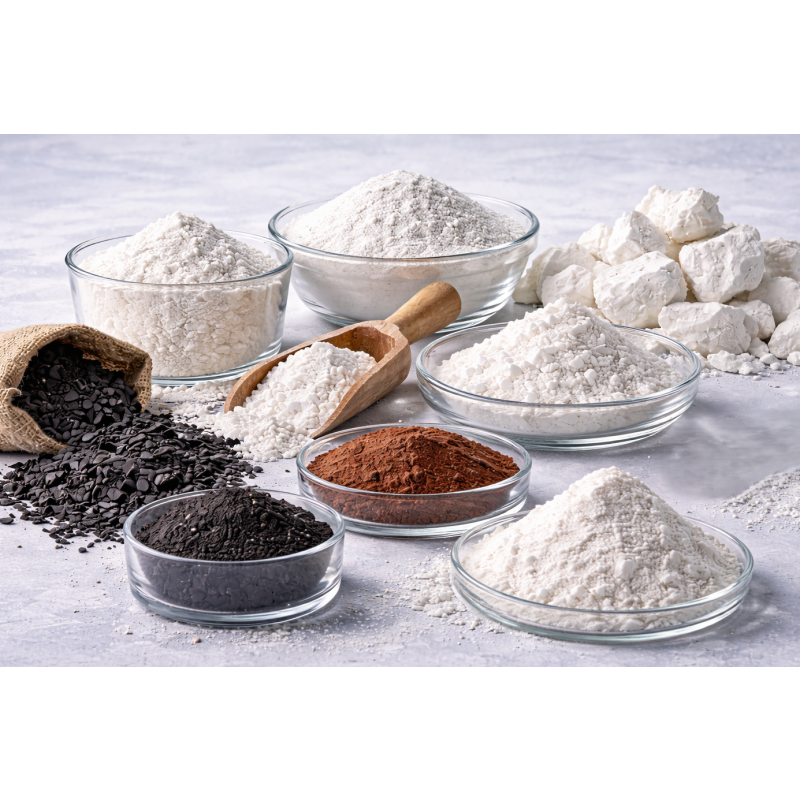
Minerals | Fundamental Raw Materials for Manufacturing and Advanced Materials
Key Takeaways
• Industrial Minerals are essential raw materials in paint, plastics, rubber, chemical, and general manufacturing industries
• Each mineral has a distinct role, such as structural reinforcement, whitening, adsorption, or corrosion protection
• Selecting the appropriate mineral type and grade helps control product quality, reduce production costs, and enhance performance
• CAS Number is a standardized reference code that verifies raw material identity, supports traceability, and quality control
ーーーーーーーーーーーーーーーーーーーーーーーーーーーーーーー
Industrial Minerals are inorganic raw materials used as fillers, functional additives, and base materials across various industries such as paints, plastics, rubber, paper, cosmetics, and environmental treatment. Understanding the role and specific properties of each mineral improves formulation design and production efficiency.
In real production lines, formulations that appear suitable in theory may deliver inconsistent results if the selected mineral type or grade does not match the intended function. Common issues include insufficient whiteness, poor material flow, or excessive absorption. These directly affect product quality, process stability, and overall production cost.
🔷Calcium Group
• Calcium Carbonate | CAS 471-34-1
A fundamental filler that enhances whiteness and hardness while helping control production costs. Widely used in paint, plastics, and paper industries.
Suitable for: Filler applications and structural reinforcement.
• Calcium Hydroxide | CAS 1305-62-0
An alkaline substance used for pH adjustment and industrial water treatment processes.
Suitable for: Chemical processing and environmental applications.
• Calcium Oxide | CAS 1305-78-8
A highly reactive and strongly alkaline substance used in processes requiring rapid chemical adjustment.
Suitable for: Metallurgy and chemical conditioning processes.
🔷 Iron
• Iron Oxide (III) | CAS 1309-37-1
A mineral pigment providing red to brown coloration with strong heat and light stability. Suitable for applications requiring durable color.
Suitable for: Pigments, coatings, and construction materials.
🔷 Magnesium
• Magnesium Oxide | CAS 1309-48-4
High-temperature resistant and capable of acid absorption. Used in applications requiring thermal and chemical stability.
Suitable for: Refractory materials and industrial chemicals.
• Magnesium Silicate Hydrate (Talc) | CAS 14807-96-6
Provides a smooth surface feel, reduces friction, and improves material flow properties.
Suitable for: Plastics, rubber, and cosmetics.
🔷 Carbon
• Activated Carbon | CAS 7440-44-0
Has a high specific surface area, ideal for adsorbing odors, colors, and contaminants in liquids and gases.
Suitable for: Water treatment systems, air purification systems, and environmental applications.
• Carbon Black | CAS 1333-86-4
Enhances mechanical strength, provides black coloration, and modifies electrical properties of materials.
Suitable for: Rubber, paints, and printing inks.
🔷 Talc
• Talc | CAS 14807-96-6
Reduces friction, improves material flow, and provides a smooth texture.
Suitable for: Plastics, cosmetics, and paper.
🔷 Titanium
• Titanium Dioxide | CAS 13463-67-7
Provides very high whiteness and opacity, with strong light and environmental stability.
Suitable for: Paints, plastics, and surface coatings.
🔷 Zinc
• Zinc Oxide | CAS 1314-13-2
Offers UV protection and antimicrobial properties while enhancing material durability.
Suitable for: Rubber, paints, and cosmetics.
When considering application characteristics:
Calcium Carbonate and Talc are commonly used as fillers to reinforce structure and control product cost.
Titanium Dioxide and Iron Oxide are used as pigments to provide whiteness, color, and product durability.
Activated Carbon is suitable for odor, color, and contaminant adsorption, while Carbon Black and Zinc Oxide are used to enhance product performance such as mechanical strength, UV protection, and specialized functional properties.
Summary
Industrial minerals directly influence the final properties of products. Proper selection is not merely about “completing a formula,” but about determining product appearance, performance, and total production cost in a significant way. For further information, please contact our sales team or download the relevant documentation.
ーーーーーーーーーーーーーーーーーーーーーーーーー
❓ FAQ
Q: What is the difference between Calcium Carbonate and Talc?
A: Calcium Carbonate focuses on increasing whiteness, reinforcing structure, and controlling production costs, while Talc emphasizes friction reduction, smooth surface feel, and improved material flow during processing.
Q: Which minerals are primarily selected in the paint industry?
A: Titanium Dioxide is used for whiteness and opacity, while Calcium Carbonate is used to reinforce the paint film structure and help control overall formulation cost.
📚 Glossary (Key Terms)
• Industrial Minerals: Inorganic raw materials used as fillers, functional additives, or base materials in industrial manufacturing processes
• Filler: A material added to a formulation to reinforce structure, adjust physical properties, or control production cost
• Pigment: A substance used to provide color, whiteness, or opacity to products
• CAS Number: An international standard reference number used to identify chemical substances for accuracy and traceability
Company Information

Industry Classification
Machine tools / Industrial machinery / Office appliances
Main 3 Products
Cleaning Agent / Chemical Raw Materials
Phone Number
Homepage URL
We have reached our 14th year since establishment. 🔹Business Activities SHOEI TRADING (THAILAND) specializes in providing high-quality cleaning agents and chemical raw materials. We particularly focus ...
CATALOG
Related Catalogs
CONTACT
Contact