
SHOEI TRADING (THAILAND) CO., LTD.
KNOWLEDGE
Knowledge
Producer goods
Glycol Ether Cleaning Solvent | Working Principles and Industrial Applications
2026-03-10
Key Takeaways
• Glycol Ether cleaning solvents can dissolve both oil-based contaminants and polar residues that are not soluble in oil
• The dual-solvency chemical structure helps reduce the need for multi-stage cleaning processes
• Near-neutral pH makes them safe for metals and high-precision components
• Suitable for deeply embedded residues such as flux, resin, and post-production contaminants
• Proper process design is required because evaporation is slower than lighter solvents
ーーーーーーーーーーーーーーーーーーーーーーーーーーーーーーー
In many industrial factories, the contamination that must be removed is not limited to “oil residues” alone. In many cases, it is a mixed contamination consisting of cutting oil or grease, polar residues such as flux, resin, or additives, as well as moisture or residues remaining after water washing. Using a solvent that can address only one type of contamination often requires additional cleaning stages, making the process more complex and harder to control in terms of quality.
Glycol Ether cleaning solvents were developed to overcome these limitations. Their chemical structure contains both ether groups, which dissolve oils and hydrophobic organic substances, and hydroxyl groups, which are compatible with water and polar substances. This structure allows Glycol Ether to function as a dual-solvency solvent capable of penetrating and breaking down mixed contaminants effectively without relying on many additional additives.
From a process perspective, Glycol Ether is commonly used in immersion cleaning to allow the solvent to penetrate deeply embedded contaminants. It can also be applied through wiping or spraying when controlled application is required, and it is often used together with surfactants to improve the dispersion of residues. One key advantage is that its evaporation rate is not excessively fast, which helps reduce white residue or film formation while allowing sufficient contact time with contaminants. This makes it particularly suitable for delicate workpieces and strongly adhered residues. Process outcomes can mainly be controlled through temperature and cleaning time.
When compared with other solvent groups, hydrocarbon solvents dry quickly and are easy to manage but have limitations in dissolving polar contaminants. Alcohol evaporates rapidly but is less effective for heavy contamination. Water-based cleaners are safer but may cause water stains and corrosion. Glycol Ether provides a wider solvency range for various contaminants, although it comes with slower evaporation and the need for proper odor management.
Overall characteristics of Glycol Ether cleaning solvents include near-neutral pH, which helps reduce corrosion risk; non-conductive properties suitable for electronics applications; formulation flexibility for specialized contamination; and the ability to provide deep cleaning without damaging the surface of the workpiece.
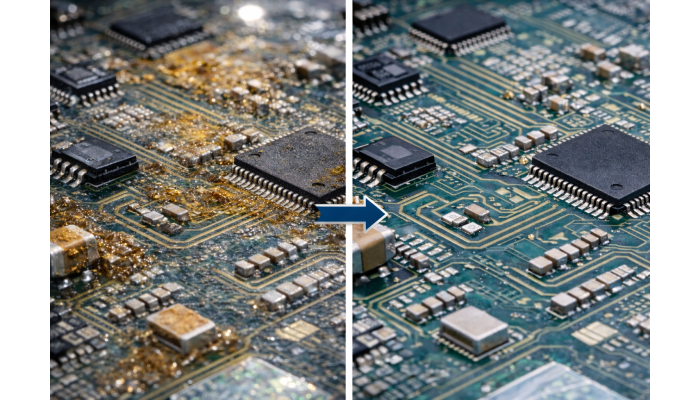
In practical applications, particularly in electronics manufacturing and mold maintenance where resin or flux residues adhere strongly, Glycol Ether helps reduce the number of cleaning steps. This results in more consistent surface cleanliness and prepares workpieces effectively for the next process without increasing the aggressiveness of the cleaning method.
Summary
Glycol Ether cleaning solvents are versatile industrial solvents designed for complex contamination. With their dual-solvency mechanism capable of addressing multiple residue types, they are suitable for factories that require high levels of cleanliness without adding unnecessary process steps.
ーーーーーーーーーーーーーーーーーーーーーーーーーーーーーーー
❓ FAQ
Q: What types of applications are Glycol Ether cleaning solvents suitable for?
A: They are suitable for applications involving mixed contamination such as oil, flux, and resin on the same workpiece.
Q: Why can they reduce cleaning steps?
A: Because they can dissolve both oil-based and polar contaminants, eliminating the need for multiple cleaning stages.
Q: What precautions should be considered when using them?
A: Ventilation, odor management, and compatibility with certain rubber materials or seals should be considered.
📚 Glossary (Key Terms)
• Glycol Ether: A solvent with dual-solvency structure designed for mixed contamination
• Dual-solvency: The ability to dissolve both hydrophobic oil residues and polar contaminants
• Polar Contaminants: Residues compatible with water but not oil, such as flux and resin
• Near-neutral pH: A property that helps reduce the risk of metal corrosion
Company Information

Industry Classification
Machine tools / Industrial machinery / Office appliances
Main 3 Products
Cleaning Agent / Chemical Raw Materials
Phone Number
Homepage URL
We have reached our 14th year since establishment. 🔹Business Activities SHOEI TRADING (THAILAND) specializes in providing high-quality cleaning agents and chemical raw materials. We particularly focus ...
PICKUP
Technology & Services
CONTACT
Contact